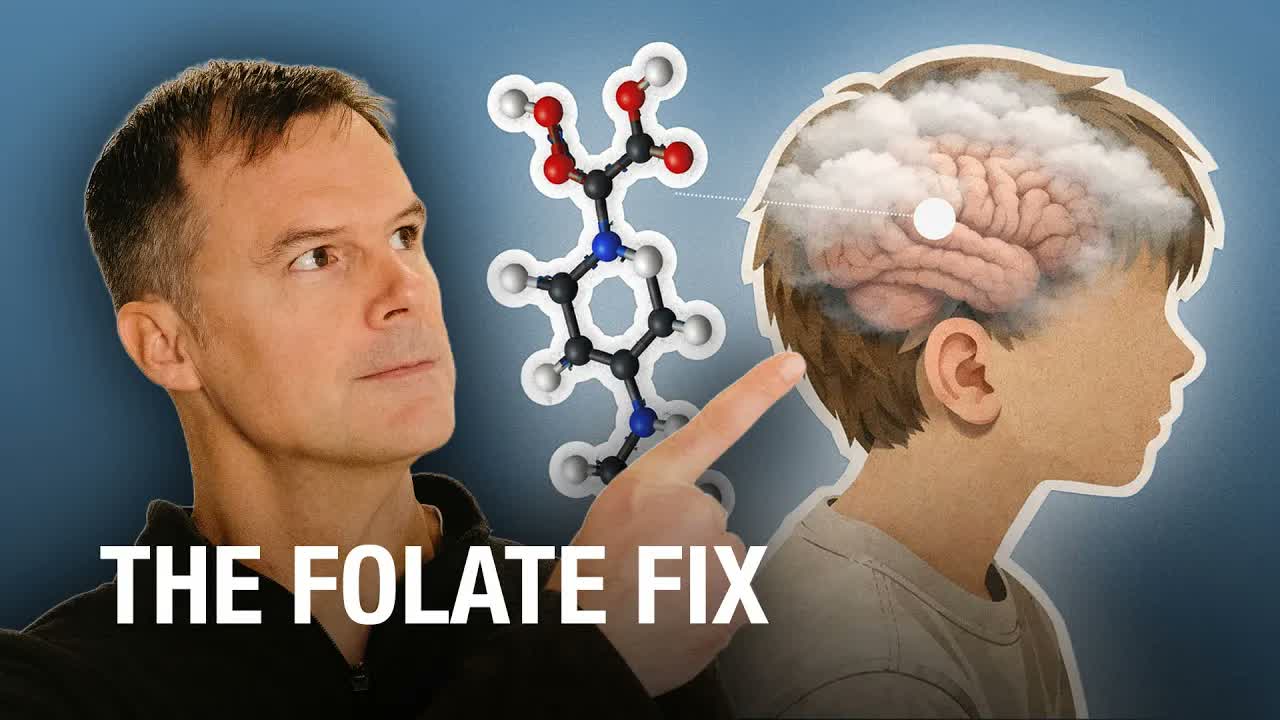
Short verdict
Real: cerebral folate deficiency, folate receptor alpha autoantibodies, and leucovorin/folinic acid treatment have published evidence in autism-related language/communication subgroups. Overreach: this does not prove a universal autism cure, a parent-run dosing protocol, or that folic acid is harmful for everyone.
What the video claims
- Many children with autism/ADHD/learning problems may have folate transport blocked at the blood-brain barrier.
- Leucovorin/folinic acid can bypass part of that bottleneck.
- Folic acid and dairy are presented as major blockers.
- The video proposes vitamin D, glutathione, homocysteine, infection/gut testing and low-dose folinic acid steps.
Evidence map
Best evidence
A small randomized trial reported improved verbal communication with high-dose folinic acid, especially in folate-receptor-antibody-positive children.
Still unsettled
Child Neurology Society cautions that the evidence base is small/heterogeneous and not enough for routine autism treatment claims.
Regulatory reality
Leucovorin is a prescription folate analog with labeled uses including methotrexate toxicity and FOLR1 cerebral folate transport deficiency, not a casual supplement protocol.
Safe practical framing
| Question | Safe answer |
|---|---|
| Is there a real treatment signal? | Yes, for selected children/subgroups; strongest signal is language/communication in FRAA-positive or folate-pathway abnormality contexts. |
| Should parents self-dose? | No. Dosing is child-specific and should be handled by a pediatrician, neurologist, developmental specialist or qualified clinician. |
| Is folic acid always bad? | No. Public-health evidence supports folic acid for neural-tube-defect prevention. In confirmed cerebral folate deficiency, folic acid may be inappropriate; do not generalize that to everyone. |
| What should a family ask? | Ask about autism evaluation, language therapy, genetic/metabolic workup when indicated, cerebral folate deficiency, folate receptor antibodies, medication interactions and nutrition status. |