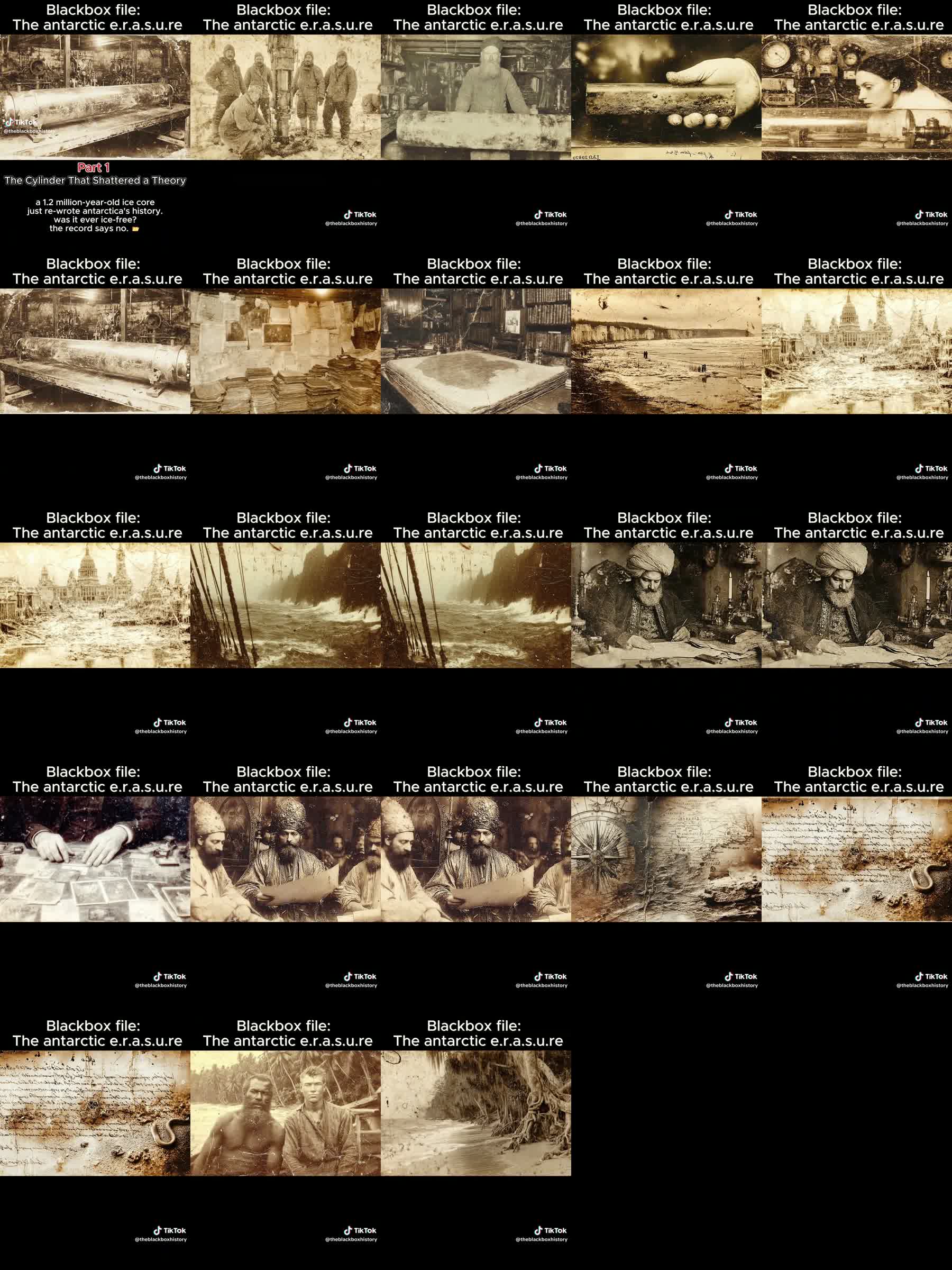
Chris sent a TikTok from @theblackboxhistory titled Blackbox file: the antarctic e.r.a.s.u.re Part 1 The Cylinder That Sh.... The useful takeaway is not “nothing strange ever happened in Antarctica.” The useful takeaway is stricter: real Antarctic ice-core science undercuts the popular claim that Antarctica was ice-free in recent human history or flash-frozen in the 1800s.
Bottom line
The Beyond EPICA ice core is a public scientific milestone: an Antarctic core about 2.8 km long with a climate archive reaching about 1.2 million years. That does not prove every institutional story about Antarctica is complete. But it strongly argues against the internet claim that Antarctica was recently ice-free, populated, then suddenly hidden under ice in the 1800s.
What the TikTok gets right
The clip points to a real scientific project: Beyond EPICA – Oldest Ice. The official project page says researchers have collected a new ice core reaching at least 1.2 million years, with analysis of trace gases, water isotopes and impurities expected to shed light on the Mid-Pleistocene Transition. A project press release says the total core measures 2.8 kilometres and may reveal fundamental details about Earth’s climate and atmosphere.
That matters because ice cores are not just stories. They preserve layered physical evidence: trapped air, dust, isotopes and chemistry. They are imperfect and require interpretation, but they are a stronger evidence class than a viral map overlay.
The viral theory it is pushing back against
The theory usually runs like this: old maps supposedly show an ice-free Antarctica; therefore Antarctica must have been known, settled or civilized in recent historical memory; then a catastrophic event, sometimes linked online to 1816 or “Tartaria,” flash-froze the continent; then the Antarctic Treaty keeps the truth hidden.
That story is emotionally powerful because it combines old maps, lost civilizations, government secrecy and forbidden geography. But its strongest version requires evidence the public record has not produced: datable human settlements under the ice, artifacts in context, repeatable survey data, and a mechanism for burying an entire continent under kilometres of ice within recent history.
The Piri Reis map is real — the Antarctica leap is the problem
The Piri Reis map of 1513 is a genuine and fascinating Ottoman world map. It used multiple source charts and includes a partial copy of a now-lost Columbus map. That alone makes it historically valuable.
The problem is the jump from “remarkable map” to “proven ice-free Antarctica.” The southern landmass has been debated, but the map’s own notes and scholarly summaries complicate the Antarctic reading. The TikTok highlights one important point: notes associated with the southern landmass describe a hot place with large snakes. That is not a natural description of Antarctica.
So the proper label is: remarkable early-modern cartography, not proof of recent ice-free Antarctica.
The Antarctic Treaty is not evidence of a cover-up by itself
The official Antarctic Treaty page says the treaty was signed in 1959, entered into force in 1961, and now has 58 parties. Its stated provisions include peaceful use, freedom of scientific investigation, exchange of scientific observations and results, and inspection access.
That does not mean every government tells the public everything. It does mean the treaty itself is not automatically proof of a buried civilization. A treaty controlling military use, claims, inspections, science and environmental rules is also exactly what you would expect for a remote continent with competing territorial claims and fragile research infrastructure.
Managing Expectations frame
- Real: the Beyond EPICA ice core and the public 1.2-million-year climate archive claim.
- Real: the Piri Reis map is a genuine 1513 artifact with a complicated source history.
- Unproven: recent ice-free Antarctica, an 1800s flash-freeze, or Tartarian civilization under the ice.
- Worth watching: how old-map mysteries become internet certainty when a visual resemblance is treated as a verdict.
Evidence checklist for Antarctica lost-history claims
- Does the claim provide public, datable artifacts from Antarctica itself?
- Are the artifacts found in context, or only shown as pictures, overlays or captions?
- Does the interpretation survive geological, glaciological and climate-core evidence?
- Are treaty restrictions being used as proof, or is there actual evidence of concealment?
- Can independent teams verify the data?
Primary links
- TikTok source: @theblackboxhistory — Antarctic erasure / ice core / Piri Reis claim
- Beyond EPICA official press release: 1.2-million-year Antarctic ice archive
- Beyond EPICA project home page and field notes
- Antarctic Treaty Secretariat: treaty provisions and parties
- Piri Reis map overview and source trail
- Local source note · transcript · metadata
History without panic or sleepwalking
Keep the question open, but keep the standard of proof higher than the story’s emotional pull.
Back to History