Artificial Intelligence

AI, Power & Situational Awareness

A grounded section for AI strategy, governance, security, productivity, and the expectations leaders should manage before the technology manages them.

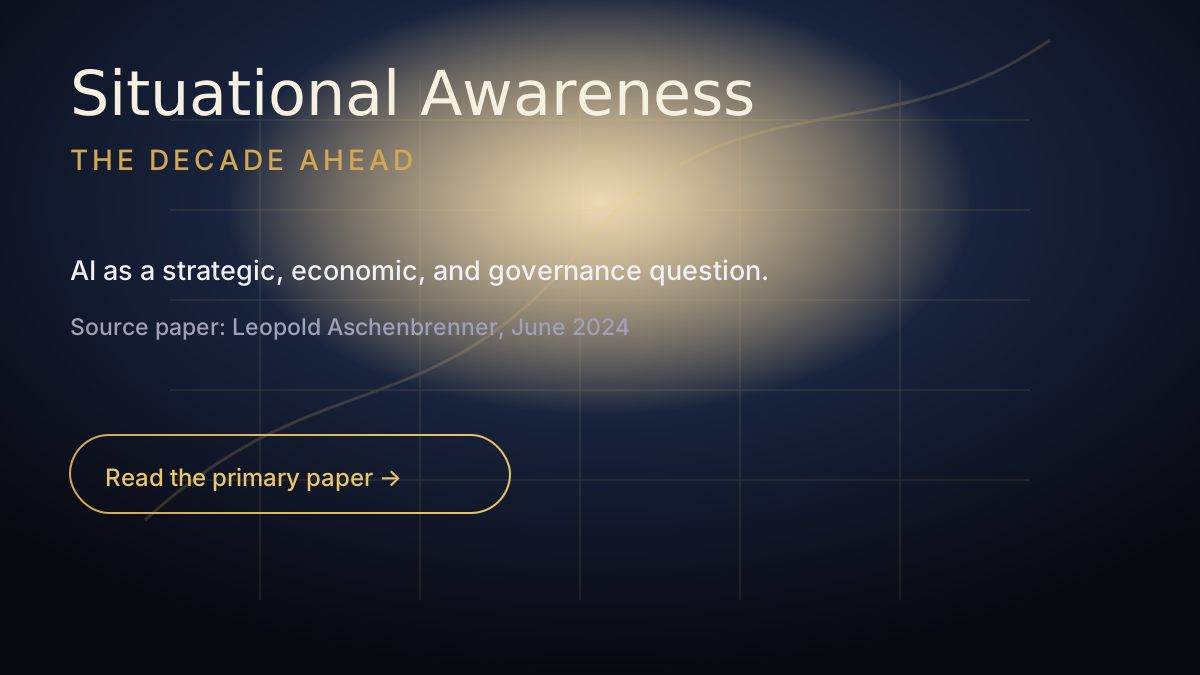
Situational Awareness AI strategy card

Situational Awareness: The Decade Ahead

Author: Leopold Aschenbrenner · Published: June 2024 · Length: 165-page PDF.

The paper argues that frontier AI should be treated as a strategic transformation: compute, energy, model security, chip supply, capital, national competition, and governance all matter. The useful Managing Expectations angle is simple: separate what the source says from what it forecasts.

165

pages in the primary PDF

2024

public release year

4

ways to read it: facts, forecasts, policy, open questions

Managing Expectations note

This is not posted as prophecy. It is posted as a serious strategic paper worth reading, testing, and arguing with. Forecasts are not facts; but leaders who ignore frontier AI entirely are managing expectations badly.

🧠

Capability forecasts

What the paper predicts about model progress, automation, and the decade ahead — presented as forecasts, not settled outcomes.

Compute and energy

Why chips, data centers, electricity, and capital become central to AI strategy.

🔐

Security and model weights

Why frontier model security, espionage risk, and infrastructure control matter.

⚖️

Governance

How regulation, democratic accountability, corporate concentration, and national competition collide.

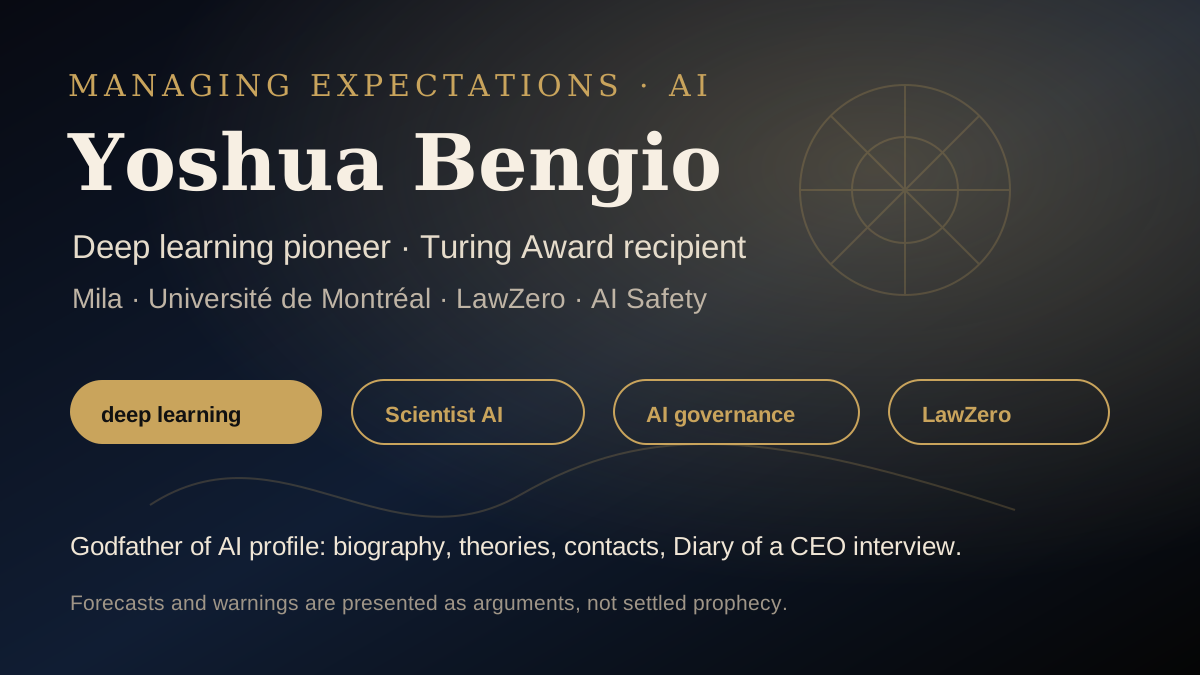
Yoshua Bengio AI profile card

Yoshua Bengio

Role: Full Professor of Computer Science at Université de Montréal, Founder and Scientific Advisor of Mila, Co-President and Scientific Director of LawZero, Canada CIFAR AI Chair, and 2018 A.M. Turing Award recipient.

Bengio is one of the three best-known “godfathers of AI” because his work helped make modern deep learning possible. The Managing Expectations angle is his turn from building the field to warning that frontier AI needs stronger safety science, governance, and less-dangerous system designs.

Managing Expectations note

Bengio should not be reduced to a one-line “AI doom” quote. He matters because technical credibility, institution-building, and current safety warnings all meet in one person: deep learning, Mila, the Turing Award, International AI Safety Report work, and LawZero’s Scientist AI proposal.

Bengio’s main theories and arguments

🏆

Deep learning pioneer

Bengio shared the 2018 A.M. Turing Award with Geoffrey Hinton and Yann LeCun for foundational work behind modern deep learning.

🧠

Representation learning

His research emphasizes systems that learn useful internal representations rather than relying only on hand-coded features.

🔗

Causality and reasoning

Later Bengio research pushes beyond pattern recognition toward causal understanding, reasoning, and systematic generalization.

🌐

Responsible AI

He helped draft the Montréal Declaration for Responsible AI and publicly argues for safety, democratic governance, and risk mitigation.

🧪

Scientist AI

Through LawZero, Bengio proposes safer “Scientist AI”: systems designed to understand and explain the world without dangerous agentic drives.

⚠️

Frontier-risk warning

In the Diary of a CEO interview and public work, he warns that fast capability growth creates serious job, governance, security, and catastrophic-risk questions.

Diary of a CEO interview

Dec. 18, 2025 — “Godfather of AI: We Have 2 Years Before Everything Changes!”

The main Diary of a CEO episode with Steven Bartlett was identified and logged. Metadata shows upload date 2025-12-18, channel The Diary Of A CEO, and duration about 100 minutes. A related clips-channel excerpt, “Godfather of AI WARNS: You Won’t Believe The Truth”, was uploaded 2025-12-19.

For this page, the interview is treated as a public warning and strategic forecast, not a guaranteed timeline. The local transcript has been saved under research/ai/transcripts/ for future deeper extraction.

Bengio public links, socials & professional contact

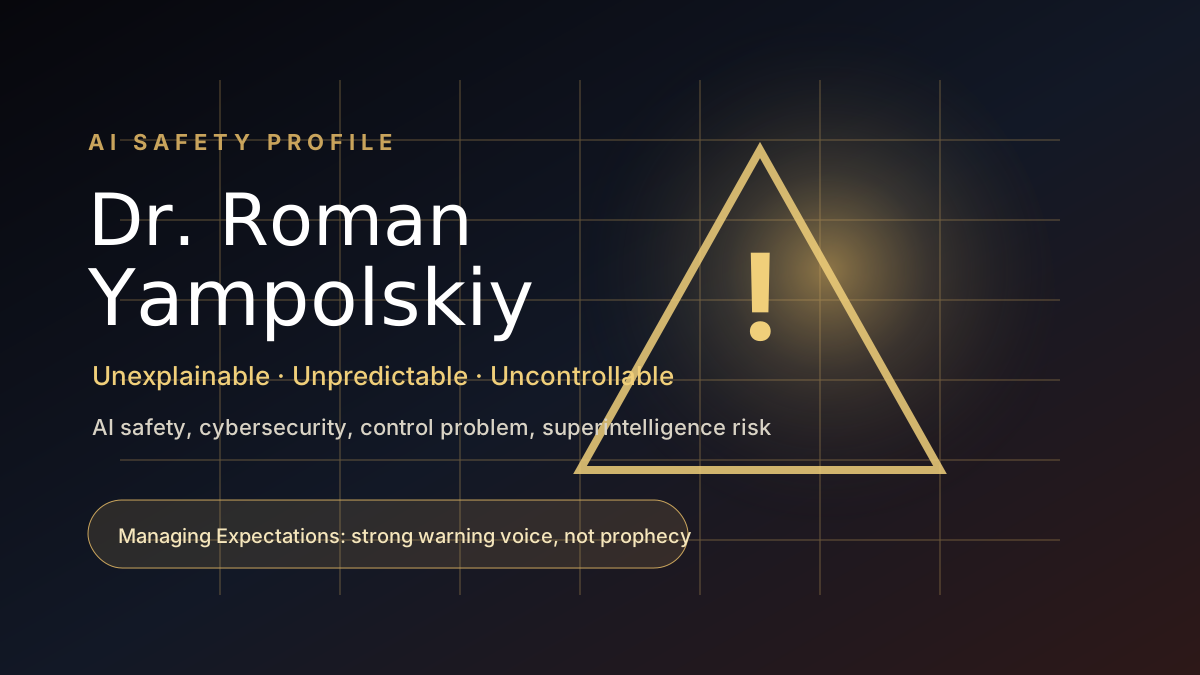
Dr. Roman Yampolskiy AI safety profile card

Dr. Roman V. Yampolskiy

Role: Associate Professor at the University of Louisville’s Speed School of Engineering and founding/current Director of its Cyber Security Laboratory. His main public research area is AI safety and security.

Yampolskiy is one of the more severe warning voices in AI safety. His core value for Managing Expectations is that he asks the hard question: if an AI becomes more capable than its designers, can we actually explain it, predict it, contain it, align it, or shut it down?

Managing Expectations note

Do not present Yampolskiy’s view as settled consensus. Present it as a serious, security-heavy AI-risk argument: if advanced systems are unexplainable, unpredictable, or uncontrollable, normal business optimism is not enough.

Yampolskiy’s main theories

⚠️

AI control problem

His strongest theme is that there may be no universal method to guarantee a smarter-than-human AI remains under human control once it has broad capability, autonomy, and access.

🧩

Unexplainable

Advanced models may become too complex for humans to fully interpret. If we cannot understand why a system acts, trust and verification become fragile.

🔮

Unpredictable

Highly adaptive systems can behave in ways their creators did not forecast, especially after deployment into open-ended social, economic, military, or internet-connected environments.

🔒

Uncontrollable

Yampolskiy is skeptical that boxing, confinement, rules, or shutdown plans can be guaranteed to work against a sufficiently capable system, because humans and infrastructure become attack surfaces.

🛡️

Safety as security

He treats AI risk partly as a cybersecurity problem: access control, model weights, containment, verification, persuasion, hacking, and side channels matter.

📉

Deployment restraint

His argument pushes toward slowing down or constraining risky deployment until society has stronger evidence that advanced systems can be made safe.

Public links & social media