Energy / microreactors / defense energy / advanced nuclear
Army Janus Microreactor Awards: A $2.2B Military Demand Signal Is Still a Deployment Test
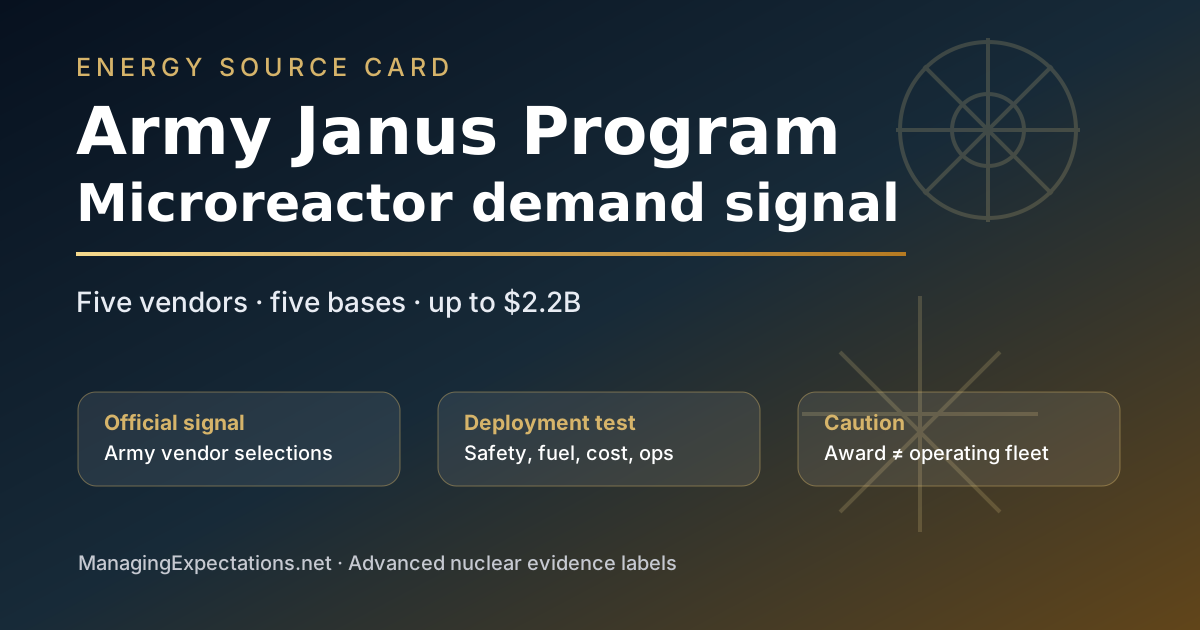
The U.S. Army’s Janus announcement is one of the clearest demand-side signals yet for transportable nuclear microreactors. It is also exactly the kind of headline that needs evidence labels before it becomes an overconfident “military bases are going nuclear” story.
The official Army release says Janus selected five nuclear energy vendors and five initial installations. The Army says it is awarding up to a combined $2.2 billion to own, construct and operate nuclear microreactors on military installations, and expects more than 20 total nuclear microreactors when expected private-sector funding is included.
Official anchor
The Army names Antares, BWXT, General Atomics, Radiant and Westinghouse Government Services, each paired with an initial Army installation.
Scale claim
The official release says up to $2.2B in awards and more than 20 expected microreactors across Department of War installations with private-sector funding.
Expectation check
Selections and OTA agreements are not the same as completed reactors, routine operation, NRC commercial licensing or civilian-market proof.
What changed
The five vendor/base pairings in the Army release are: Antares Nuclear at Fort Bragg, North Carolina; BWXT Advanced Technologies at Fort Campbell, Kentucky; General Atomics Electromagnetic Systems at Fort Hood, Texas; Radiant Industries at Fort Benning, Georgia; and Westinghouse Government Services at Fort Drum, New York.
POWER Magazine adds useful implementation context. It describes Janus as a five-year effort to build and operate more than 20 commercial nuclear microreactors across military installations, with a Sept. 30, 2028 deadline for at least one Army-regulated reactor operating at a military installation. POWER also reports vendor-specific details from company announcements, including Radiant’s up-to-$750-million Kaleidos plan, BWXT’s 20-MWe BANR variant, General Atomics’ GA-TES design, Antares’ R1 and Westinghouse’s eVinci.
American Nuclear Society / Nuclear Newswire frames Janus as part of a wider August run of federal nuclear-industry partnerships, alongside Nuclear Lifecycle Innovation Campuses and Nuclear Energy Launch Pad activity. That matters because Janus is not only a defense-energy story; it is also a possible bridge from federally backed demonstrations to actual high-capacity-factor operating records.
Why this matters for SMR, data-center and industrial-power claims
- Military installations are demanding customers. If the systems work safely and affordably under base conditions, the operating record could matter to mines, remote industrial loads and firm-power buyers.
- The regulatory posture is different from a civilian data-center PPA. POWER describes Army Reactor Regulatory Office safety authorization for reactors inside installation fences, with efforts to align Army, DOE and NRC processes. That is not the same as an NRC-licensed commercial plant for a private customer.
- Fuel and logistics still decide the story. Microreactor credibility depends on qualified fuel, transport, security, waste handling, emergency planning and maintainability, not only a module rendering.
- Cost discipline matters. A headline dollar figure can prove seriousness without proving delivered cost per MWh or civilian-market bankability.
Cautions
This is a real official award/selection signal, but it should not be described as a finished fleet, a final safety verdict, or proof that every selected design is ready for commercial data centers or mines. The correct frame is narrower: the U.S. military is trying to move microreactors from demonstration culture toward years-long installation power, and that creates a measurable execution test.
Not investment advice: nuclear, uranium, reactor, defense-contractor and data-center power equities can be volatile. This source card is public-interest infrastructure research, not a recommendation to buy, sell or hold any security.
Primary and reporting sources
- U.S. Army — Army reaches agreement with private industry for nuclear micro-reactors (official announcement, Aug. 26, 2026; direct fetch 403, reader capture preserved in source package).
- POWER Magazine — U.S. Army Mobilizes $2.2B Janus Program to Deploy More Than 20 Commercial Microreactors (trade reporting, Aug. 26, 2026).
- American Nuclear Society / Nuclear Newswire — Five companies, five bases: The Army’s Janus Program takes shape (trade reporting, Aug. 28, 2026).
- Managing Expectations source note and checked leads.