What the original post shows
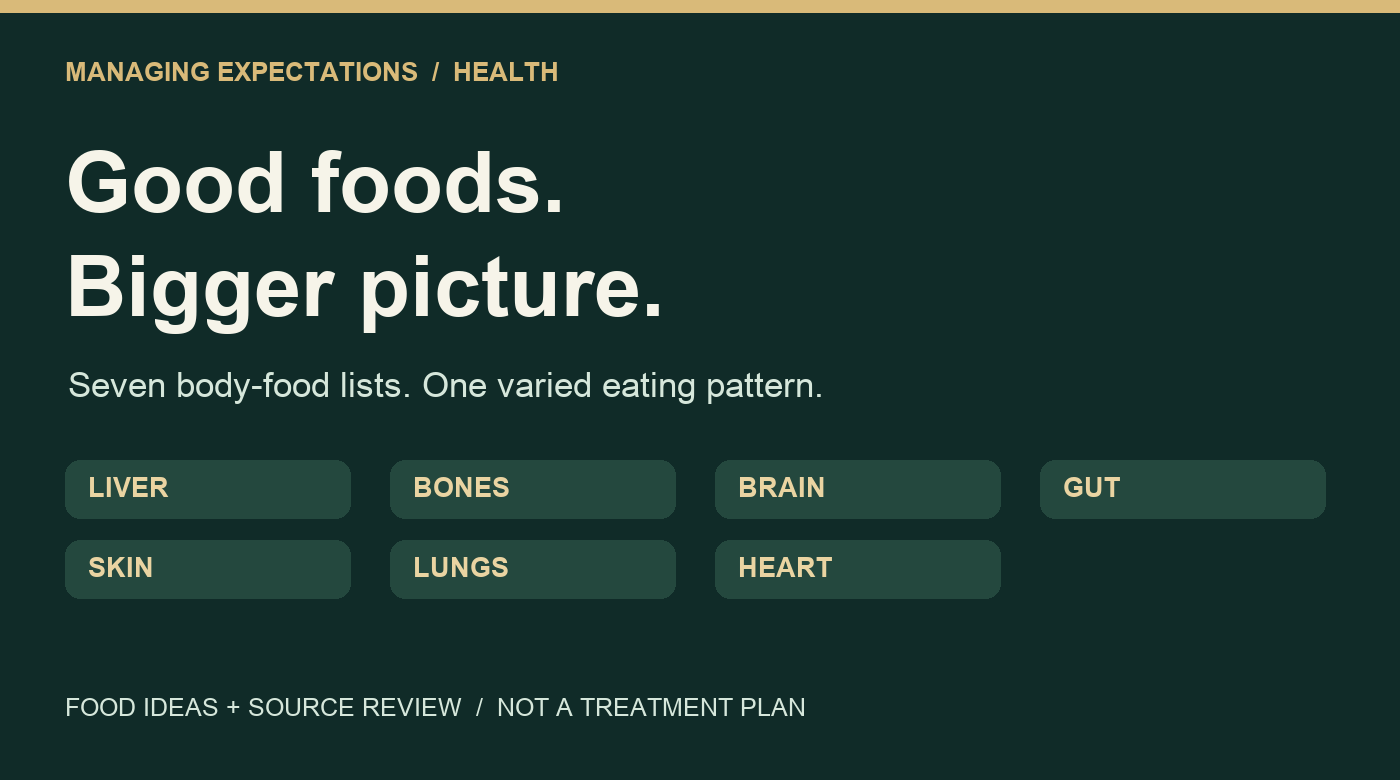
ThinkBeyond (@Blessinghls) posted a short X video captioned “Body foods 😋 😁”. Its illustrated cards carry the visible credit “Simran Selects” and group foods under liver, bone, brain, gut, skin, lung and heart headings. The downloaded file runs about 21 seconds and has no audio track: this review uses the on-screen labels, not an invented spoken transcript. The clip does not explicitly promise cures, detoxification or disease reversal.
Watch the original “Body foods” video on X →
Body foods 😋 😁 — ThinkBeyond (@Blessinghls)
Original post, September 18, 2026
Seven lists, checked in context
1. Liver: a real coffee signal, not a cleansing menu
Shown: Garlic · Coriander Leaves · Turmeric · Black Coffee · Radish.
Coffee has a meaningful human research trail. A 2021 meta-analysis of observational studies found an association between greater coffee consumption and less significant liver fibrosis, but no significant overall association with fatty-liver incidence or prevalence. That is a narrower finding than saying coffee prevents or treats liver disease; observational associations cannot establish cause and effect.[3]
Garlic, coriander, turmeric and radish can be culinary choices, but this source review does not establish that this exact combination specifically benefits the liver. Turmeric in food should not be confused with concentrated curcumin supplements: NCCIH notes uncertainty about health benefits and reports of liver damage with some enhanced-absorption formulations.[11]
2. Bones: calcium matters, and food form matters
Shown: Kale · Amaranth · Black Sesame Seeds · Figs · Yogurt · Sardines.
This list has a solid nutrient-based explanation. Calcium helps build and maintain bones; yogurt, kale and canned sardines with their edible bones are recognised sources. Vitamin D helps the body absorb calcium.[5]
The important detail is sardines with bones, not simply any fish product. The chart does not specify whether amaranth means leaves or grain, or whether figs are fresh or dried, so assigning precise calcium values would be misleading. Portions are not interchangeable, and a short food list is not a complete osteoporosis or fracture-prevention plan.[5]
3. Brain: promising dietary research, mixed clinical results
Shown: Blackberries · Walnuts · Blueberries · Matcha · Dark Chocolate.
The wider brain-and-diet question deserves nuance. In a three-year randomized trial involving 604 older adults at elevated dementia risk, the MIND diet did not produce significantly different cognitive or brain-MRI outcomes from a control diet; both groups received support for mild calorie restriction.[8]
A 2026 post-hoc analysis found that participants whose MIND-diet adherence improved most also showed better cognitive changes. That is an encouraging association, but it is not the same as demonstrating a benefit from randomized treatment assignment—and neither analysis tested this infographic’s exact five-food list.[9]
Enjoying berries or nuts is different from buying them as proven memory boosters. The evidence reviewed here does not make matcha or dark chocolate a dementia-prevention prescription.
4. Gut: think fibre and tolerance, not a universal reset
Shown: Pear · Fennel Seeds · Papaya · Chia Seeds · Yogurt · Kiwi.
The clearest general principle is fibre. NIDDK recommends fibre-containing foods and enough liquids to help stools become softer and easier to pass. Increase fibre gradually rather than making a sudden large change.[4]
Yogurt is a separate point: it may contain live cultures, but not every fermented food is a proven probiotic treatment. Benefits can depend on the organism, strain, product and condition studied. A result for one probiotic cannot automatically be applied to every tub of yogurt.[10]
This review does not establish equal digestive benefits for every item on the card, or that this combination treats IBS or “resets” everybody’s microbiome. Those stronger claims are not stated in the clip.
5. Skin: nutrients support normal function
Shown: Almonds · Sunflower Seeds · Orange · Tomato · Avocado.
Vitamin C provides a clear example of real nutrition biology: the body needs it to make collagen, which helps wounds heal. Oranges and tomatoes contribute vitamin C.[6]
That supports eating a varied diet that meets nutritional needs. It does not establish that this five-food combination clears acne, reverses ageing or guarantees a visible cosmetic improvement. A nutrient’s normal function and the outcome of a skin-treatment trial are different kinds of evidence.
6. Lungs: healthy eating is support, not smoke-damage repair
Shown: Flax Seeds · Blueberries · Walnuts · Leafy Greens · Broccoli · Tomatoes.
These food categories fit a plant-rich eating pattern, but the sources reviewed do not establish that this particular list repairs lungs. The American Lung Association’s protection advice emphasizes not smoking, avoiding harmful indoor and outdoor exposures, and staying physically active.[2][12]
The practical distinction is important: good nutrition belongs alongside lung care, not in place of smoking cessation, cleaner air or prescribed treatment. This is context for interpreting the “lung foods” label, not an accusation that the video promises to reverse smoking damage.
7. Heart: the pattern is stronger than the “superfood” idea
Shown: Pistachios · Pomegranate · Beetroot · Avocado · Oats.
Nuts, fruits, vegetables and whole grains fit the American Heart Association’s dietary guidance. Its scientific-statement summary emphasizes variety and the overall pattern, including healthier protein choices and limiting added sugars and salt, rather than concentrating on individual “good” or “bad” foods.[12]
These are useful shopping ideas, not an exclusive list or proof that a pomegranate juice or beetroot product prevents heart attacks. What you eat regularly, and what you choose instead of less nutritious options, matters more than ticking off five ingredients.
Make the list useful at the grocery store
Our practical suggestion is to borrow the variety, not the implied division into organs. Mix vegetables, fruit, whole grains and suitable protein foods across meals. Choose options you enjoy and can afford; look at added sugar and salt rather than assuming a health-themed label settles the question.[12]
For example, the ingredients could inspire oats with berries and plain yogurt, or a meal with vegetables and sardines or another suitable protein. These are meal ideas, not prescriptions. Nobody needs to buy all 38 food-label mentions, drink coffee, use matcha, or take supplements to follow a varied eating pattern.
How we checked it
We captured the exact X post and video, inspected the on-screen cards, and checked the seven groupings against government nutrient information, digestive-health guidance, professional heart and lung advice, and human research. All seven headings and 38 food-label mentions are preserved in the linked inventory. This is a targeted review of the groupings, not a systematic review of every ingredient. “Not established here” does not mean no studies exist.
Full source media and working captures are retained locally. The public page links to the original post rather than rehosting the full third-party artwork or video. Research access limitations and the distinction between nutrient functions, observational associations and randomized trials are recorded in the source note.
Sources
- [2] lung-protection
- [3] liver-coffee
- [4] gut-fiber
- [5] calcium
- [6] vitamin-c
- [8] Trial of the MIND Diet for Prevention of Cognitive Decline in Older Persons
- [9] Adherence to the MIND Diet and Longitudinal Changes in Global Cognition: A Post-Hoc Analysis of the MIND Trial.
- [10] Probiotics - Health Professional Fact Sheet
- [11] Turmeric: Usefulness and Safety
- [12] American Heart Association (2021) — 10 features of a heart-healthy eating pattern
Research trail: source note · complete food inventory · on-screen text transcription · evidence map.