Energy / HALEU / microreactors / uranium enrichment / data-center firm power
Centrus–Radiant HALEU Contract: Fuel Supply Progress, Not Microreactor Deployment Yet
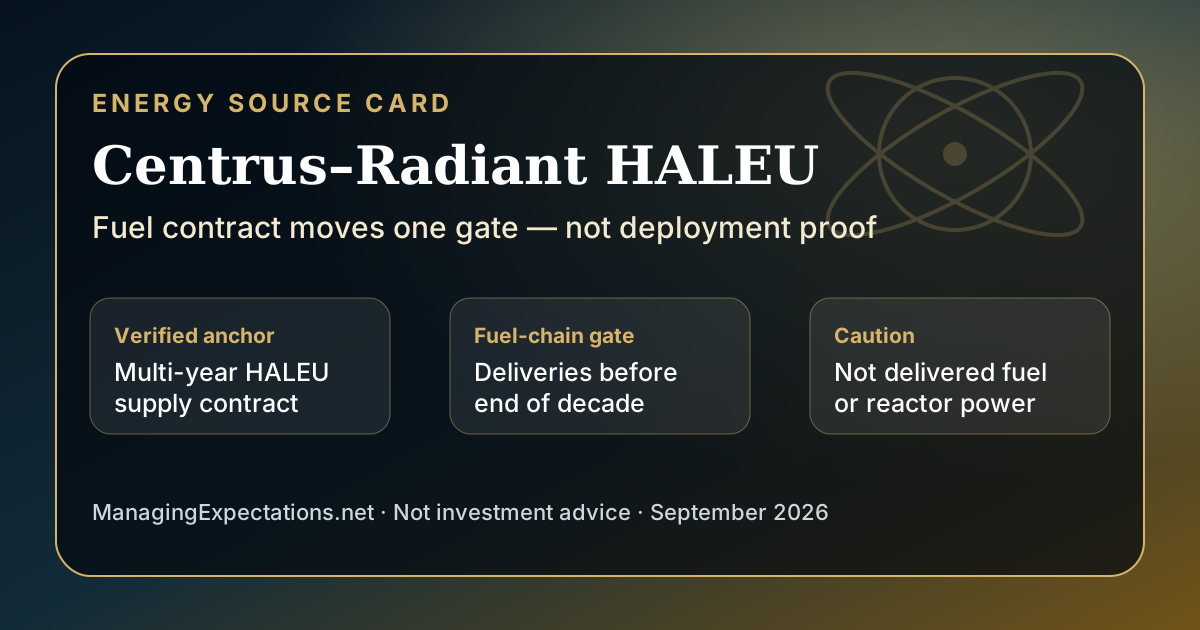
The useful headline is not “Radiant microreactors are now powering customers.” It is narrower and more important for the advanced-nuclear watch: Centrus says it has signed a definitive multi-year contract to supply HALEU fuel for multiple Radiant Kaleidos microreactors, with deliveries expected before the end of the decade.
That matters because fuel is one of the least glamorous but most decisive gates in small-reactor deployment. A microreactor can have a design, a test plan and a customer story, but it still needs enriched material, fabrication, transport, site licensing, security and operating approval before it becomes electricity.
Verified contract signal
Centrus announced a definitive multi-year HALEU supply contract for multiple Radiant Kaleidos microreactors on September 9, 2026.
Fuel-chain timing
The release says Centrus will begin delivering HALEU before the end of the decade and that Radiant prepayments support domestic enrichment capacity.
Expectation check
The source trail does not show delivered fuel, NRC operating approval, a completed reactor, a PPA or power delivered to a data center or mine.
What changed
Centrus Energy’s official release says Centrus and Radiant announced a definitive multi-year contract to supply high-assay low-enriched uranium, or HALEU, for multiple Kaleidos microreactors. The company says deliveries will begin before the end of the decade and that the agreement includes Radiant prepayments to support Centrus’ domestic commercial enrichment-capacity program.
The release also says the enrichment will be U.S.-origin and “unobligated,” meaning it can be used for national-security applications. That detail matters because Radiant’s microreactor lane includes commercial and industrial use cases, but also defense and remote-power contexts where fuel origin and restrictions can affect deployment.
NucNet and Nuclear Engineering International both treated the announcement as a fuel-cycle story: a supply contract tied to the broader HALEU bottleneck for advanced reactors. NEI describes HALEU as uranium enriched between 5% and 20% uranium-235 and frames Kaleidos as a transportable plug-in-ready microreactor concept. Those are context points, not proof of commercial operation.
Why it matters for the Energy watch
- For SMRs and microreactors, fuel contracting is a real gate. It does not solve deployment, but it is more concrete than a generic partnership announcement.
- For data centers and AI campuses, the relevance is future firm-power optionality. This contract does not put near-term megawatt-hours on any AI campus.
- For mines, remote industry and defense sites, microreactors remain a serious watch category because diesel replacement is a clear use case. The hard parts are licensing, safety case, insurance, logistics, waste, local acceptance and total cost.
- For uranium and enrichment readers, the signal is strategic infrastructure pressure, not a stock tip.
Cautions
Do not treat a fuel-supply contract as delivered fuel or an operating reactor. The public evidence supports a company-announced multi-year HALEU supply contract and trade-corroborated fuel-chain context. It does not prove that Centrus expansion schedules will be met, that Radiant will receive all fuel on time, or that any Kaleidos unit will clear every test, licence, site, customer and operating gate.
The Radiant page surfaced in search for this item resolved during extraction to a January 2023 partnership page, so this article uses the current Centrus official release and PRNewswire distribution as the 2026 primary anchor, with NucNet/NEI for trade context. DOE HALEU and Federal Register/NRC pages are used only as process background.
Not investment advice: Centrus, uranium, enrichment, HALEU, SMR developers, defense-energy suppliers and data-center firm-power narratives are volatile. This article is source-literacy and infrastructure evidence research, not a recommendation to buy, sell or hold any security or commodity exposure.
Primary and reporting sources
- Centrus Energy — Centrus and Radiant Announce Long-Term Partnership for Domestic HALEU to Supply Kaleidos Microreactors (official company release, September 9, 2026).
- PRNewswire — Centrus / Radiant release distribution (wire release, September 9, 2026).
- NucNet — Centrus signs HALEU supply contract for Radiant microreactors (trade reporting, September 9, 2026).
- Nuclear Engineering International — Centrus, Radiant sign HALEU deal (trade reporting, September 10, 2026).
- U.S. DOE Office of Nuclear Energy — HALEU Availability Program (official fuel-program context).
- Federal Register / NRC — Radiant Nuclear special nuclear material licence application notice (regulatory-process context, July 27, 2026).
- Managing Expectations source note and checked leads.