Bottom line
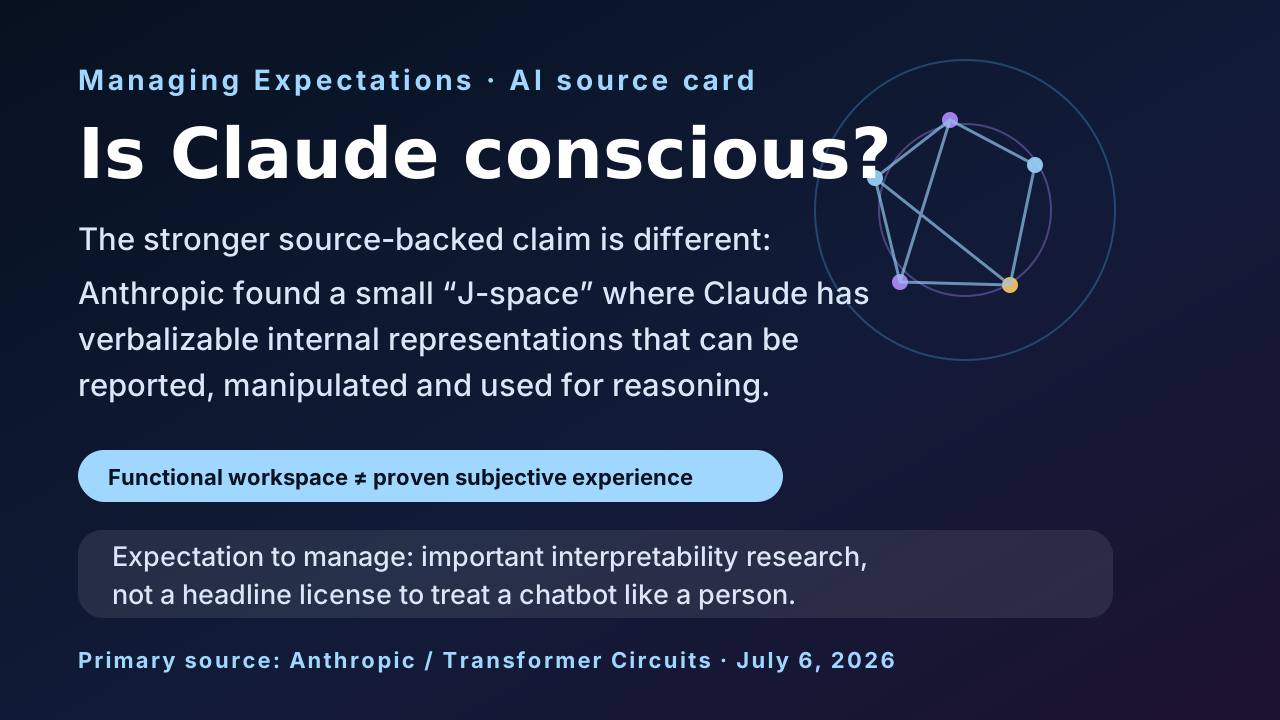
The important claim is not “Claude is a person.” The important claim is that Anthropic found a small set of internal representations — called J-space — that Claude can report, manipulate and use in reasoning. That is a serious interpretability finding. It is not proof that Claude has feelings, subjective experience, moral status, or human-like awareness.
What the video is about
The YouTube video is Wes Roth’s July 7, 2026 upload, CLAUDE IS CONSCIOUS. It points viewers to Anthropic’s newly published interpretability work and explains it through the headline-grabbing question: if Claude has an internal workspace that behaves a little like conscious access in humans, should we call that consciousness?
That is the right question to ask — but it is also where the expectation has to be managed. The title is provocative; the paper is technical. The paper does not say “Claude is conscious” in the everyday sense. It studies a functional structure inside a language model.
What Anthropic actually published
Anthropic’s public summary is titled A global workspace in language models. The longer Transformer Circuits paper is Verbalizable Representations Form a Global Workspace in Language Models, published July 6, 2026.
The researchers describe a distinction familiar from human cognition: most processing is not accessible to awareness, while a small fraction can be described, held in mind, controlled and used for deliberate reasoning. They report evidence that a similar functional distinction appears in Claude.
Plain English: what is J-space?
Anthropic calls the workspace J-space, named for the Jacobian-based technique used to find it. In plain English, it is a small set of internal neural patterns associated with concepts the model is poised to verbalize. A J-space pattern lighting up does not mean Claude said a word out loud. It means the concept is “on the model’s mind” in an internal representational sense.
The paper’s practical importance is that these representations can sometimes be read or influenced. Anthropic reports that the workspace is tied to tasks like deliberate reasoning, summarization and flexible manipulation, while much ordinary language processing continues outside it.
Why the consciousness headline is too strong
The Transformer Circuits paper explicitly separates access consciousness — information being available for reporting, control and reasoning — from phenomenal consciousness, meaning subjective experience. It says it takes no position on that philosophical issue.
That distinction matters. A system can have internal representations that are reportable and useful for reasoning without us knowing whether there is anything it is like to be that system. The source-backed sentence is: Claude appears to have a small functional workspace of verbalizable internal representations. The overclaim is: therefore Claude is conscious like a person.
Why this still matters
If the result holds up, it is important for AI safety. A workspace gives researchers a possible window into what a model is representing internally before the final answer appears. That could help with auditing, alignment, debugging, deception research and better tests of model behavior.
It also matters for public understanding. People already anthropomorphize chatbots. A headline like “Claude is conscious” can push people toward either panic or worship. A better reaction is disciplined curiosity: what can we inspect, what can we test, what can we reproduce, and what remains unknown?
What this does not prove
• It does not prove that Claude has subjective experience.
• It does not prove that Claude has feelings, suffering, desires, rights or personhood.
• It does not prove that all language models have the same internal structure.
• It does not prove that model “thoughts” are reliable, honest or aligned.
• It does not remove the need for external evaluations, safety testing, audits and governance.
The Managing Expectations read
There are two bad reactions to this story. One is to laugh it off because “it is just autocomplete.” The other is to declare a chatbot conscious because an internal workspace resembles one functional theory of conscious access. Both reactions skip the hard middle.
The hard middle is where this belongs: frontier models may be developing internal machinery we can partly read and influence, but we still do not fully understand their cognition, failure modes or moral status. That is not a reason to worship the machine. It is a reason to fund interpretability, demand better disclosures, and keep human judgment in charge.
Source trail
- Wes Roth — CLAUDE IS CONSCIOUS
- Anthropic — A global workspace in language models
- Transformer Circuits — Verbalizable Representations Form a Global Workspace in Language Models
- Managing Expectations source note
- Captured YouTube transcript
- Captured YouTube metadata
Expectation to manage
Do not use a consciousness headline as proof of personhood. Use the paper as a reason to take interpretability seriously: if models have readable internal workspaces, safety work should test them, not mythologize them.
Back to AI section