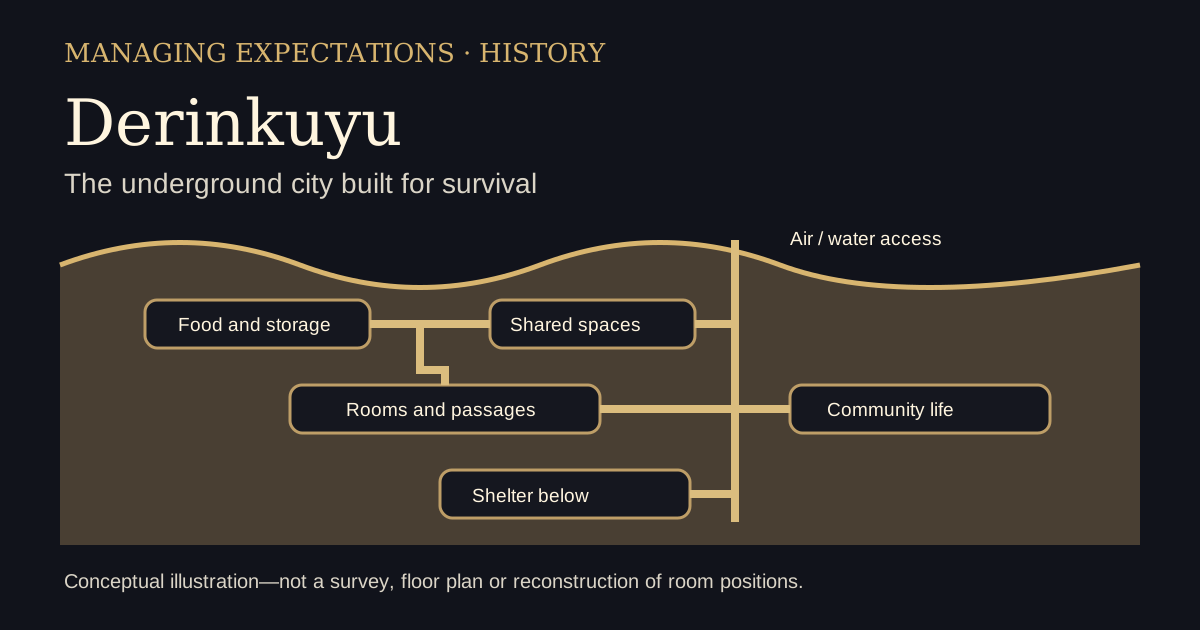

Imagine preparing a town for danger by carving downward instead of building walls upward. Beneath Derinkuyu in central Türkiye, generations cut rooms, passages, storage spaces and places of worship into the rock. Its most extraordinary achievement was not simply depth. It was making an underground refuge usable by a community.
A new feature from The Archaeologist’s Notebook, presented by Giselle Király, brings that achievement to life. The supplied Facebook video matches the channel’s YouTube edition, published October 23, 2026. Its central subject is real. Some of the most memorable numbers and stories, however, need more careful labels than a dramatic opening allows.
The geology made it possible. The need for safety made it useful.
Derinkuyu lies in Cappadocia, where volcanic deposits formed soft rock known as tuff. Türkiye’s official museum description explains that underground settlements were carved downward into this material to provide refuge during threats or attacks. Their relatively sheltered temperature also offered relief from summer heat and winter cold.
The museum puts Derinkuyu’s depth at approximately 85 metres. It lists stables, cellars, dining halls, churches and a space for boiling grape molasses. A roughly 55-metre ventilation shaft also functioned as a well. Those are different measurements: the depth of a shaft should not be confused with the depth of the entire complex.
UNESCO includes Derinkuyu and nearby Kaymaklı within Göreme National Park and the Rock Sites of Cappadocia. Its account connects the region’s underground towns with communities seeking refuge during Arab invasions in the Byzantine period. This is a human history of adaptation and protection, not evidence that extraordinary technology was required.
Who built it? There is no single, securely dated founding moment.
The video acknowledges that the earliest construction date is uncertain before discussing possible Hittite beginnings and Phrygian development. That uncertainty deserves to remain visible. BBC Travel’s 2022 feature discusses those early possibilities, while a Turkish Ministry of Culture and Tourism summary estimates ninth- to tenth-century construction. UNESCO emphasizes the wider region’s late-antique and Byzantine heritage.
These sources do not give us one agreed birthday for every room. A rock-cut complex can be enlarged, repurposed and used across many periods. “A layered underground settlement with a substantial Byzantine refuge history” is firmer than claiming that the entire city was built by one people exactly 2,000 years ago.
The video also invokes Xenophon. His Anabasis, Book IV, section V, really describes underground houses entered through well-like openings, with space for people, animals and provisions. But the passage does not name Derinkuyu. It is evidence for ancient underground dwelling, not a dated construction record for this particular city.
A refuge was more than a collection of hiding places
The official museum’s explanation offers a practical picture of how the complex worked. Stables were near the entrances because moving animals into lower levels was difficult. Kitchens and grape-processing spaces were placed on upper floors for easier movement of food and supplies. The number of kitchens suggests shared facilities rather than a separate kitchen for every household.
A large room on the second floor is interpreted as a missionary school, with adjacent study rooms. A cross-shaped church lies farther down. Storage, worship, food preparation and water access helped sustain a community, rather than merely conceal isolated individuals.
BBC Travel describes narrow passages and large rolling stone barriers that could close sections from within. These features make defensive sense. They do not, by themselves, establish the video’s sweeping statement that no army ever breached the city. A claim about every attack across centuries would require a much fuller historical record.
What does “20,000 people” actually mean?
The familiar figure is best treated as a reported estimate of shelter capacity, not an excavated census or proof that 20,000 permanent residents lived below ground continuously. BBC Travel uses “up to 20,000” and describes a temporary haven during danger. The museum confirms the refuge function but does not provide a population count in the descriptions reviewed here.
Likewise, “18 levels” is repeated in the video and BBC account, but it should not be read as a visitor itinerary or a precise count agreed by every site description. The official sources reviewed here anchor the depth at about 85 metres and say only a portion can be visited. The museum dates public opening to 1965.
The lost chickens—and the caveat near the end
The feature opens with an unnamed homeowner following missing chickens through a gap while renovating his basement in 1963. BBC Travel also recounts that version, attributed to its guide.
Importantly, around 20:23 in the video, Király says the chicken detail is not confirmed. That late qualification belongs beside the opening anecdote, not hidden behind it. The 1963 rediscovery is widely reported; the chickens are a memorable but unverified detail.
“Lost city” also compresses a more complicated history of local use, abandonment and renewed exploration. The film and BBC account connect the break in the community’s history with the departure of Cappadocian Greeks in the 1920s. Neither establishes that every person in the region had forgotten every underground space.
Where the evidence is thinner
- An intercity escape tunnel: the film describes an approximately eight-kilometre connection to Kaymaklı. Long connections are repeated in popular accounts, but this review did not retrieve an archaeological survey establishing the complete route. Treat it as a reported claim, not a route map.
- Acoustic tubes and everyday routines: claims about a purpose-built communication network, exact siege durations, particular lamp fuels, waste handling and temporary morgues need more specific archaeological documentation than the official summaries provide. Plausible reconstruction is not the same as a documented routine for every household.
- Excavated versus open to visitors: the museum says roughly ten percent can be visited. That is not automatically the same as the proportion excavated, mapped or understood.
The Managing Expectations takeaway
Derinkuyu does not become less impressive when the numbers are qualified. It becomes more understandable: a remarkable built environment shaped by geology, conflict, cooperation and repeated adaptation.
The lesson is to separate the visible structure, the interpretation of its rooms and the stories told around it. We can admire the ingenuity without requiring every cinematic detail to be settled fact.
Sources and viewing trail
- Submitted Facebook video · resolved Reel. The Archaeologist’s Notebook; original capture retained locally.
- The Archaeologist’s Notebook: “This massive, underground lost city was found in a guy’s basement”, October 23, 2026. Matching channel ID, description, opening narration and chapter sequence; approximately 24 minutes.
- Türkiye Ministry of Culture and Tourism museum entry: tuff, refuge function, depth, room uses, communal kitchens and opening in 1965.
- Turkish Museums: Nevşehir Derinkuyu Underground City: architectural features and the distinction between the complex and the portion open to visitors.
- Ministry summary: Derinkuyu Underground City: defensive purpose and its ninth- to tenth-century dating estimate.
- UNESCO: Göreme National Park and the Rock Sites of Cappadocia: listed property, Byzantine heritage and refuge context.
- Geena Truman, BBC Travel, August 11, 2022: reported rediscovery, capacity estimates, competing early origins and expert/guide commentary. A travel feature, not an excavation report.
- Xenophon, Anabasis, translated by H. G. Dakyns, Book IV, section V: underground dwellings; the passage does not identify Derinkuyu.
Review dated October 24, 2026. The complete submitted video was captured and machine-transcribed for research. Proper names in the article were checked against creator metadata and official sources; the raw automatic transcript contains errors and is kept locally, not presented as an official transcript. The creator’s player is embedded rather than rehosting the documentary or its Getty/Alamy imagery. Capture and evidence note.