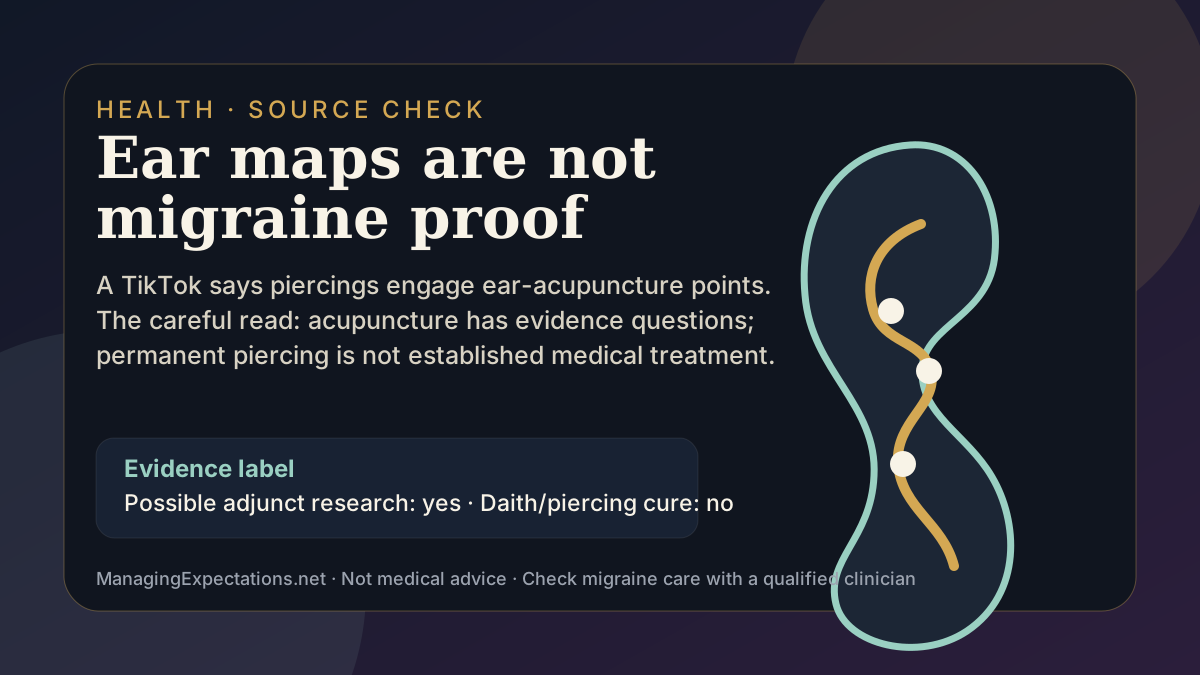
The Reel has a real hook: auricular acupuncture and ear-based neuromodulation are legitimate research topics. But it turns that kernel into a much stronger suggestion — that ordinary ear piercings may permanently engage organ and nervous-system points, including for migraine.
Reader caution
This is media-literacy research, not medical advice. If you have migraine, chronic headaches, infection, piercing complications, keloids or neurological symptoms, use qualified medical care. Do not replace diagnosis or treatment with a piercing trend.
What the TikTok says
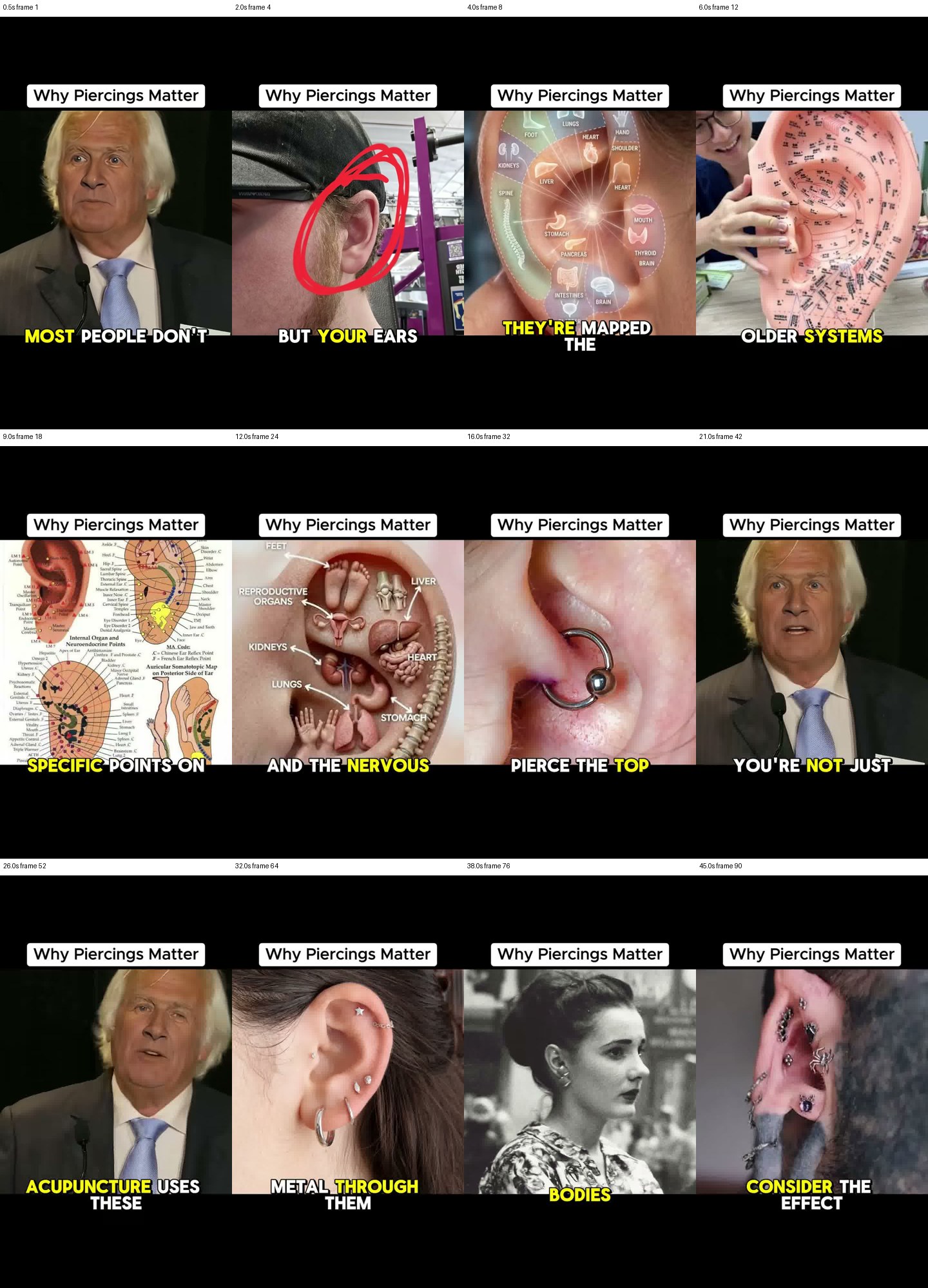
The captured transcript says ears “aren’t just ears” but are “mapped”; that older meridian/acupuncture systems link ear points to organs and the nervous system; that some people pierce the top of the ear to help migraines; and that piercing these areas may engage points “meant to connect to something else.”
“For instance, some people specifically pierce the top of the ear to help with migraines. When you pierce through these areas, you’re not just going through skin.”
The visual style uses ear diagrams, acupuncture-point imagery and piercing imagery to invite a question: if acupuncture uses temporary stimulation, what happens when metal is left there permanently?
The real research kernel
Auricular acupuncture is real. The ear has branches of sensory nerves, and some medical/complementary systems use ear points for pain, stress, addiction support and headache-related symptoms. NCCIH says acupuncture’s mechanisms are not fully understood, but evidence suggests nervous-system effects, local tissue effects and nonspecific/placebo effects can all contribute.
For migraine generally, NCCIH summarizes moderate-quality evidence that acupuncture may reduce migraine frequency, while noting that differences versus sham acupuncture can be small. That evidence concerns acupuncture delivered as a treatment — not decorative piercing performed by a nonmedical piercer.
Recent auricular-acupuncture migraine papers are mixed but interesting. A 2025 systematic review of randomized trials reported positive pooled outcomes for auricular acupuncture, while also warning that the inference is constrained by trial-method quality and that better RCTs are needed. A small 2021 trial of semi-permanent auricular needles found improvement over four weeks, but that is still not proof for permanent piercing.
Daith/top-ear piercing is the weak link
The specific social-media claim that daith or top-ear piercing helps migraine is not established. The American Migraine Foundation says daith piercing is not recommended as a migraine treatment strategy and describes the supporting evidence as anecdotal, with possible placebo effects and risks including pain and infection.
A 2017 case report described one chronic-migraine patient who improved after daith piercing, but the authors themselves wrote that daith piercing cannot be recommended as migraine treatment because of lack of scientific evidence, an unquantified failure rate and associated risks. A 2024 narrative review found only a small set of case reports/retrospective evidence and no clinical trial; it concluded current evidence does not support daith piercing for migraine, tension-type headache or other headache disorders.
What about “organ maps”?
Ear maps are part of acupuncture traditions and some modern auricular systems. They can be meaningful inside those systems, and some points may correlate with nerve stimulation targets. But the stronger claim — that a random piercing reliably changes the linked organ or nervous-system function in a clinically predictable way — needs evidence the Reel does not provide.
There is also a practical difference between a trained clinician selecting a point, applying a controlled stimulus for a defined purpose, monitoring response and removing/adjusting treatment, versus permanent jewelry placed for style or trend. Those should not be treated as the same intervention.
Risks the Reel underplays
Piercings are wounds. Cleveland Clinic notes that upper-ear cartilage has less blood flow than the earlobe and is more likely to become infected; upper-ear infections can sometimes be serious. Ear piercings are also a common cause of ear keloids, especially in people with risk factors or previous keloid history.
That does not mean all piercings are dangerous. It means “maybe this helps migraines” is not enough of a medical justification for a cartilage piercing if the evidence is weak and the risk is real.
Evidence labels
- True kernel: auricular acupuncture and ear-based neuromodulation are real research areas.
- Reasonable but limited: acupuncture may help some migraine patients as an adjunct, but effects, protocols and evidence quality vary.
- Not proven: permanent ear/daith piercing is not established migraine treatment.
- Overreach: organ-map symbolism does not prove that ordinary piercings permanently affect organ function.
- Safety issue: cartilage piercing carries infection, healing and keloid risks.
Source-documentation image
Primary links
- TikTok source: @seedtruth video 7663181517891341586
- American Migraine Foundation: Daith piercings as migraine treatment
- NCCIH: Acupuncture effectiveness and safety
- PubMed: 2025 auricular acupuncture migraine systematic review/meta-analysis
- PubMed: 2021 auricular semi-permanent needle migraine trial
- PubMed: 2024 daith piercing narrative review
- Cleveland Clinic: infected ear piercing
- Cleveland Clinic: keloid on ear
- Local source note
- Captured transcript
Bottom line
The disciplined expectation is: ear acupuncture is a real treatment tradition with some migraine research, but the TikTok’s piercing implication is not proven. If someone wants acupuncture, choose a qualified practitioner. If someone wants a piercing, treat it as body modification with risks — not as a migraine cure.
Health Source Cards
Continue the Managing Expectations health library: social-video claims, wellness symbolism, medical controversy, and reader-protection source notes.
Back to Health Section