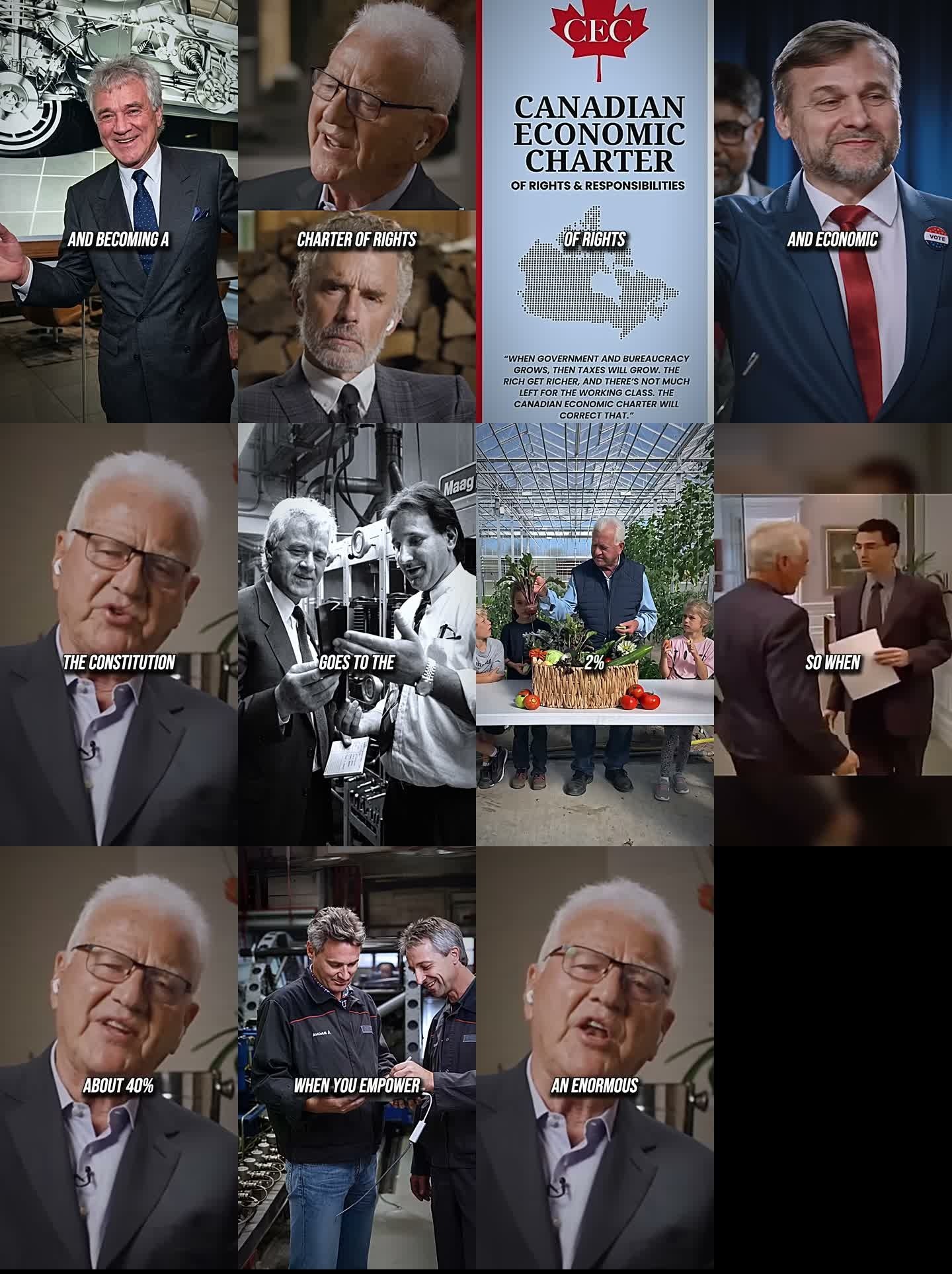
The YouTube Short features Frank Stronach arguing that a human charter of rights is not enough. His phrase is an “economic charter of rights”: a business constitution that gives workers, management, shareholders, society and reinvestment a defined share in the success of the enterprise.
The core line
“When you empower employees with a share in the profits, you release an enormous energy.”
What the short claims
Stronach says human rights need to be fortified by economic rights. He calls the result “economic democracies,” arguing that democracy itself needs an economic base. He describes a corporate constitution where a fixed share of profits goes to shareholders, employees, management, charity/society, and reinvestment for research.
The clip also claims that after this constitution was put in place, profits rose sharply in the following years. That performance claim should be treated carefully unless traced to full company records. The broader idea, however, is clear and worth covering: workers are more than labour inputs; they should have a visible stake in the productive wealth they help create.
Why this belongs in Freedom
Freedom is usually discussed as speech, elections, privacy and due process. Those matter. But a person can have the right to vote and still live with no ownership, no savings, no bargaining power and no share in the upside of the company they help build.
Economic freedom is not just “low taxes” or “less regulation.” It is also whether ordinary people can participate in ownership, profit, enterprise and long-term wealth creation. Without that, freedom becomes formal rather than practical.
Stakeholder capitalism without the fog
The phrase “stakeholder capitalism” is often used vaguely. Stronach’s model is more concrete: predetermine how profits are shared. That does two things. First, it tells employees that their effort is not just rented by the hour. Second, it limits the temptation for executives or outside capital to treat every dollar of surplus as theirs alone.
A real economic charter would need clear numbers, audited accounts and simple rules. Otherwise “sharing success” becomes a slogan. The point is not charity from the top. The point is a constitutional structure inside the business.
The hard questions
- Who counts as an employee? Full-time, part-time, contractors, franchise workers, temporary labour?
- What profit number is used? Operating profit, net income, cash flow, adjusted earnings?
- Can management game the formula? If yes, the charter is theatre.
- Does it apply in bad years? Workers share upside, but should not be turned into shock absorbers for bad executive decisions.
- Is ownership portable? Can workers build durable assets, or only receive annual bonuses?
Managing expectations
A profit-sharing charter will not fix every economy. It will not replace good management, honest accounting, sound products or competitive markets. But it asks the right freedom question: if employees create value, why should they be excluded from the wealth that value creates?
The strongest version of Stronach’s argument is that democracy needs an economic foundation. Citizens who are economically dependent, permanently indebted and excluded from ownership are easier to manage. Citizens with a stake are harder to control — and more likely to build.
Source links
- Original YouTube Short
- Local transcript
- Local source note
- Frank’s Projects: Magna Charter
- Frank Stronach: business leader page
- National Post: Frank Stronach on workers getting their share
Freedom section
Source-grounded notes on liberty, responsibility, ownership, work, land, surveillance, due process and civic courage.
Back to Freedom