Two new videos point back to one of Frank Stronach’s most important business ideas: Magna was not just built as an auto-parts company. It was built around a written business constitution that tried to make employees, management, shareholders, research and society part of the same profit system.
Bottom line
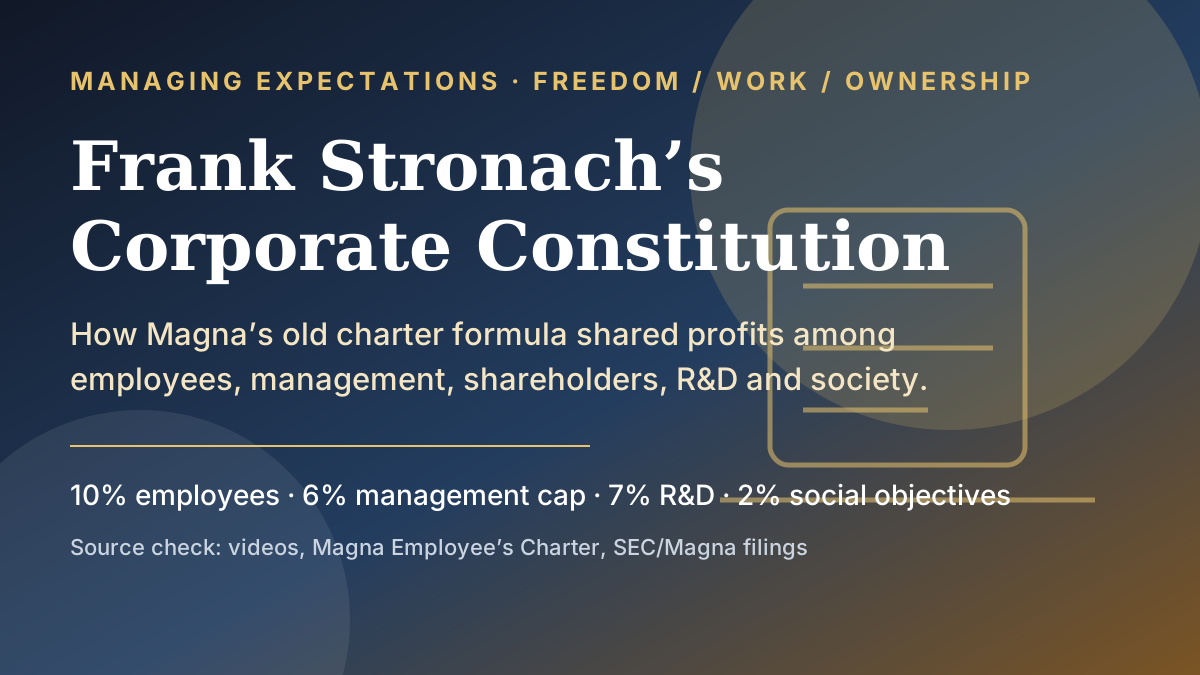
Stronach’s model was not vague “stakeholder capitalism.” Magna’s historical Corporate Constitution put numbers around the bargain: 10% of qualifying employee pre-tax profits before profit sharing for employee equity/profit sharing or pension; a 6% cap on aggregate eligible management incentive bonuses; at least 7% of pre-tax profits for research and development; up to 2% of pre-tax profits for social objectives; and shareholder dividend rules tied to after-tax profits.
What the videos add
The LeDrew interview frames Stronach as the immigrant founder who arrived in Canada in 1954 with a few hundred dollars, built Magna, and now argues that red tape and permitting delays would make it impossible to build the same company in today’s Canada. The second video, from Stronach’s channel, gives the more important governance clue: “nobody works for me — you people work with me.” It says Magna culture began when he introduced a profit-sharing plan in his factories, calls the idea “Fair Enterprise,” and identifies the Corporate Constitution and Employee’s Charter as the institutional expression of that idea.
The philosophy: employees as partners, not rented hands
The heart of the model is psychological and constitutional. Stronach’s repeated line is that people do not merely work for the founder; they work with the enterprise. That is not just a nice phrase. It becomes real only if the company’s documents, accounts and incentives give workers a measurable share in success.
Magna’s current “Our Culture” page still uses the language of a “Fair Enterprise culture” based on fairness and concern for people, and says the Employee’s Charter, Operational Excellence and Code of Conduct are building blocks for innovation, involvement and teamwork. Magna’s current Employee’s Charter says employees and management work together to ensure company success and that employees “should share in the company’s success.”
The historical profit-sharing architecture
Magna’s older annual-report filings describe the Corporate Constitution as part of its charter documents. The company said it defined the rights of employees and investors to participate in profits and growth and imposed discipline on management. The key elements were:
| Constitutional rule | How it worked | Why it mattered |
|---|---|---|
| Employee equity/profit sharing | 10% of qualifying employee pre-tax profits before profit sharing allocated to employee equity participation/profit sharing and other employee profit programs, or the defined benefit pension plan for participating employees. | Workers received a formula-based claim on success, not just discretionary morale bonuses. |
| Employee option after pension change | The 2003 filing says employees could continue in the 10% equity/profit-sharing plan or receive a reduced 6% entitlement plus a defined benefit pension. | The model combined ownership/profit participation with retirement security choices. |
| Management incentive cap | Aggregate incentive bonuses for eligible/corporate management capped at 6% of pre-tax profits before profit sharing. | Managers were entrepreneurial profit participants, but the constitution limited the pool. |
| Research and development | Minimum 7% of pre-tax profits had to be allocated to R&D during the year or immediately following year. | The constitution forced reinvestment in future competitiveness rather than only distributing surplus. |
| Social objectives | Maximum 2% of pre-tax profits could be allocated to political, patriotic, philanthropic, charitable, educational, scientific, artistic, social or other useful community objectives. | The company could fund civic/community aims, but within a defined ceiling. |
| Shareholder dividends | At least 10% of after-tax profits for a year, and on average at least 20% of after-tax profits over the current and two preceding years, subject to the constitution’s terms. | Investors also had a defined participation right, not just workers and management. |
The Employee’s Charter layer
The Employee’s Charter was the human-rights layer inside the enterprise. In older filings it included job security, a safe and healthful workplace, fair treatment, competitive wages and benefits, employee equity and profit participation, communication and information, a hotline, and an Employee Relations Advisory Board. The current Magna version has modernized wording but preserves the core themes: safe workplace, job security through training/development, fair treatment, competitive total rewards, communication/transparency and an open-door process.
The decentralization layer
The Constitution did not sit on top of a centralized bureaucracy. Magna’s filings describe divisions as autonomous business units and profit centres led by general managers who could determine pay rates, hours of work, suppliers and contracts within the framework of the Corporate Constitution and Employee’s Charter. That is the missing connection: profit sharing only has force if local units can actually operate like accountable businesses.
The discipline layer
The model also restrained management and capital. It required majority non-management directors, restricted changes to share capital without class approvals, limited unrelated-business investments above a threshold, and required R&D allocation. In other words, it was a constitution in the real sense: not a slogan, but a set of constraints on what management could do with company surplus.
What changed after 2010
This article treats the Corporate Constitution formula as a historical Magna structure. In 2010, Magna entered a transaction to eliminate its dual-class share structure. SEC filings around that transaction state that the Stronach Trust’s voting power fell from roughly 66.1% before closing to about 7.43% after closing. Current Magna materials still preserve Employee’s Charter and Fair Enterprise language, and recent proxy materials show employee deferred profit-sharing plans holding a meaningful share block, but the old Corporate Constitution should not be presented as unchanged current law unless the specific modern charter documents are reviewed.
Why the structure matters
The reason this belongs on Managing Expectations is that it turns “economic rights” into a design problem. Most companies say employees are their greatest asset. The Magna formula asked: what percentage of profit proves it? What percentage must be reinvested in technology? What is management allowed to take? What must shareholders receive? What can society receive? Those are constitutional questions.
The weakness is also obvious: formulas depend on definitions. “Pre-tax profits before profit sharing,” “employee pre-tax profits,” eligible employees, eligible management and participating entities are accounting/legal definitions. A charter can create trust only if the definitions are transparent and hard to game.
Managing Expectations verdict
Stronach’s Corporate Constitution is best understood as a serious experiment in economic democracy inside a capitalist public company. It did not abolish hierarchy or markets. It did something more practical: it put employees, management, shareholders, R&D and social objectives into a profit-allocation framework. The lesson is not that every company should copy Magna exactly. The lesson is that if a company claims to value workers, innovation and community, those values can be written into the constitution of the business — with numbers.
Source links
- Frank Stronach: I Couldn’t Build Magna in Today’s Canada — LeDrew interview
- Who Is Frank Stronach? — Frank Stronach channel
- Magna Employee’s Charter
- Magna Our Culture / Fair Enterprise page
- Frank’s Projects: Magna Charter
- Local source note
- LeDrew video transcript archive
- Stronach video transcript archive
Economic freedom needs design
Ownership, profit sharing and workplace rights become real only when the formula is written down, audited and protected from management discretion.
Back to Freedom