Energy / HALEU / uranium enrichment / advanced nuclear
GAO’s Uranium-Fuel Warning: HALEU Ambition Still Needs a Costed Supply Chain
A reactor design can look compelling on paper and still be stopped by a less glamorous question: who can make the qualified fuel, at what scale, under what cost ledger, and on what schedule?
GAO-26-107385 is useful because it pulls the advanced-nuclear conversation back to the fuel-chain gate. The report does not say every SMR or advanced reactor will fail for lack of fuel. It says the U.S. enriched-uranium system still has reporting, economic-analysis and program-management gaps that matter before firm-power promises are treated as bankable infrastructure.
Official finding
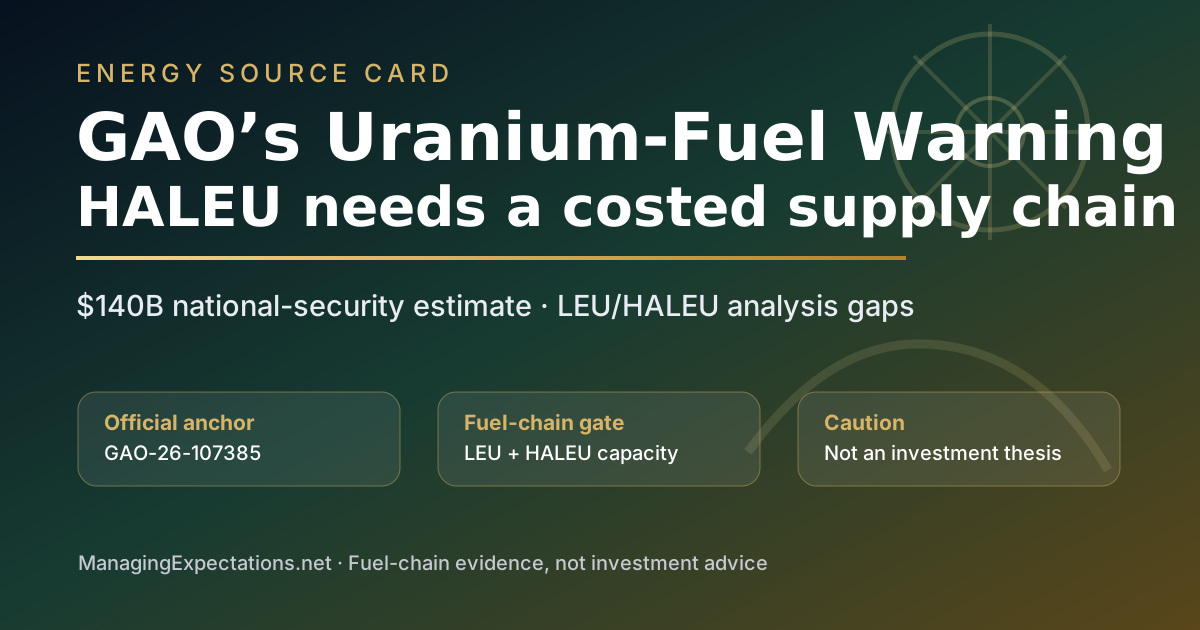
GAO says NNSA has three long-term enrichment efforts with estimated costs of about $140 billion through 2105, but had not yet reported those new estimates to Congress as required.
Commercial fuel gate
GAO says DOE awarded $900 million for LEU enrichment and $1.8 billion for HALEU capacity, but had not documented an analysis showing whether those actions are sufficient.
Expectation check
HALEU demand depends on advanced reactors being proven, licensed, ordered and deployed. Demand estimates vary; near-term supply may not meet demand.
What changed
The GAO report surfaced in this Energy Watch through current nuclear-news coverage even though the official report page is dated August 20, 2026. American Nuclear Society / Nuclear Newswire covered the report on August 25, highlighting the same oversight point: national-security and commercial nuclear-fuel efforts need clearer cost reporting and economic analysis.
GAO says NNSA is preserving enough low-enriched uranium and highly enriched uranium inventory for national-security needs until the 2040s while pursuing three long-term enrichment efforts. Those efforts carry estimated total program costs of about $140 billion through 2105. GAO says those new cost estimates had not yet been conveyed in the biennial report required by Congress.
On the civilian side, GAO says DOE awarded $900 million to one company to expand LEU enrichment for the existing commercial reactor fleet and $1.8 billion to two companies to build HALEU capacity for advanced reactors. The accountability issue is not simply the headline dollar amount. GAO says DOE did not document an analysis to determine whether its actions are sufficient to induce expansion of commercial LEU and HALEU production in the United States.
Why this matters for SMR and AI-power claims
- Fuel is a deployment gate, not a footnote. Many advanced-reactor designs rely on HALEU or specialized fuel forms that must be licensed, manufactured, transported and qualified.
- Demand estimates can be circular. If many advanced reactors succeed, HALEU demand rises; if licensing, orders or construction slip, demand falls. GAO flags that uncertainty rather than endorsing one hype curve.
- Cost reporting matters for taxpayers. If national-security enrichment programs carry century-scale costs, Congress needs the ledger before long-term options become commitments by drift.
- For data centers, mines and industrial users looking at nuclear firm power, the lesson is to ask about fuel supply, not only reactor module count or megawatts in a presentation.
Cautions
This is not proof that U.S. advanced nuclear cannot scale. It is also not proof that any listed uranium, enrichment or SMR company is a buy or sell. The verified point is narrower: GAO identified missing cost-reporting and economic-analysis documentation in federal enriched-uranium supply efforts, and DOE/NNSA agreed to outline actions in response to the recommendations.
Not investment advice: uranium, enrichment, SMR and data-center power equities can be volatile. This source card is a public-evidence note, not a recommendation to buy, sell or hold any security.
Primary and reporting sources
- U.S. Government Accountability Office — Nuclear Fuel: Actions Needed to Enhance Cost Reporting and Economic Analysis for Federal Uranium Supply Efforts (GAO-26-107385).
- American Nuclear Society / Nuclear Newswire — GAO report analyzes nuclear fuel efforts in national security and commercial sectors (trade reporting, August 25, 2026).
- DOE Office of Nuclear Energy — HALEU Availability Program (official program context).
- Managing Expectations source note and checked leads.