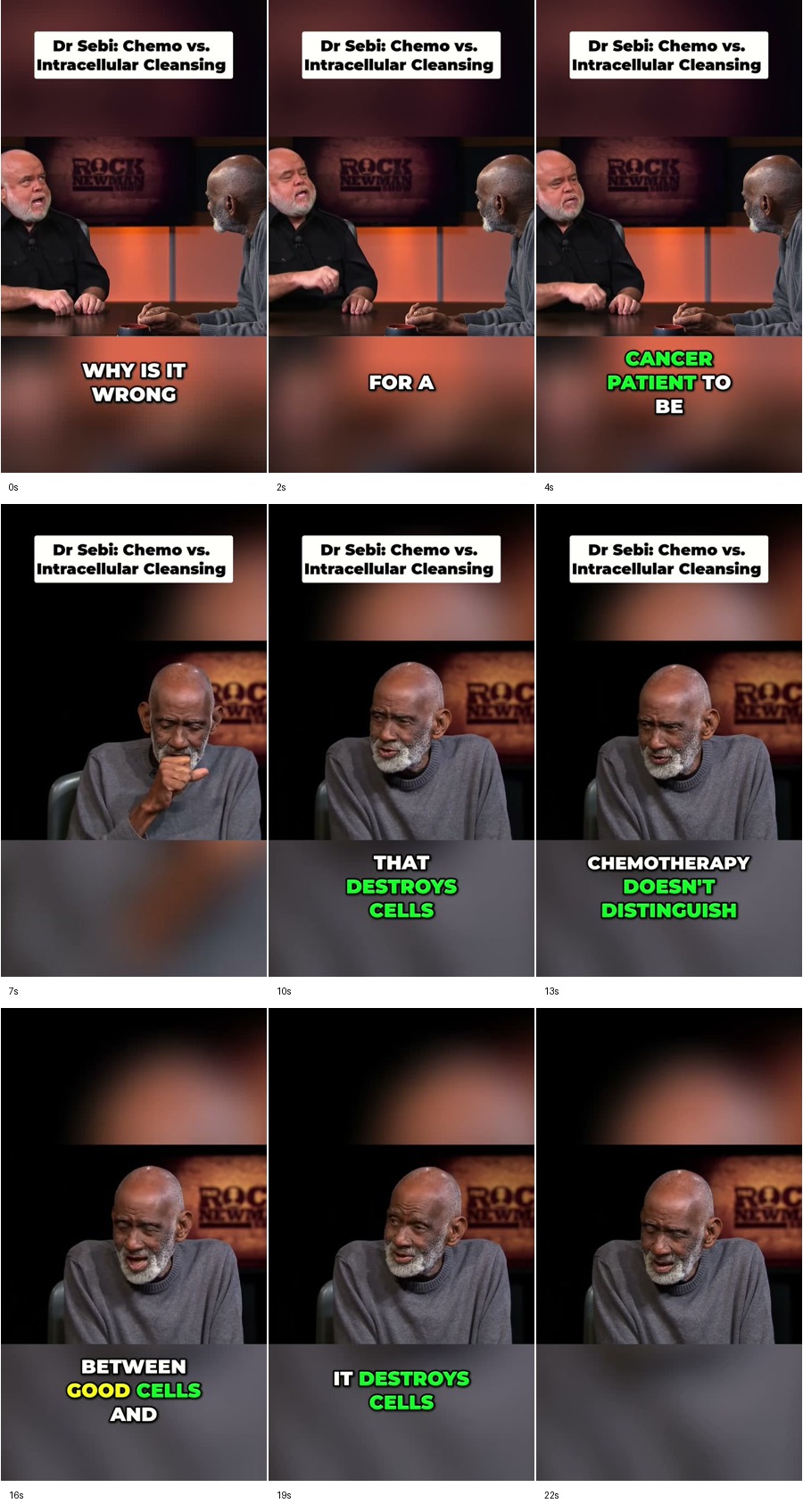
The Facebook Reel is only 27 seconds long, but it carries a whole belief system. A speaker identified on-screen as Dr. Sebi is asked whether chemotherapy is wrong for cancer patients. The answer offered is blunt: chemotherapy destroys cells, does not distinguish between good and bad cells, is an “acid approach,” and the better path is “intracellular cleansing.”
The interesting part is not only whether the medical statement is accurate. It is how the symbols work. “Chemo” becomes the image of poison. “Cleansing” becomes purity. “Inside the cell” becomes deep repair. “Dr. Sebi” becomes inherited authority. The account name — a sea moss and herb store — turns that symbolism toward a familiar wellness funnel.
Reader caution
This article is source-card media literacy, not medical advice. Do not stop, delay or replace chemotherapy, radiation, surgery, immunotherapy, targeted therapy, hormone therapy or other prescribed cancer care because of a social-media reel. Bring supplement, herb, detox, fasting, sea moss, alkaline or “cleansing” ideas to the oncology team and pharmacist before using them.
What the Reel says
The captured transcript is short:
“Why is it wrong for a, or is it wrong for a cancer patient to be treated with chemotherapy? Chemotherapy is an approach that destroys cells. Chemotherapy doesn’t distinguish between good cells and bad cells. It destroys cells. It’s an acid approach. Okay. My approach is an intracellular cleansing.”
The public Facebook metadata describes the clip this way: “Chemotherapy destroys cells indiscriminately, harming both good and bad. My approach focuses on intracellular cleansing, a gentler method for the body.”
That wording does three things at once: it names a real fear, it simplifies the medical issue, and it offers a symbolic substitute.
The real kernel: chemotherapy can harm healthy cells
The Reel is not starting from nothing. The U.S. National Cancer Institute explains that chemotherapy can kill fast-growing cancer cells and can also kill or slow the growth of healthy cells that grow and divide quickly, such as cells lining the mouth and intestines and cells involved in hair growth. That is why chemotherapy can cause side effects such as mouth sores, nausea, hair loss and fatigue.
So the honest sentence is: chemotherapy can harm some normal fast-dividing cells, and the side effects can be serious. Patients deserve clear information about benefits, risks, alternatives, side-effect prevention and symptom support.
But the Reel turns that real side-effect issue into a larger emotional picture: chemotherapy is destruction itself.
The symbolic move: chemo becomes poison, cleansing becomes innocence
“Cleansing” is one of the most powerful words in wellness media because it sounds moral before it sounds medical. It suggests that the body is dirty, blocked or polluted — and that the answer is not a difficult treatment decision, but a return to purity.
That is why “intracellular cleansing” is so persuasive as a phrase. It gives the listener a picture: the problem is hidden deep inside the cell, and the solution reaches deeper than ordinary medicine. The phrase feels precise, but the Reel does not provide a cancer type, a treatment protocol, a clinical trial, a survival endpoint, a dose, a safety profile or a comparison with standard therapy.
In other words, it works first as a symbol, not as evidence.
The “acid approach” phrase
The Reel calls chemotherapy an “acid approach.” That phrase should be treated as rhetoric, not as a medical explanation. Chemotherapy is not one thing. It is a category of drugs used in different cancers, stages, combinations and goals: cure, control, shrinkage before surgery, recurrence-risk reduction, symptom relief, or help for other treatments.
Once a complex treatment category is compressed into one image — acid — the audience is pushed toward rejection before the evidence is discussed.
The Dr. Sebi symbol
Dr. Sebi, born Alfredo Bowman, remains a strong symbol in alternative-health culture. For supporters, the name can represent natural healing, distrust of mainstream medicine, Black independent health knowledge, anti-pharmaceutical suspicion, alkaline-diet language and the promise that illness can be reversed by returning to nature.
That symbolic power matters. People often arrive at cancer content frightened, exhausted, angry, financially stressed or grieving. A confident voice saying “there is another way” can feel like mercy.
But symbolic authority is not clinical evidence. A name, a legacy, a testimonial tradition or a community memory does not by itself prove that an approach treats cancer.
The product-funnel clue
The Reel came from an account identified in public metadata as The SeaMoss and Herb Store. That does not automatically make the post false, but it changes the reader’s job. When a social post moves from a frightening medical contrast into cleansing, herbs, sea moss, minerals or detox language, the audience should ask: is this education, or is it trust-building for a sale?
Managing Expectations has seen this pattern before. A sacred or cultural symbol opens the door — bells, frequencies, ancient diets, suppressed healers, hidden remedies. Then the post pivots to detox, supplements or a protocol. The symbol creates warmth; the product inherits the trust.
What official sources say about complementary approaches
NCI and NCCIH do not say every complementary practice is worthless. Some approaches, such as acupuncture, mindfulness-based stress reduction, yoga, massage or music-based support, may help with symptoms, stress or side effects when used appropriately and safely.
But NCCIH is direct on the larger claim: no complementary health approach has been shown to prevent or cure cancer. It also warns that some complementary products can interfere with cancer treatment. NCI similarly warns that “natural” does not mean safe, and that herbs or supplements may be harmful by themselves, in high doses, or when combined with medicines.
Memorial Sloan Kettering’s integrative medicine database gives the same practical caution: the FDA does not evaluate the safety and labeling of dietary supplements before sale in the way many consumers assume, and clinical effects are often difficult to predict because human data may be limited.
Evidence labels
- Verified: The Facebook Reel exists and frames chemotherapy against “intracellular cleansing.”
- Real kernel: Chemotherapy can affect fast-dividing healthy cells, which is one reason side effects occur.
- Oversimplified: “Chemotherapy doesn’t distinguish between good and bad cells” turns a side-effect mechanism into a blanket dismissal.
- Rhetorical / symbolic: “Acid approach” and “intracellular cleansing” are not enough to describe or validate a cancer treatment.
- Unsupported: The Reel does not provide clinical evidence that “intracellular cleansing” treats cancer or improves survival.
- Marketing caution: A herb-store account using cancer-treatment language deserves extra scrutiny before the audience buys a product or protocol.
How to read this kind of Reel
When a cancer Reel uses symbolic language, ask five questions:
- What exact cancer type and stage is being discussed?
- What standard treatment is being criticized, and what benefit does it claim to offer?
- Is the alternative defined clearly enough to test?
- Are there human clinical trials showing improved outcomes, or only testimonials and metaphors?
- Is the post selling herbs, detoxes, courses, consultations, minerals, teas, sea moss or a protocol?
Primary links
- Facebook Reel: “Chemotherapy vs. Intracellular Cleansing: A New Approach”
- National Cancer Institute: Chemotherapy to Treat Cancer
- National Cancer Institute: Complementary and Alternative Medicine
- NCI PDQ: Cancer Therapy Interactions With Foods and Dietary Supplements
- NCCIH: Cancer and Complementary Health Approaches
- NCCIH: Detoxes and Cleanses
- FDA: Illegally Sold Cancer Treatments
- Memorial Sloan Kettering: About Herbs, Botanicals & Other Products
- Local source note
- Local Reel transcript
Bottom line
This Reel belongs on Managing Expectations because it shows how a symbol can outrun a source. Chemotherapy side effects are real. Cancer patients deserve better side-effect care, better explanations, and better respect. But “cleansing” is not proof, “acid” is not an oncology analysis, and a familiar alternative-health name is not a clinical trial.
The healthy expectation is not blind trust in every treatment and not blind rejection of medicine. It is disciplined hope: ask hard questions, manage side effects, check interactions, respect fear, and do not let a beautiful symbol become a substitute for evidence.
Health, Symbols & Source Cards
Continue the Managing Expectations health library: social-video claims, wellness symbolism, medical controversy, and reader-protection source notes.
Back to Health Section