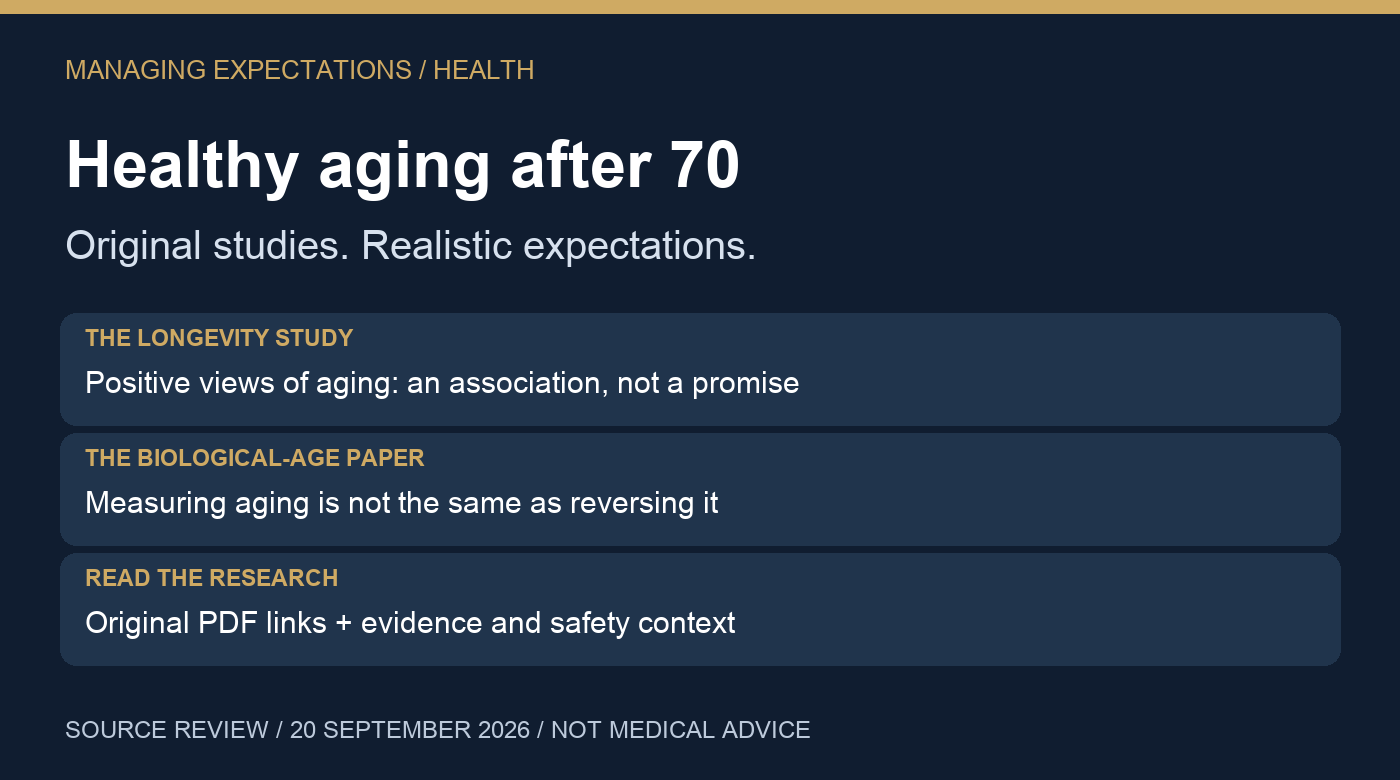
The bottom line
The video points to real aging research, including a long-running study linking more positive views of aging with longer survival. But neither that study nor the Dunedin biological-aging paper proves that a mindset change adds a fixed number of years to your life, or that the video's collection of habits reverses aging after 70. There is room for constructive action without promising a biological reset.
Watch the source video
“AGING Speeds Up After 70 — But you Can Actually Reverse it (Here's What Science Says)” was uploaded on September 19, 2026 by the channel named Dr. Aven Royce. The channel name is attribution, not independent verification of professional credentials. This review used the retrieved video metadata and English captions; the papers below, rather than the title, anchor our conclusions.
The Yale-linked study behind “7.5 years longer”
At approximately 14:56, the video introduces Becca Levy's work. The matching original paper is:
Levy, B. R., Slade, M. D., Kunkel, S. R., & Kasl, S. V. (2002). Longevity Increased by Positive Self-Perceptions of Aging. Journal of Personality and Social Psychology, 83(2), 261–270.
The researchers used the Ohio Longitudinal Study of Aging and Retirement, with 660 adults aged 50 or older. Baseline views about their own aging were linked to subsequent mortality records over roughly 23 years. More positive self-perceptions were associated with longer survival; the association remained after accounting for age, gender, socioeconomic status, loneliness and baseline functional health.
A small reporting detail matters: the abstract and publisher's announcement describe a 7.5-year survival advantage. The results section reports group median survival of 22.6 versus 15 years and calls that difference 7.6 years. This is a group survival comparison, not a prescription that gives each individual 7.5 extra years.
What it does—and does not—establish
- Supported: a prospective association between attitudes toward one's own aging and later survival in this cohort.
- Not established: causation from a randomized mindset intervention. Adjustment for measured factors does not remove every possible confounder or reverse-causation pathway.
- Not a study exclusively of people over 70: participants were 50 or older at baseline.
- Not proof that mindset beats exercise or medical care: the paper's discussion compares its result with findings from other longevity studies. It did not randomize participants to positive thinking versus exercise, cholesterol treatment or a healthy diet. The video's “in that same population” wording overstates that comparison.
Challenging ageist assumptions and staying engaged can be worthwhile without blaming people for illness, disability or a shorter life. Health also reflects disease, resources, environment and access to care—not simply attitude.
The Dunedin paper: measuring aging is not reversing it
At approximately 1:07, the video describes Daniel Belsky's research:
Belsky, D. W., et al. (2015). Quantification of biological aging in young adults. Proceedings of the National Academy of Sciences, 112(30), E4104–E4110.
- Download the original research PDF from Duke University — 21 pages including supporting material
- Journal / DOI record · Duke repository record
The analysis involved 954 members of the Dunedin birth cohort. The researchers assessed biological age at 38 and used repeated measurements of 18 biomarkers at ages 26, 32 and 38 to estimate pace of aging. Biological-age estimates at chronological age 38 ranged from 28 to 61. Faster aging was associated with poorer physical function and signs of cognitive decline.
This was observational measurement research in young adults—not an anti-aging treatment trial in older people. The estimates are model-based summaries, not a literal age stamped on every cell. Nor was this simply a DNA-methylation blood test: the work combined physiological measures across organ systems. Its own authors described the methods as proof of concept needing refinement. Changing a biomarker score is not, by itself, proof of living longer.
Where the video's practical advice needs qualification
The most defensible message is to support strength, mobility, adequate nutrition, sleep and connection. Those goals do not require accepting every proposed cellular mechanism, supplement or longevity number.
- Protein: the video presents 25–30 grams per meal as a hard ceiling beyond which protein cannot help muscle. That is too categorical. A short-term muscle-protein-synthesis response is not the same as a universal absorption or usefulness limit; needs depend on body size, activity, health and overall intake. People with kidney disease or nutritional problems need individualized advice.
- Senolytics: dasatinib is a prescription cancer medicine, not a self-directed longevity supplement. Small exploratory studies of dasatinib plus quercetin cannot establish dementia prevention or longer life. Strawberries and high-dose fisetin supplements are not interchangeable exposures.
- Fasting, cold exposure and supplements: the cited longevity studies did not test these as an aging-reversal package. A 10–12-hour eating window is not a validated individual “autophagy switch.” Restrictive eating can be inappropriate with frailty, low weight or glucose-lowering medication; abrupt cold exposure can be risky with cardiovascular conditions.
- Fatigue and memory: persistent fatigue or new cognitive changes should not automatically be attributed to aging mitochondria or “brain cleanup.” They merit clinical assessment for potentially treatable causes.
Supporting research: promising is not proven
The video's 12-person senolytic example matches Millar et al. (2025), A pilot study of senolytics to improve cognition and mobility in older adults at risk for Alzheimer’s disease (DOI). STAMINA was a 12-week, single-arm, open-label pilot in adults 65 or older with mild cognitive impairment and slow walking speed. There was no placebo control for cognitive or mobility outcomes. The whole group's 12-week MoCA change was not statistically significant; the eight-person lower-baseline-score subgroup improved by about two points. An inflammatory marker, TNF-α, decreased relative to a separate biomarker comparison group, but the biological significance was uncertain. This is a reason for larger controlled trials, not proof that the treatment prevents dementia, clears senescent cells throughout the human body or extends life.
For the protein ceiling, Trommelen et al. (2023) found a greater, longer anabolic response to 100 grams than 25 grams of protein after exercise. That experiment involved 36 healthy young men and short-term tracer measurements—not a recommendation for 100-gram meals in older adults. It does, however, contradict an absolute claim that protein above 25–30 grams is automatically wasted or stored as fat.
There is firmer intervention evidence for trainable strength in later life: Fiatarone et al. (1994), Exercise training and nutritional supplementation for physical frailty in very elderly people, tested supervised progressive resistance training in a randomized trial of 100 frail nursing-home residents. Strength and mobility improved. This supports appropriately supervised, adapted exercise—not a promise that every participant will achieve the same gains or that exercise reverses all aspects of aging.
A realistic takeaway
Work toward maintaining or improving function rather than chasing a promised age reversal: appropriately adapted strength and balance activity, sufficient food and protein, attention to sleep problems, social connection and meaningful activities. Changes should fit the person's health and abilities. Positive expectations can support engagement; they are not a substitute for treatment and are not a guarantee.
Not medical advice. Do not stop prescribed care or start dasatinib, senolytic combinations, fasting or supplements on the basis of a video. Discuss significant changes with a qualified clinician, particularly with frailty, kidney disease, diabetes or cardiovascular disease.
Sources and access
The two full original study PDFs were retrieved and checked for title, authors and readable pages. Links above point directly to the publisher or university repository; we are not relabeling an AI summary as a study or mirroring copyrighted papers without a clear republication licence. If the APA download presents a browser security check, open it in a normal browser or use the DOI/PubMed record.
- APA's original announcement of the Levy study — publisher context, not an additional trial.
- Duke's explanation of the Belsky study — includes the proof-of-concept limitation.
- Source note and retrieval details · Video metadata