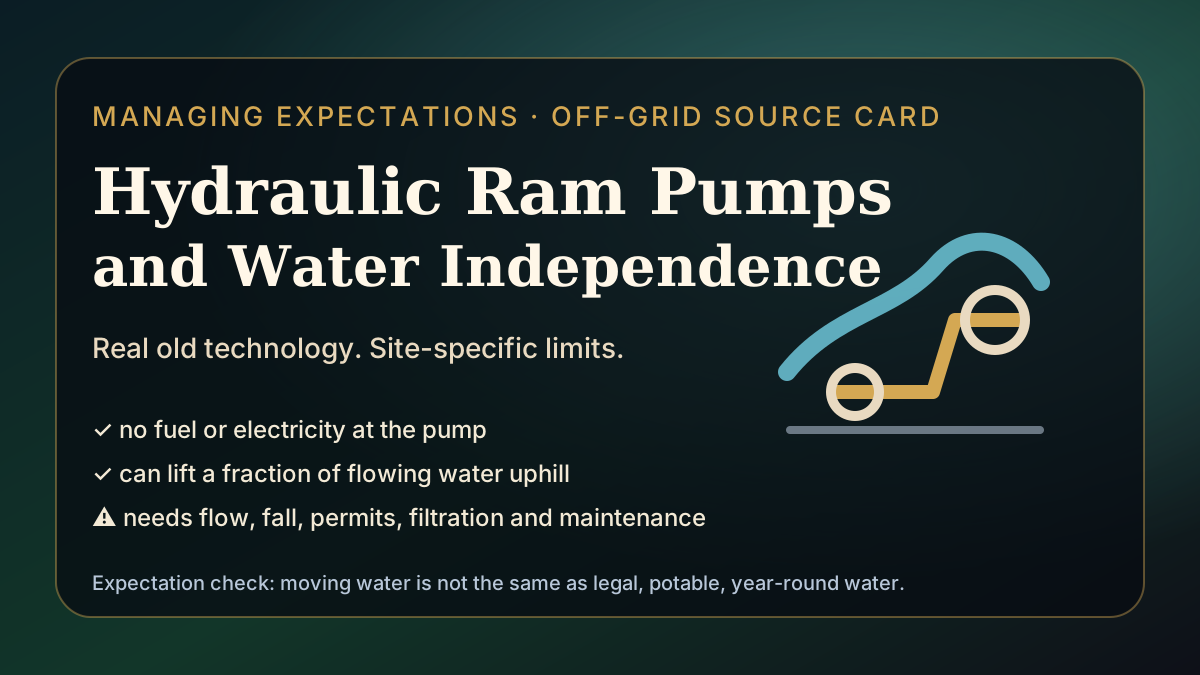
The Reel’s useful kernel is strong: a hydraulic ram pump can move some flowing water uphill without electricity or fuel. The expectation check is just as important: it needs a continuous water source, vertical drop, correct plumbing, maintenance, legal water rights and drinking-water treatment if humans will consume it.
Safety and legal caution
This is source review, not engineering design, plumbing advice, water-law advice or drinking-water approval. Before copying an off-grid water system, check local water rights, stream rules, intake work permits, plumbing codes, flood/freeze risk, neighbour impacts, filtration/disinfection and lab testing.
What the Reel says
The Facebook Reel was posted by modernruralcivilian. The caption says the account sells ram pumps and uses the hashtags #rampump, #offgrid and #water. The transcript says:
“This right here … is a production built hydraulic ram pump that was produced by a company and sold to the public back in 1911. I am obsessed with hydraulic ram due to the success that we’ve had creating water independence here on our homestead property.”
The exact 1911 product shown in the Reel was not independently verified from the clip alone. The broader claim — that ram pumps are old, real and useful for off-grid water in the right setting — is well supported.
What a hydraulic ram pump actually does
A hydraulic ram pump uses the energy of flowing water and the water-hammer effect to lift a portion of that water to a higher elevation. It does not need an electric motor at the pump. That is why ram pumps remain attractive for remote farms, homesteads and community water projects.
Engineering for Change describes the AIDFI ram pump as delivering water to higher elevation using flowing water without electricity. It says these systems use gravity from stream sources, require no electricity or fuel, and can last for years with maintenance. The key phrase is flowing water: the pump is not creating energy; it is harvesting energy from moving water and vertical head.
The expectation check
| Claim or hope | Reality check | Why it matters |
|---|---|---|
| “Free water” | No fuel or electricity at the pump, but not free of site work, pipe, valves, maintenance, intake protection or legal requirements. | Off-grid still needs engineering and stewardship. |
| “Water independence” | Possible where there is reliable flow and enough vertical fall. Not useful on flat land without a flowing source. | The land decides whether the tool fits. |
| “Pumps uphill” | Yes, but only a fraction of incoming water is delivered uphill; the rest exits as waste/discharge water. | You need enough source flow to spare. |
| “Drinkable water” | A ram pump moves water. It does not filter, disinfect or prove potability. | Surface water can carry pathogens and needs treatment/testing. |
| “Just install it” | In B.C., water use may require authorization; surface and groundwater rights are governed provincially. | Water independence must still respect water law and neighbours. |
For B.C. readers: water rights matter
The Province of British Columbia states that a water right is the authorized use of surface water or groundwater, and that all water in B.C. is owned by the Crown on behalf of residents. It says that if land contains or has access to surface water or groundwater, in most cases a person must apply to the province for the right to use the water and pay an annual rental fee.
That does not make off-grid water impossible. It means the honest planning question is not only “Can I make the pump work?” It is also: “Can I legally divert this water, where does the discharge go, what happens in drought, and what does the intake do to the stream?”
For drinking water: moving is not treating
Health Canada’s water-quality materials point readers to Canadian drinking-water guidelines and microbiological hazards such as Giardia, Cryptosporidium, enteric viruses, E. coli and total coliforms. A ram pump can be part of a water system, but the drinking-water system still needs appropriate treatment, storage protection and testing.
Practical checklist before copying the Reel
- Do you have a reliable flowing source year-round?
- Is there enough vertical drop between intake and pump to drive the system?
- How high and how far must water be delivered?
- Is the source flow enough after accounting for discharge/waste water?
- Are water rights, stream work, intake screening and local permits handled?
- Will the system freeze, clog with debris, flood, or run dry seasonally?
- If used for household drinking, what filtration, disinfection and testing will be used?
- Who maintains valves, gauges, seals, drive pipe, intake and delivery lines?
Bottom line
Hydraulic ram pumps are not fantasy. They are one of the better examples of “old technology” that can still matter: simple, mechanical, durable and powered by the landscape itself.
But the real lesson is not “buy a pump and become independent.” It is: match the tool to the land, the law and the water-quality plan. A ram pump can reduce dependence on grid power. It cannot remove the need for good design, clean water and responsible use.
Source links
- Original Facebook Reel share link
- Local transcript of Reel audio
- Local public metadata extract
- Hydraulic ram overview
- Engineering for Change: AIDFI Ram Pump
- Province of B.C.: Water licensing and rights
- Health Canada: Water quality guidelines and technical documents
- Local source note
Grow shelf
Back to Farming & Gardening for source-aware notes on food, water, soil, homesteading and practical experiments.
Back to Grow