Energy / uranium / fuel security / hyperscalers / data-center firm power
Hyperscalers Are Asking About Uranium: Fuel Security Signal, Not a Purchase Order Yet
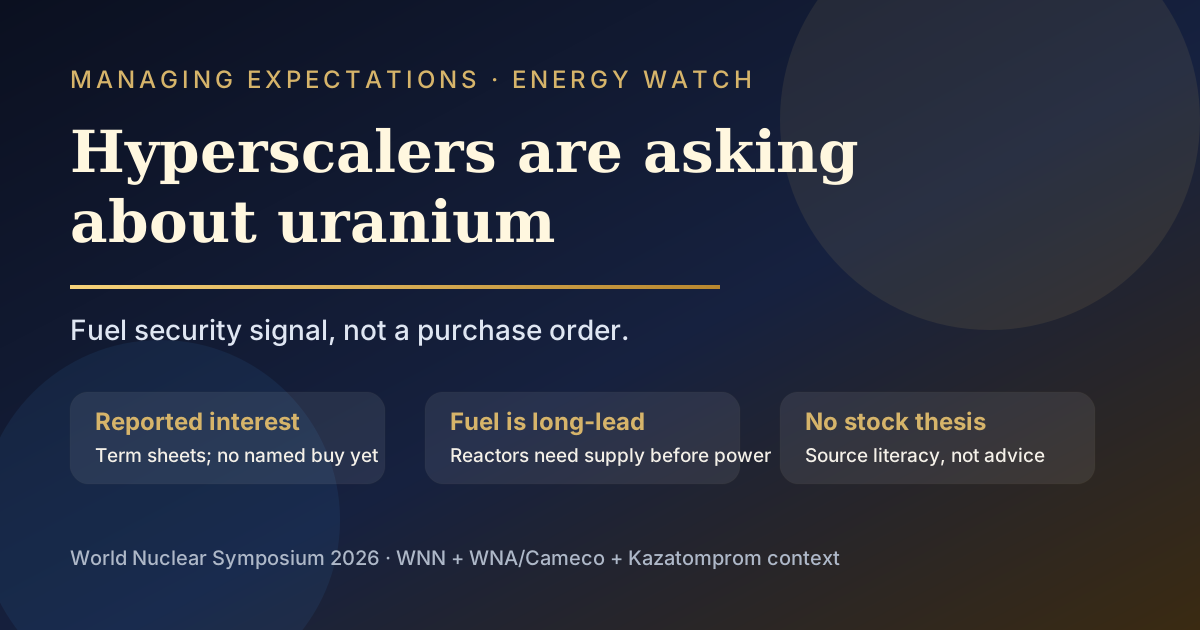
The newest useful Energy-watch signal is not another headline saying AI needs power. It is one layer deeper: uranium executives are now talking publicly about hyperscalers asking whether fuel itself should be part of their long-term firm-power strategy.
That matters because a nuclear data-center plan is not only a reactor, a site and a power purchase agreement. It also depends on uranium, conversion, enrichment, fabrication, transport, regulatory approvals and contracted delivery windows. The public evidence still has a hard boundary: the fresh reporting supports interest and term-sheet discussion. It does not show that Google, Amazon, Microsoft, Meta or any other named hyperscaler has bought uranium directly.
Verified reporting signal
World Nuclear News reported September 11 that Cameco's Cory Kos said big-name hyperscalers are “poking around” uranium term sheets, while adding that “nobody's bought anything yet.”
Fuel-cycle context
World Nuclear Association's Cameco interview frames uranium as a long-lead item that should be planned at the start of new nuclear buildout, not after reactors are announced.
Expectation check
Kazatomprom's official H1 2026 materials show production and sales guidance context, but not a hyperscaler purchase or new Western reactor-delivery proof.
What changed
World Nuclear News, reporting from World Nuclear Symposium 2026 in London, quoted Kazatomprom Chief Strategy and International Development Officer Dastan Kosherbayev as saying Eastern uranium appetite is strong enough that Kazatomprom could have sold its entire production volume into the East and still seen more demand. The same article says roughly half of Kazatomprom's annual sales go to what it calls the East, with the rest almost evenly split between Europe and the United States.
The new hyperscaler angle came from Cameco's Vice President, Investor Relations and Communications, Cory Kos. WNN reported him saying a few big-name hyperscalers are looking at uranium term sheets, but “nobody's bought anything yet.” His explanation is practical: if a technology company may end up owning a reactor, contracting with a nuclear operator, buying nuclear electricity through a PPA, or relying on grid nuclear supply, it may also start asking whether fuel security belongs in the planning file.
That is a different evidence class from a power deal. Google and Fortum's Loviisa PPA, covered here last week, was a signed electricity offtake agreement. Centrus and Radiant's HALEU contract was a named fuel-supply agreement for a microreactor developer. This item is earlier: a market-behaviour signal from executives at major uranium producers.
Why it matters for the Energy watch
- Data-center nuclear demand is moving upstream. The conversation is no longer only about megawatts; it is beginning to touch uranium availability and fuel-cycle timing.
- Fuel can become a bottleneck before reactors operate. Uranium, conversion, enrichment and fabrication are long-lead supply chains, especially for advanced-reactor fuels.
- For Canada and uranium districts, the strategic question is whether Western buyers contract early enough to support reliable supply rather than assuming supply will appear later.
- For mining and market readers, this is a source-backed watch signal, not proof of a commodity shortage, price target, or equity thesis.
Cautions
Do not overstate the hyperscaler claim. The reported quote says some large technology names are looking, not that they have bought uranium. No named purchase, delivery volume, counterparty, price or fuel form is disclosed in the source trail checked for this article.
Do not flatten uranium into reactor deployment. A uranium strategy does not prove an SMR will be licensed, built, fuelled or connected to a data center. The hard evidence gates remain signed contracts, regulator filings, fuel-service arrangements, construction progress, operating licences and delivered megawatt-hours.
Not investment advice: uranium producers, uranium developers, nuclear fuel companies, SMR developers, utilities and AI/data-center power narratives are volatile. This source card is evidence-literacy and infrastructure research, not a recommendation to buy, sell or hold any security, commodity or token exposure.
Primary and reporting sources
- World Nuclear News — Uranium companies see new chapter for the market (trade reporting from World Nuclear Symposium 2026, September 11, 2026).
- World Nuclear Association — Cameco: Delivering the Next Phase of Nuclear Growth (company-controlled interview, updated August 27, 2026).
- Kazatomprom — Kazatomprom announces 1H2026 Financial Results (official company release, August 21, 2026).
- Kazatomprom — Operating and Financial Review, six months ended June 30, 2026 (official PDF).
- World Nuclear Association — World Nuclear Power Reactors & Uranium Requirements (standing reference table and caveats).
- Managing Expectations source note and checked leads.