Not medical advice
This article is a source review, not dosing guidance and not a recommendation to use ivermectin for cancer, Alzheimer’s disease, Parkinson’s disease, prevention, or any other off-label purpose. Do not take veterinary/horse ivermectin paste. Cancer and neurodegenerative disease decisions should be made with qualified clinicians.
The claim being checked
The X post promotes an ivermectin “full dosage schedule for cancer and prevention,” naming Dr. William Makis and listing low, medium, high and very-high daily doses. The video itself is a speaker discussing alleged success with ivermectin for Parkinson’s and Alzheimer’s disease, including anecdotal reports of improved mobility, memory and recognition after low or high doses. The thumbnail also shows a “horse paste” protocol graphic.
Embedded source lead
IVERMECTIN: FULL DOSAGE SCHEDULE FOR CANCER & PREVENTION
— Ivermectin Research Hub (@Ivermectin_hub) July 28, 2026
1000s of people use Dr. William Makis MD’s IVERMECTIN dosing chart. Here’s a clear, categorized breakdown based on body weight (mg/kg per day).
LOW DOSE: ≤ 0.5 mg/kg/day
**Best for:**
- Cancers in remission
-… pic.twitter.com/9RBEaU5ipX
Evidence label
| Claim area | What the studies show | Evidence label |
|---|---|---|
| Ivermectin has anticancer mechanisms | Reviews and many cell/animal studies report effects on proliferation, apoptosis, autophagy, PAK1/KPNB1 pathways, drug resistance and tumor microenvironment. | Real preclinical signal. |
| Ivermectin is a proven cancer treatment | Major reviews still say clinical evidence is sparse. A 2025 gynecologic-cancer review explicitly cautions against using ivermectin as treatment. | Not proven. |
| Published human cancer outcomes exist | A 2026 prospective observational cohort reported patient-reported outcomes for ivermectin + mebendazole through a telemedicine platform, but it was not randomized and has an expression of concern noted on PubMed. | Interesting but weak/contested human evidence. |
| Ovarian cancer support | Ovarian papers are mainly cell-line/proteomic/mechanistic work. The 2025 gynecologic review says clinical studies are limited and strongly cautions against use. | Lab signal, no established clinical regimen. |
| Parkinson’s support | PubMed has mouse-model and dopamine/P2X4 pathway papers. These do not prove clinical reversal in people. | Preclinical neuroscience signal only. |
| Alzheimer’s support | The searched PubMed trail did not reveal a strong human Alzheimer’s ivermectin treatment study matching the video’s anecdotal claims. | Anecdotes not verified as clinical evidence. |
| Horse-paste megadose schedule | FDA/MedlinePlus warn against animal products and large doses; FDA label dosing for approved parasitic indications is far lower and condition-specific. | High-risk unsupported protocol. |
The supporting research pulled
The strongest pro-ivermectin literature is not the dosing meme. It is the drug-repurposing literature: laboratory and animal studies suggesting ivermectin may affect cancer-relevant pathways. The 2020 review in Pharmacological Research describes multiple antitumor mechanisms across cancer cells and notes that ivermectin can reverse multidrug resistance and may work better in combination with chemotherapy drugs in experimental settings. But that same review states there had been no clinical trials of ivermectin as an anticancer drug at the time and that major mechanism and dosing questions remained.
For ovarian/gynecologic cancer, the 2020 EPMA Journal paper is a molecular/cell-line study. It is not a human treatment trial. The most important counterweight is the 2025 Gynecologic Oncology Reports review, which says the data on ivermectin as a gynecologic cancer-fighting compound is lacking, clinical studies are limited to cell-line effects, safety and efficacy in gynecologic cancers have not been assessed, and the authors do not recommend and strongly caution against ivermectin use in treatment.
For Parkinson’s, PubMed includes a 2020 mouse-model paper on macrocyclic lactones ivermectin and moxidectin and rotational behaviour, plus a P2X4/dopamine paper where ivermectin enhanced levodopa-induced motor behaviour in an experimental model. That is worth studying, but it is not a clinical protocol and it does not validate the video’s anecdotal “reversal” claims.
For Alzheimer’s, the public-source trail located here did not support the video’s strongest claims. The transcript says a preclinical Alzheimer’s abstract exists and is “scrubbed from Google.” In this pass, the located biomedical trail does not establish a human Alzheimer’s ivermectin treatment effect. Treat those Alzheimer’s claims as anecdotal until the exact paper and full context are identified.
Safety and dosing concerns
The thumbnail’s horse-paste graphic is the biggest red flag. MedlinePlus/FDA warn that animal ivermectin products are not substitutes for human prescriptions and can seriously harm people. FDA also warns that large doses can be dangerous. The official Stromectol label describes approved human use for certain parasitic conditions and includes warnings about serious neurologic reactions in particular contexts, drug interactions and increased bioavailability with a high-fat meal.
The X caption’s suggested daily cancer doses, especially high and very-high dose categories, should not be treated as a safe public protocol. “No long-term side effects reported” is not the same as proven long-term safety, especially for cancer patients who may be older, on chemotherapy, anticoagulants, steroids, seizure medications, immune therapies or other interacting drugs.
Managing expectations
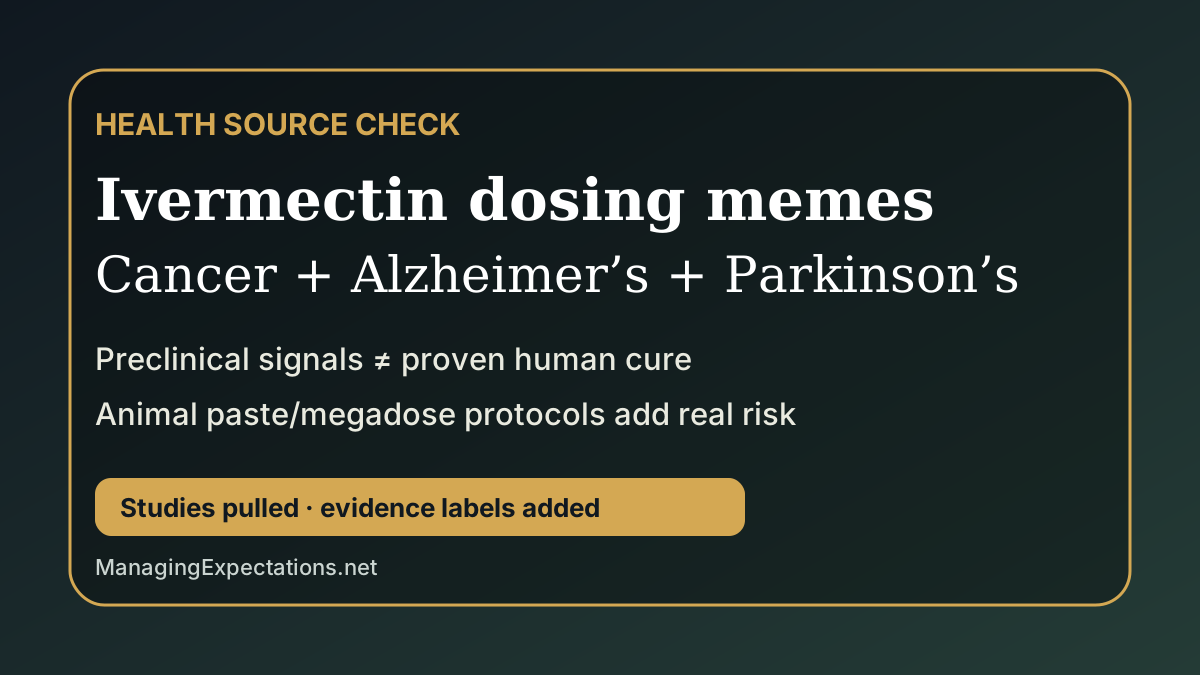
The honest conclusion is neither “ivermectin is fake” nor “ivermectin cures cancer.” The honest conclusion is: ivermectin has real biology and real preclinical research interest. It does not have enough high-quality human evidence to justify viral cancer/prevention dosing charts, and animal-paste protocols are especially unsafe as public advice.
- Original X post from Ivermectin Research Hub
- Review: Ivermectin, a potential anticancer drug derived from an antiparasitic drug
- Gynecologic Oncology Reports review: Ivermectin and gynecologic cancer — what’s the data?
- Ovarian cancer cell-line/mechanism paper
- 2026 prospective observational cohort: ivermectin + mebendazole in cancer patients
- ClinicalTrials.gov: ivermectin + balstilimab trial record
- Parkinson’s mouse-model paper: ivermectin/moxidectin rotational behaviour
- P2X4/dopamine paper mentioning ivermectin modulation
- FDA label for Stromectol ivermectin tablets
- MedlinePlus: Ivermectin drug information and animal-product warning
- FDA consumer warning: animal ivermectin products and large doses
Open the full source note and captured transcript.