Real progress—not one cure for every cause of blindness
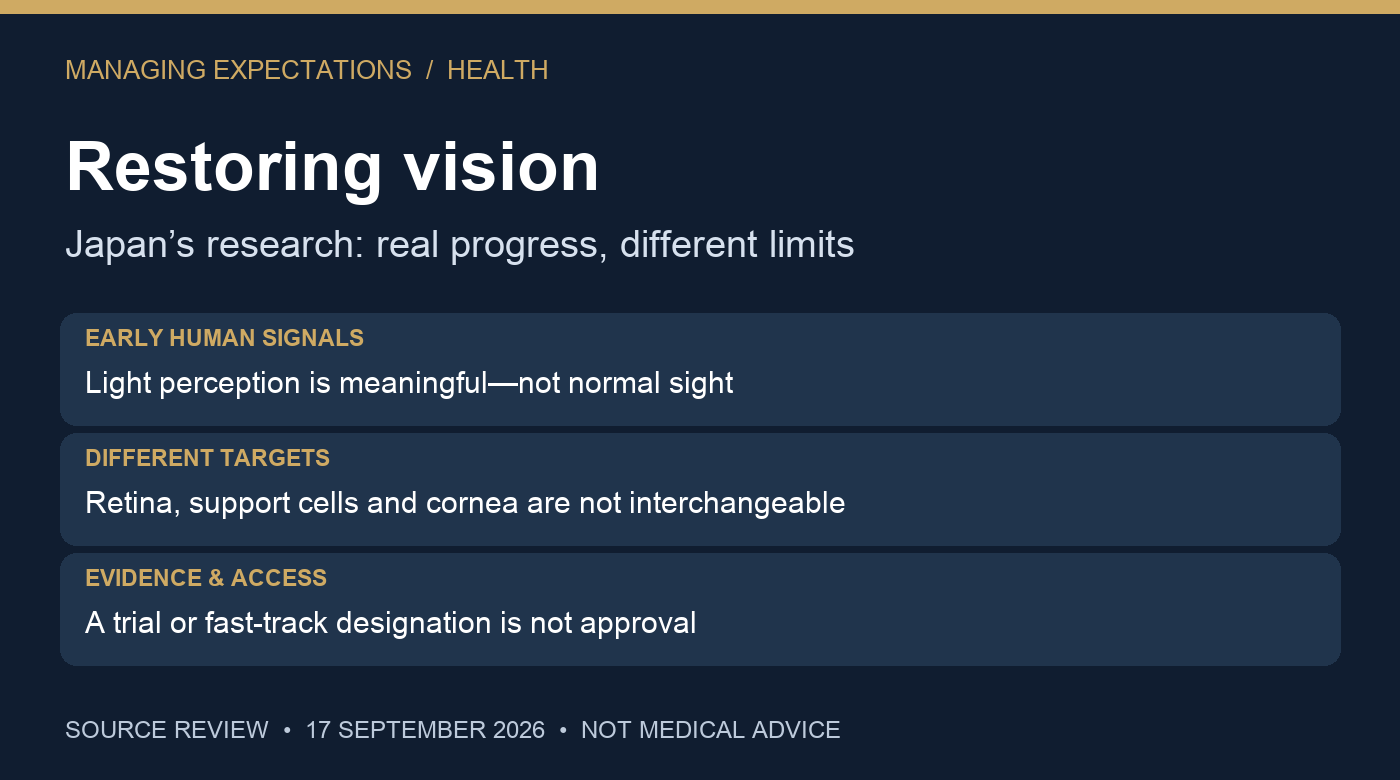
The video points to genuine Japanese research in optogenetic gene therapy, retinal support-cell transplants, retinal organoids, corneal repair and light-sensitive implants. Some approaches have encouraging early human results. Others remain principally supported by animal studies. None of that means normal sight has been restored to everyone, or that all the treatments are approved and available.
The distinction matters: recovering light perception can be meaningful, but it is not the same outcome as reading, recognizing faces or driving.
Watch the source video: Polarisyn →
1. RV-001: three high-dose patients regained light perception in an early trial
Restore Vision’s May 1, 2026 announcement is real. It reported interim Phase 1/2 results from six participants with advanced retinitis pigmentosa, divided into two dose cohorts of three. The sponsor said all three high-dose participants progressed from no light perception to light perception or better within one month. One achieved visual acuity measurable on the Berkeley Rudimentary Vision Test. In the low-dose cohort, one participant reached light perception at approximately three months. [1]
The company reported no dose-limiting toxicity or drug-related serious adverse events in that interim analysis, with follow-up out to 168 days. That does not mean every participant completed the same follow-up, that there were no possible risks, or that long-term safety is established.
The Japanese registry, jRCT2033240611, identifies an open-label, uncontrolled, single-arm trial with dose-limiting toxicity as the primary endpoint. Its updated target is 45 participants; six is the interim group, not the entire planned trial. This is an encouraging sponsor-reported signal, not yet a large randomized demonstration of restored useful vision. [2]
RV-001 aims to make surviving retinal neurons light-sensitive using a chimeric-rhodopsin gene. “Gene-agnostic” means the strategy does not depend on correcting one particular causal mutation. It does not establish success for every mutation, every patient or every cause of blindness. The registry targets non-syndromic retinitis pigmentosa, not cataracts, optic-nerve destruction or all retinal diseases.
The video also overstates the commercial meaning of a manufacturing partnership. Forge Biologics’ July 21 announcement concerns development and manufacturing for clinical-trial supply. It explicitly describes RV-001 as investigational and not approved by any regulatory authority—not a treatment already entering ordinary commercial use. [3]
2. iPSC-derived RPE: an important transplant milestone, not a whole new retina
The 2014 Japanese milestone involved retinal pigment epithelium, or RPE: a supporting cell layer beneath the light-sensing retina. It was not transplantation of a complete eye or an entire functional retina. The research led by Masayo Takahashi and colleagues was later reported by Mandai and colleagues in the New England Journal of Medicine. At one year, the transplanted sheet remained intact and measured visual acuity was unchanged. That was important feasibility and safety work, not proof of recovered normal sight. [4]
A later five-recipient study used banked, HLA-matched donor-derived iPSC-RPE cells. Grafts survived through the one-year observation period without abnormal growth. The phrase “without immunosuppressants” needs qualification: the study avoided systemic immunosuppressive medication but used local steroids, and it reported suspected or mild ocular immune reactions and other adverse events. This was not a guarantee that donor tissue cannot be rejected. [5]
3. Retinal organoids and DSP-3077: graft survival is not proven wiring into human vision
A two-patient Japanese study reported stable survival of transplanted iPSC-derived retinal organoid sheets over two years. It was a real step toward replacing lost retinal tissue. But the video moves too quickly from animal evidence of host–graft connections to language suggesting confirmed functional connections in the human recipients. The human findings do not establish that conclusion. [6]
The later posted trial-registry results are especially important. Follow-up through 208 weeks reported no immune rejection or unexpected tissue overgrowth, but no improvement in ETDRS visual acuity in either participant. One case showed a local retinal-sensitivity signal at the graft site; that is not equivalent to demonstrated overall visual recovery or established functional integration. [7]
DSP-3077 is a related investigational retinal-sheet programme. Sumitomo Pharma America announced in August 2026 that its first participant had received treatment in a U.S. Phase 1/2a study. The registry, NCT06891885, describes a planned 12-participant, open-label, uncontrolled study focused on safety and tolerability. It schedules visits through month 60 and additional long-term safety collection in years 6–15. The sponsor also reports U.S. orphan designation. Neither permission to conduct a trial nor orphan designation is marketing approval or proof of efficacy. [8]
4. Osaka’s corneal sheets: a different disease with promising small-study results
The cornea is the clear front surface of the eye; it is not the retina. The Osaka study treated four patients with limbal stem-cell deficiency using iPSC-derived corneal epithelial sheets. In the 2024 Lancet report, all four treated eyes had better corrected distance visual acuity, reduced corneal opacity and improved disease stage at 52 weeks compared with baseline. [9]
No tumour formation, clinical rejection or serious adverse events were observed during two years, but non-serious adverse events did occur. The study was small, nonrandomized and uncontrolled; its results cannot rule out uncommon or delayed harm. The first two patients received low-dose cyclosporine, while the latter two did not. This is promising evidence for a specific corneal condition—not treatment of retinitis pigmentosa or every form of vision loss.
5. OUReP: light-sensitive film, with animal evidence—not a verified low-cost human cure
Okayama University researchers Toshihiko Matsuo and Tetsuya Uchida developed OUReP, a photoelectric dye-coupled polyethylene film intended for implantation beneath the retina. It produces electrical potential in response to light and is designed to stimulate surviving retinal cells without a separate camera or battery. This is a real engineering programme. [10]
Peer-reviewed experiments include visual-response findings in retinal-degeneration rat models and recovery of visual-evoked-potential signals in a monkey model over months of observation. Those are preclinical findings. A brain response to a flash in an animal is not proof that an implanted person can read, recognize faces or navigate independently. [11]
Older university and research descriptions discuss preparation for a first-in-human trial. We did not locate verified published human outcome data establishing OUReP’s efficacy in this review. An exact-name ClinicalTrials.gov search also returned no records, but that is not an exhaustive search of every Japanese registration or alternative device name. Low-cost materials may be an advantage; a validated patient price, affordability and long-term human performance remain unestablished.
6. MCO-010: accelerated development and an application under review are not approval
MCO-010 belongs to Nanoscope Therapeutics. It is separate from Restore Vision’s RV-001; Nanoscope’s study called RESTORE should not be confused with the company Restore Vision.
Official Japanese documents confirm pioneering regenerative-product and orphan regenerative-product designations dated January 16, 2026 for MCO-010 in inherited retinal dystrophy with severe vision loss. Those designations support development and review. They are not permission to market the treatment. [12]
There is a newer development than the video’s January milestone: Nanoscope announced on September 9, 2026 that the U.S. FDA had accepted and filed its biologics licence application for MOGENRY, the proposed MCO-010 product. That is a company-reported filing milestone, not an approval. Its announcement still uses “if approved.” We did not independently retrieve an FDA acceptance letter. [13]
Three corrections that change the overall story
- Different technologies, different conditions. RPE support cells, retinal neurons and corneal surface cells have different jobs. Outcomes cannot be pooled into one “blindness cure.”
- Not everything in the video is an iPSC therapy. Optogenetic gene delivery and a photoelectric plastic implant are distinct approaches; they are not simply the same stem-cell discovery packaged differently.
- Eye treatment did not begin with these programmes. Luxturna already has U.S. approval for a specific biallelic RPE65-associated retinal dystrophy, with viable retinal cells required under its label. It is a narrow, established indication—not a cure for all inherited vision loss. [14]
What this means for someone losing vision
The most useful next step is a precise diagnosis from an ophthalmologist or retinal specialist. For inherited retinal disease, ask whether genetic testing, an existing approved option or a registered trial fits the actual condition. A promising study in advanced retinitis pigmentosa does not automatically apply to glaucoma, corneal injury or age-related macular degeneration.
Gene delivery, ocular surgery and cell transplantation each carry risks, including inflammation, infection, immune reactions and procedure-related damage; long-term graft behaviour and durability still need follow-up. Absence of a serious adverse event in a small cohort does not prove absence of risk. Do not delay established care or purchase internet “vision drops” or unregulated stem-cell procedures because a video promises a universal cure. Sudden new vision loss warrants urgent medical assessment.
The reasonable expectation is hopeful but specific: several credible research paths are advancing, and some patients have achieved meaningful early benefits. The questions remain which patients benefit, how much vision returns, how long it lasts, what risks emerge and whether regulators ultimately authorize a particular treatment.
Sources and research trail
- Restore Vision, May 1, 2026 interim announcement; full sponsor release.
- Japanese trial registry: RV-001, jRCT2033240611.
- Forge/Restore Vision development and clinical-supply partnership.
- Mandai et al., NEJM 2017: Autologous Induced Stem-Cell–Derived Retinal Cells for Macular Degeneration.
- Sugita et al., 2020: HLA-Matched Allogeneic iPS Cells-Derived RPE Transplantation; open-access paper PDF.
- Hirami et al., 2023: Safety and stable survival of stem-cell-derived retinal organoid for two years.
- Japanese organoid study registry and later posted outcomes, jRCTa050200027.
- Sumitomo first-patient announcement; DSP-3077 trial registry.
- Soma et al., Lancet 2024: iPSC-derived corneal epithelium first-in-human study; DOI.
- Okayama University: photoelectric-film retinal prosthesis—older development account, not a current approval notice.
- OUReP monkey visual-evoked-potential study; RCS-rat visual-response study.
- PMDA pioneering-designation list; MHLW orphan regenerative-product notice, hosted by Saitama Prefecture.
- Nanoscope’s September 9 BLA-filing announcement—sponsor disclosure, not an FDA approval notice.
- FDA: Luxturna; prescribing-information PDF.
Capture notes and limitations · Six-program evidence ledger · Original supplied video link