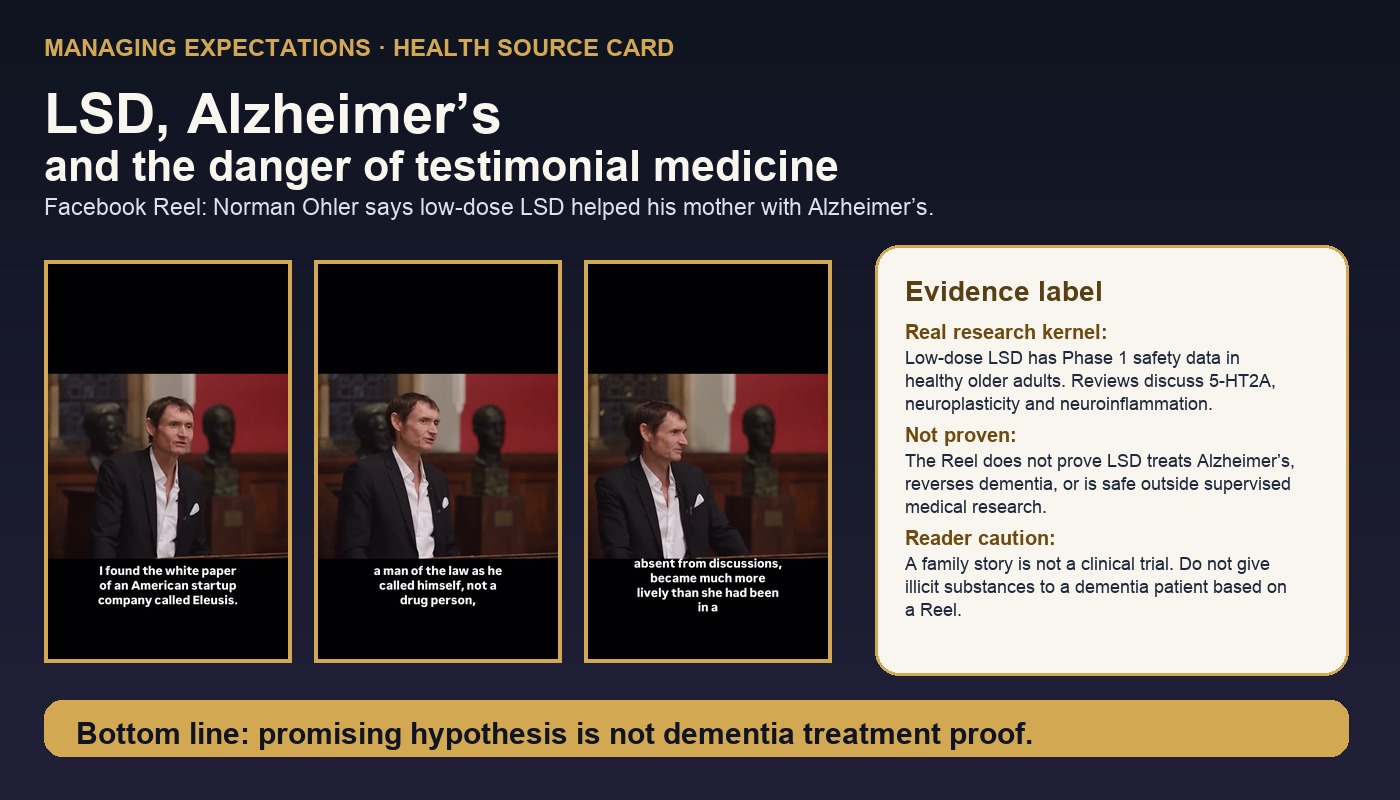
The Facebook Reel is persuasive because it is intimate. Norman Ohler says he found an Eleusis white paper, showed his retired-judge father research suggesting LSD might regenerate receptors involved in dementia, and then watched his mother — who had Alzheimer’s — become more lively after a microdose.
That kind of story should not be mocked. Families living with dementia are desperate for moments of return. But this is exactly where Managing Expectations has to slow the claim down: an emotional family observation is not the same thing as clinical evidence.
Reader caution
This article is source-card media literacy, not medical advice. LSD is a controlled substance in many places and is not an approved Alzheimer’s treatment. Do not give LSD, psilocybin, 5-MeO-DMT or any psychedelic substance to a person with dementia because of a social-media Reel. Dementia patients can be medically fragile, may be taking interacting medicines, and may not be able to consent safely outside a supervised clinical setting.
What the Reel says
The captured transcript says Ohler found the white paper of an American startup company called Eleusis; that the company had done clinical trials with LSD; and that he understood the study to suggest LSD regenerates “the very same receptors in the brain that degenerate when you have dementia.” He then describes a family microdosing experience in which his mother became more lively, spoke better, picked up a newspaper and read headlines.
“My mother who had been more and more absent from discussions became much more lively than she had been in a long time, could suddenly speak much better … Her cognitive abilities were enhanced.”
The Facebook caption makes the same claim in a stronger promotional form: it says his father called the experience “a medicinal miracle” and points readers to the full Oxford Union talk.
The real research kernel
There is real scientific interest here. A 2020 Psychopharmacology Phase 1 study tested repeated very low doses of LSD — 5, 10 and 20 micrograms every fourth day — in 48 healthy older volunteers with a mean age of about 63. The study reported that low-dose LSD was well tolerated over 21 days, with no higher adverse-event frequency than placebo, and stated that the results support further clinical development for Alzheimer’s prevention or treatment research.
That matters, but it is not the same as showing benefit in Alzheimer’s patients. The participants were healthy older adults. The trial was about safety, tolerability, pharmacokinetics and dose response, not whether LSD improved dementia outcomes.
Reviews since then have explored possible mechanisms: serotonin 5-HT2A signalling, neuroplasticity, neuroinflammation, mitochondrial function and related pathways. A 2024 review in Ageing Research Reviews called psychedelics a therapeutic possibility worth exploring for Alzheimer’s-related dementia. A 2026 Neuroscience paper described hallucinogenic therapy for Alzheimer’s as a hypothesis-generating model, while stating that clinical efficacy in Alzheimer’s remains limited and largely preclinical.
What is not proven
The Reel’s strongest leap is turning “there is a plausible mechanism and early safety research” into “this worked for my mother.” A single family observation cannot show whether the change came from LSD, expectation, attention, setting, day-to-day fluctuation, sleep, medication timing, placebo response, temporary stimulation, or the well-known unpredictability of dementia symptoms.
ClinicalTrials.gov searches found psychedelic-related dementia research, including a recruiting psilocybin trial for depression in people with mild cognitive impairment or early Alzheimer’s disease. That is important, but it is not a completed LSD Alzheimer’s efficacy trial and it is focused on depression symptoms, not proof of disease reversal.
There is also a safety gap. Dementia patients are often older, medically complex and more likely to be on multiple drugs. Psychedelics can affect perception, anxiety, blood pressure, behaviour and judgment. A controlled research protocol is different from a family deciding to experiment at home.
Evidence labels
- Verified: The Reel exists and publicly identifies the speaker as Norman Ohler discussing LSD, Eleusis, his mother and Alzheimer’s.
- Supported kernel: Low-dose LSD has Phase 1 safety/tolerability research in healthy older adults, and reviews discuss possible mechanisms relevant to neurodegeneration.
- Not established: The reviewed record does not prove LSD treats Alzheimer’s, reverses dementia, regenerates patient cognition, or is safe for home use in dementia.
- Clinical-trial context: Psychedelic dementia-adjacent trials exist, but the public record reviewed here did not show a completed LSD Alzheimer’s efficacy trial.
- Media-literacy caution: A moving testimonial can point toward a research question, but it should not become a treatment instruction.
How to read this kind of health Reel
- Ask whether the study involved patients with the disease or only healthy volunteers, animals, cells or mechanisms.
- Separate safety/tolerability from efficacy. “Well tolerated” does not mean “treats Alzheimer’s.”
- Separate symptoms, mood and attention from disease modification.
- Check whether the trial was registered, randomized, placebo-controlled, and powered for meaningful outcomes.
- Do not turn a family story into a dosing protocol.
Primary links
- Facebook Reel: Norman Ohler on LSD and Alzheimer’s
- PubMed: Low-dose LSD safety/tolerability in healthy older volunteers
- PubMed: Psychedelics as a Treatment for Alzheimer’s Disease Dementia
- PubMed: Psychedelics for Alzheimer’s disease-related dementia review
- PubMed: Hallucinogenic therapy in Alzheimer’s disease targeting mitochondrial-associated membranes
- ClinicalTrials.gov: Psilocybin for depression in MCI or early Alzheimer’s disease
- Local source note
- Local Reel transcript
- Download the shareable PDF research brief
Bottom line
The disciplined expectation is this: LSD and related psychedelics are a real research frontier for brain aging, mood, inflammation and neuroplasticity. That makes the subject worth following. But the Reel’s testimonial does not prove an Alzheimer’s treatment, and it should not be converted into home experimentation with a vulnerable person.
Hope should be allowed to ask new questions. It should not be allowed to skip the evidence.
Health Source Cards
Continue the Managing Expectations health library: social-video claims, wellness symbolism, medical controversy, and reader-protection source notes.
Back to Health Section