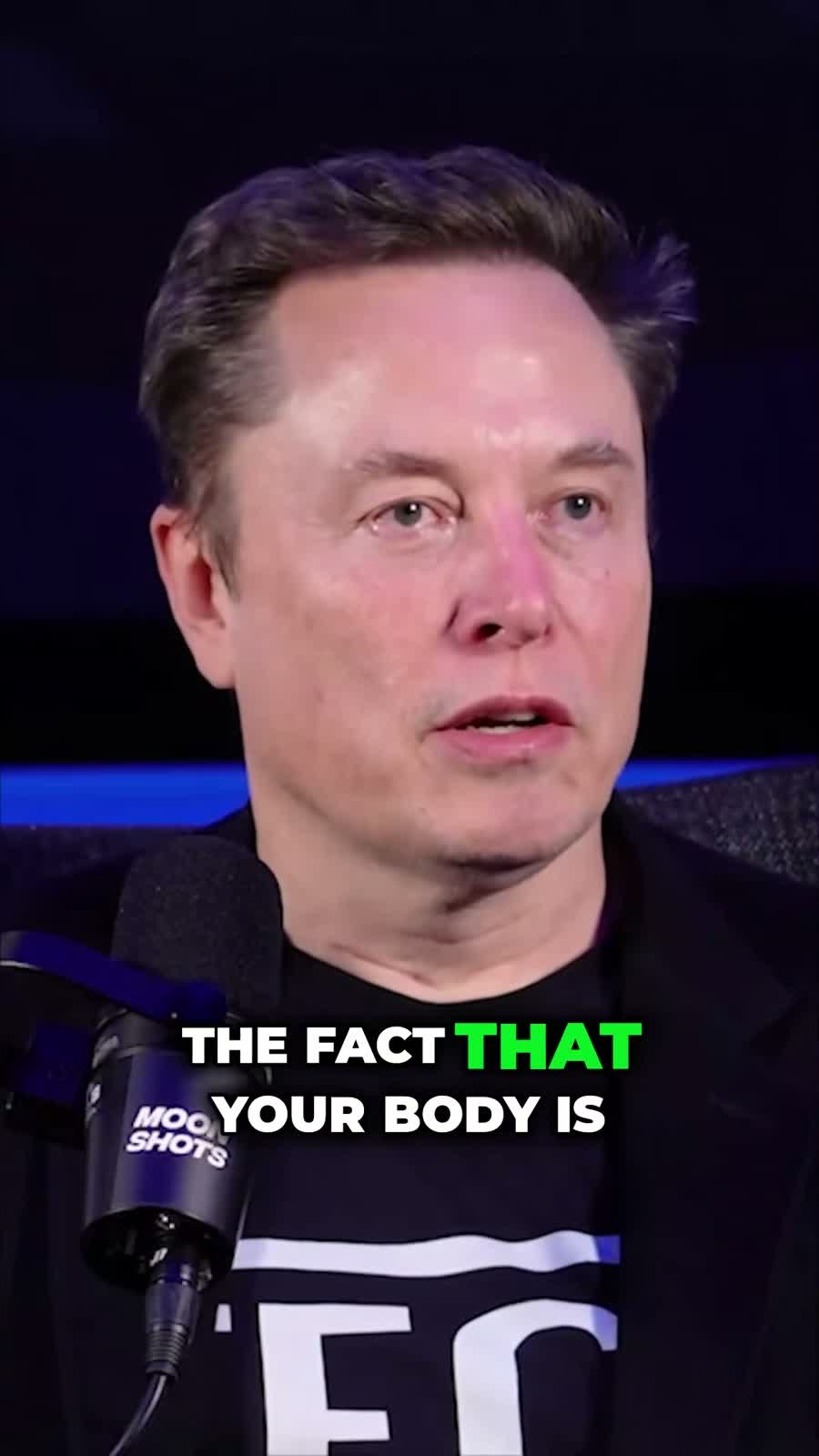
Chris sent a TikTok from Future Shock AI presenting an Elon Musk-style interview clip about aging. The clip asks why the body seems to age in sync — “nobody has an old left arm and a young right arm” — then frames aging as a “program to die” that could be changed. The strongest Managing Expectations reading is: real biology, real long-lived animal examples, but a speculative software metaphor.
Medical caution
This is source review and science-literacy commentary, not medical advice, diagnosis, treatment guidance, biohacking protocol, supplement guidance or a recommendation to pursue experimental longevity interventions. Gene therapy, cellular reprogramming and anti-aging medicine belong in qualified clinical and regulatory settings.
What the TikTok claims
The visible TikTok caption says the body may age according to a biological clock, that aging might be a program that could potentially be rewritten, and that animals such as the Greenland shark show nature can produce lifespans far beyond humans. The transcript includes: “Nobody has an old left arm and a young right arm,” “if you change the program, you will live longer,” and “the important thing is not to die from something stupid before the solutions come.”
The social post is a short motivational edit. It does not provide the full interview, a study citation, a clinical-trial result, or proof that a near-term human age-reversal solution exists.
What is real
There really are measurable biological-age signals. DNA methylation clocks, including Steve Horvath’s multi-tissue clock, can estimate age-related patterns across many human tissues. More recent multi-omics work also suggests human aging is not perfectly linear; some molecular changes cluster around particular life periods.
There are also genuinely long-lived animals. Bowhead whales can live for more than 200 years, and a 2016 Science paper used eye-lens radiocarbon dating to estimate that Greenland sharks can live for centuries, with the oldest animals estimated around 392 years with wide uncertainty and sexual maturity possibly not reached until about 150 years.
What the software metaphor gets wrong or overstates
Calling aging a “program to die” is a metaphor, not settled biology. Aging is influenced by genetic regulation and epigenetic patterns, but also by DNA damage, cancer risk, immune changes, metabolism, protein quality control, senescent cells, mitochondrial dysfunction, tissue wear, infection history, environment and random events.
The body’s parts often age together because they share the same genome, blood chemistry, hormones, immune system, nutrition, stress signals and environment. That does not prove there is one master kill-switch. In fact, different tissues can age differently, and disease can make one organ biologically older or more damaged than another.
What would count as proof
To turn the TikTok’s claim into medicine, researchers would need more than a persuasive analogy. They would need reproducible interventions that improve hard clinical outcomes — healthier organs, lower disease risk, preserved function and longer healthy lifespan — without unacceptable cancer, immune, developmental or off-target risks.
That is why the practical label remains cautious: aging clocks and longevity biology are real; broad human age-reversal software is not yet proven.
Evidence labels
- Verified: The TikTok exists and was posted by Future Shock AI under a longevity / Elon Musk framing.
- Verified: Biological-age clocks and epigenetic aging research are real scientific fields.
- Verified: Bowhead whales and Greenland sharks are examples of unusually long-lived vertebrates.
- Claim / metaphor: Aging is a “program to die” that can be rewritten like software.
- Not established by the TikTok: A near-term, safe, approved human solution that broadly reverses aging.
Primary links
- TikTok: Future Shock AI clip on Elon Musk and aging clocks
- Genome Biology 2013: DNA methylation age of human tissues and cell types
- Nature Aging 2024: Nonlinear dynamics of multi-omics profiles during human aging
- Science 2016: Eye-lens radiocarbon dating and Greenland shark longevity
- Cell Reports 2015: Insights into longevity from the bowhead whale genome
- Local source note and transcript excerpt
Bottom line
The clip is useful as a doorway into real longevity science, but the correct public takeaway is not “humans are about to hack death.” It is: biology contains clocks, species differ dramatically in lifespan, and partial reprogramming is a serious research frontier — but aging is not yet a simple software bug with a proven fix.
Health Papers, Studies & Films
Continue the source library for health papers, studies, documentaries, interviews, and medical controversies.
Back to Health Section