Reviewed 2026-09-23 · Assistive communication, clinical evidence and patient questions.
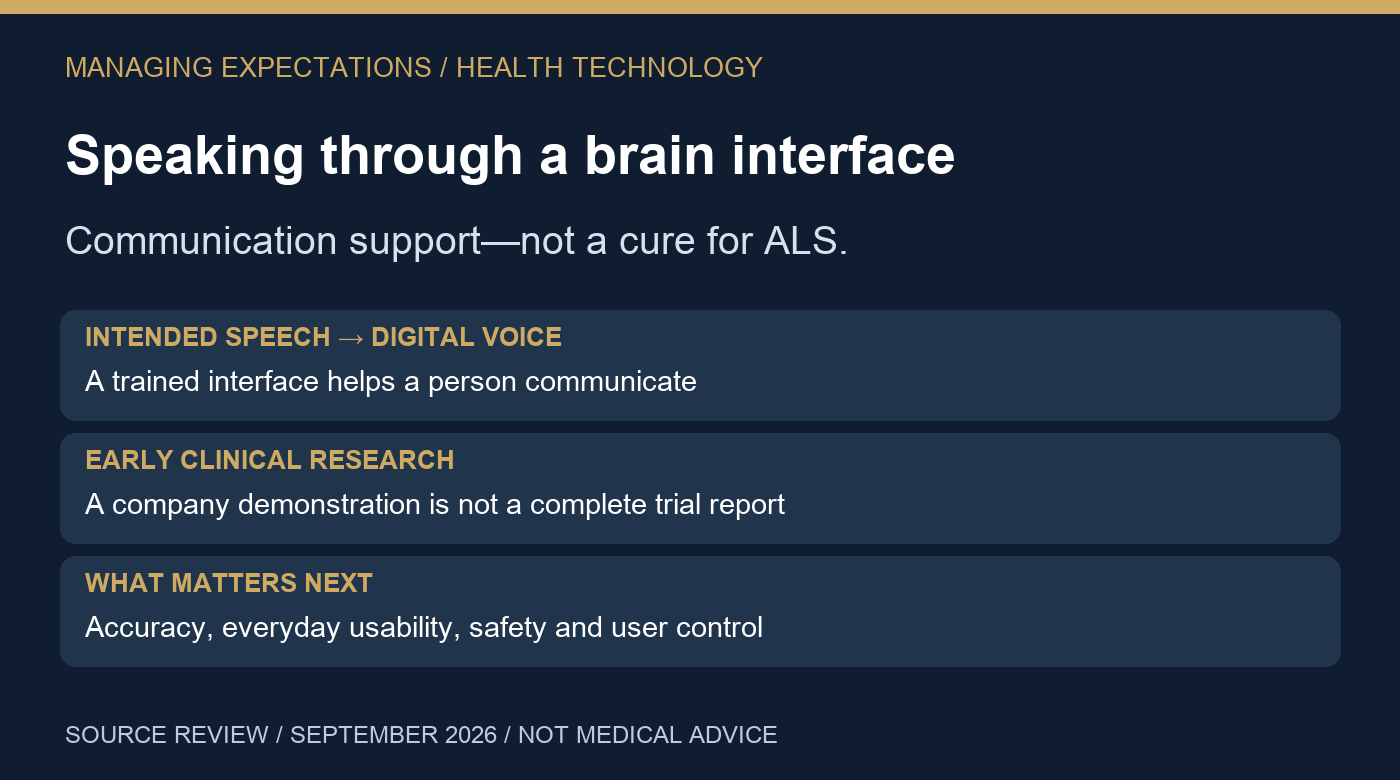
A man with ALS using a brain implant to tell his wife “I love you” is more than an attention-grabbing technology clip. It points to a deeply practical goal: helping someone remain part of a conversation when their speech is becoming difficult to understand. The promising part is real assistive communication—not evidence that ALS has been cured or that a computer can read every private thought.
The supplied Deeplearn HQ Short, uploaded September 23, 2026, summarizes Neuralink’s official September 18 film, “Speaking With The Mind.” This expanded review checks that source against the VOICE trial record and independent speech-interface research, then asks what patients and families still need to know.
The short answer
- Confirmed source: Neuralink publicly presented Terry as a voluntary participant in its speech-restoration research.
- Company-reported capability: the system translates signals associated with intended speech into communication, with reconstructed voice output.
- Not established by the video: long-term benefit and safety for a broad patient population, unrestricted thought reading, an ALS cure or routine access to an approved product.
What Terry’s demonstration actually establishes
According to Neuralink’s description, Terry was diagnosed with bulbar-onset ALS in 2024. He can still move his mouth and body, but his speech has become difficult for loved ones to understand. Describing him simply as someone with no ability to speak loses that important clinical distinction.
The official film identifies him as the third participant in the VOICE study—not the third person ever to receive any Neuralink implant. It shows training with prompted sentences, decoded communication and a computer speaking aloud. These are meaningful demonstrations, but the film is company-produced and edited. It is not a complete clinical outcomes report.
September 18 is the verified publication date of the official video. The reviewed material does not establish Terry’s exact implantation date, so the Short’s “just placed a chip” wording should not be treated as a precise surgical timeline.
From brain signals to a familiar voice
At a useful conceptual level, there are three components:
- Recording: implanted electrodes detect activity associated with speech-related brain processes.
- Decoding: a model trained with the participant maps those signals to intended communication.
- Output: a computer renders text or audible speech, potentially using a synthetic version of the participant’s familiar voice.
Neuralink’s September 18 company post says Terry first trained by miming speech and then by thinking the words. It credits Grok Voice for the voice output. The official YouTube description gives the same training progression. Those are company statements about this demonstration, not independently audited performance measurements.
“His own voice” here means a reconstructed or synthetic voice delivered through a speaker. It does not mean the implant repaired his vocal muscles or reversed the underlying neurodegeneration. Nor should a voice-generation brand be assumed to perform every part of neural decoding: the complete production architecture and its performance have not been established by the Short.
The film’s captions describe a button used to release speech aloud during a shown session. That is a useful example of user control, not proof that every system mode has the same safeguard. Details matter: intended-speech decoding, the timing of output and the ability to correct or cancel a message are different engineering questions.
What the VOICE trial is measuring
The official registry record is NCT07224256: VOICE, an early feasibility study of a robotically implanted brain–computer interface for communication restoration. Neuralink Corp is the sponsor.
- Design: single group, open label; estimated enrollment of six. This is not a randomized comparative efficacy trial.
- Primary outcomes: the proportion of participants with device-related and procedure-related adverse events at 12 months.
- Longer follow-up: adverse events and preliminary speech performance up to 48 months, including monthly maximum correct words per minute.
- Public status: the record retrieved September 23, 2026 lists recruitment, with no posted results. Its last posted update is November 4, 2025, so the estimated enrollment is not a verified current count of implanted participants.
- Schedule: estimated primary completion October 2028 and study completion October 2031. These are registry estimates, not promised dates for approval or public availability.
Neuralink’s speech-restoration page gives an eligibility overview. The fuller registry specifies ages 22–75, severe speech impairment and impaired upper-limb function associated with ALS, primary lateral sclerosis, spinal cord injury or stroke, communication in English and a stable caregiver, among other requirements. It does not accept healthy volunteers. Actual eligibility requires a trial team’s assessment; meeting a website description does not establish acceptance or expected benefit.
Neuralink states that its devices are investigational and have not been approved by the FDA or other regulatory authorities. Permission to conduct a study is not the same as authorization to market an implant as an established treatment.
What independent, peer-reviewed research adds
Speech-restoration research did not begin with this Neuralink announcement. The studies below offer important context—but their performance figures are not Terry’s results and are not measurements of Neuralink’s system. They use different electrodes, decoders, tasks and participants.
2024: accurate speech-to-text followed by a personalized voice
Card and colleagues’ New England Journal of Medicine study described one man with ALS and severe dysarthria using an intracortical speech neuroprosthesis. Attempted speech was decoded into text, then rendered through text-to-speech software resembling his pre-ALS voice.
After further training, the authors reported approximately 97.5% word accuracy over an 8.4-month period. He used the system for self-paced conversations at approximately 32 words per minute, accumulating more than 248 hours of use. The earlier 99.6% result concerned a small, 50-word vocabulary; it should not be presented as the result for unrestricted conversation.
This is evidence of useful communication in a person—not merely a laboratory model. Its limits matter too: one participant, continuing calibration, residual speech movements and researcher assistance to connect and start the system. The paper cautioned that durability as ALS progresses and results in other people were uncertain.
2025: streaming a voice instead of waiting for a whole sentence
Littlejohn, Cho and colleagues’ Nature Neuroscience study used recordings from a cortical-surface array in one woman with severe paralysis after a brainstem stroke. The decoder synthesized speech in 80-millisecond increments, aiming to reduce the pauses that interrupt conversation.
The study and its published performance figure distinguish a general-vocabulary task from a constrained 50-phrase communication task. Task design, speed and accuracy differ. Eighty milliseconds is the decoding chunk size, not a blanket claim that every thought becomes correctly spoken audio in 80 milliseconds. The paper’s offline continuous-decoding demonstrations should also not be confused with an already-proven, always-on everyday product.
2025: expression, intonation and a more demanding accuracy test
Maitreyee Wairagkar and colleagues’ Nature study demonstrated direct voice synthesis, changes in intonation and short melodies in the same ALS participant studied in the 2024 NEJM paper. These are not two independent patient cohorts.
In a six-choice sentence-matching test, listeners achieved a mean score of 94.34%. In a harder test requiring listeners to transcribe speech without a menu of answers, the median word-error rate was 43.75%. Reporting only “94% accurate speech” would conceal that difference. The authors described synthesized speech as often, but not consistently, intelligible.
Together these studies show why the field is exciting—and why a single headline accuracy number is inadequate. A system that produces text accurately, one that streams audible speech quickly, and one that preserves expression may solve different parts of the communication problem.
The missing measurements in Terry’s case
The official film, company post, speech-restoration page and retrieved VOICE registry do not provide a Terry-specific word-error rate, tested vocabulary size, correct-words-per-minute result, latency distribution, session denominator or long-term adverse-event rate. This is a statement about the sources reviewed, not a claim that no such data exist anywhere.
Those gaps cannot be filled by borrowing a BrainGate result, another Neuralink participant’s cursor-control record or a count of recording channels. Meaningful follow-up would report:
- Accuracy on new, self-chosen messages—not only practiced or prompted phrases.
- Typical conversational speed, correction burden and performance across good and bad days, not only a monthly maximum.
- How much training and caregiver or technician assistance is required.
- Whether performance persists as disease, fatigue or neural signals change.
- All relevant device- and procedure-related adverse events, including events in participants who do not feature in promotional videos.
- Comparisons with the person’s best available non-implant communication system and measures of independence and quality of life.
Canadian research access is a different question
UHN’s November 20, 2024 announcement identified Toronto Western Hospital as the Canadian surgical site for CAN-PRIME, with Health Canada authorization to begin recruitment. That study concerns safety and initial functionality for people with quadriplegia to control external devices.
The separate CAN-PRIME registry, NCT06700304, currently lists recruitment, with a last posted update of May 31, 2025. It is not the VOICE speech-restoration protocol. The reviewed VOICE record identifies a United States study site at UT Southwestern in Dallas. Shared implant and robot names do not establish that Terry’s speech intervention is routinely available in Canada.
For a Canadian patient or family, the sensible next step is to discuss communication needs with the treating ALS or neurological team and read the precise trial criteria. A registry listing, an overseas video or an expression of interest does not guarantee eligibility, an implant, insurance coverage or benefit.
Safety, support and the right to control one’s voice
An implanted interface entails surgery, device dependence, calibration and ongoing support. The important safety discussion is not simply whether a person can produce a sentence. It includes the risks of implantation and possible removal, how hardware and software failures are handled, what happens if the interface stops working, and who maintains it after the trial.
VOICE’s primary focus on adverse events is a reminder that safety is still being evaluated. No posted adverse-event results does not mean no adverse events occurred. Similarly, the FDA’s explanation of its Breakthrough Devices Program makes clear that faster development or review does not remove the requirement to meet safety and effectiveness standards for marketing authorization. Designation, permission to investigate and authorization to sell are different steps.
The demonstration concerns speech a participant deliberately intends to communicate. It does not establish unrestricted access to memories or every private thought. That is not a reason to dismiss privacy concerns: neural recordings, decoded words and a recognizable synthetic voice can all be sensitive.
Neuralink’s patient-registry privacy notice, last updated March 27, 2025, says joining the registry is not trial enrollment and is not a prerequisite for later participation; a separate consent document is required for research participation. The notice describes collection of contact, demographic and medical information, sharing with relevant research teams and service providers, and uses of anonymized information. It is a notice for the interest registry, not a complete account of every implanted participant’s neural-data or voice-model consent terms.
Before joining a study, patients deserve clear answers: Who may access or reuse neural recordings? Can data train other AI systems? Who controls a personalized voice model? Can an unwanted output be cancelled or corrected before it is spoken? What does withdrawal mean for retained research records, the implant and future communication support? These are questions for consent and oversight—not allegations that a particular company has misused someone’s data.
Communication support available without waiting for a brain implant
The ALS Association’s communication guidance recommends early work with a speech-language pathologist. Options can include communication boards, typing, speech-generating devices, switch access, head tracking and eye-gaze systems, depending on the person’s abilities and preferences.
Voice banking and message banking can preserve a personal synthetic voice or recordings of meaningful phrases. An implant is not required for those approaches. No single option fits everyone, and funding and access vary by location. Existing assistive communication should not be delayed because an investigational implant might become more widely available.
Hope without a treatment promise
This is health-technology research coverage, not medical advice or an enrollment recommendation. A device that restores useful communication can be valuable without curing ALS. Decisions about implants, trial participation and assistive technology belong with the person, their chosen supporters and qualified clinical teams.
Bottom line: Terry’s demonstration is a meaningful, company-reported example of the direction speech interfaces are taking. Independent peer-reviewed studies support the broader scientific possibility. They do not supply Neuralink’s missing clinical metrics, establish broad long-term safety or make an investigational device a routine treatment.
Watch the original demonstration
Neuralink’s official film, “Speaking With The Mind,” was published September 18, 2026. It is a company-produced account featuring a voluntary trial participant—not a peer-reviewed clinical outcomes report.
Open the official demonstration on YouTube · Watch the supplied Deeplearn HQ Short
Useful moments in the official film
Approximate caption-based navigation points, not performance measurements.
- 2:12 — Terry identified as the third VOICE participant
- 3:39 — Decoder training explained
- 4:22 — Shown button-to-speaker workflow
- 6:26 — Family communication demonstration