Friedrich Nietzsche belongs in Voices because he forces one of the hardest expectation-management questions: what happens after the old framework breaks? Not after a bad day. Not after one disappointment. After the shared moral architecture of a civilization loses authority and people are left with freedom they may not be mature enough to carry.
Source-card caution
This article uses a social reel as the prompt, not as the authority. The factual anchors are Nietzsche’s biography, his published works, and reputable philosophy references. The famous Turin horse story is treated as a widely repeated episode with symbolic power, but not every detail is as firm as the basic fact of his January 1889 collapse.
The social lead
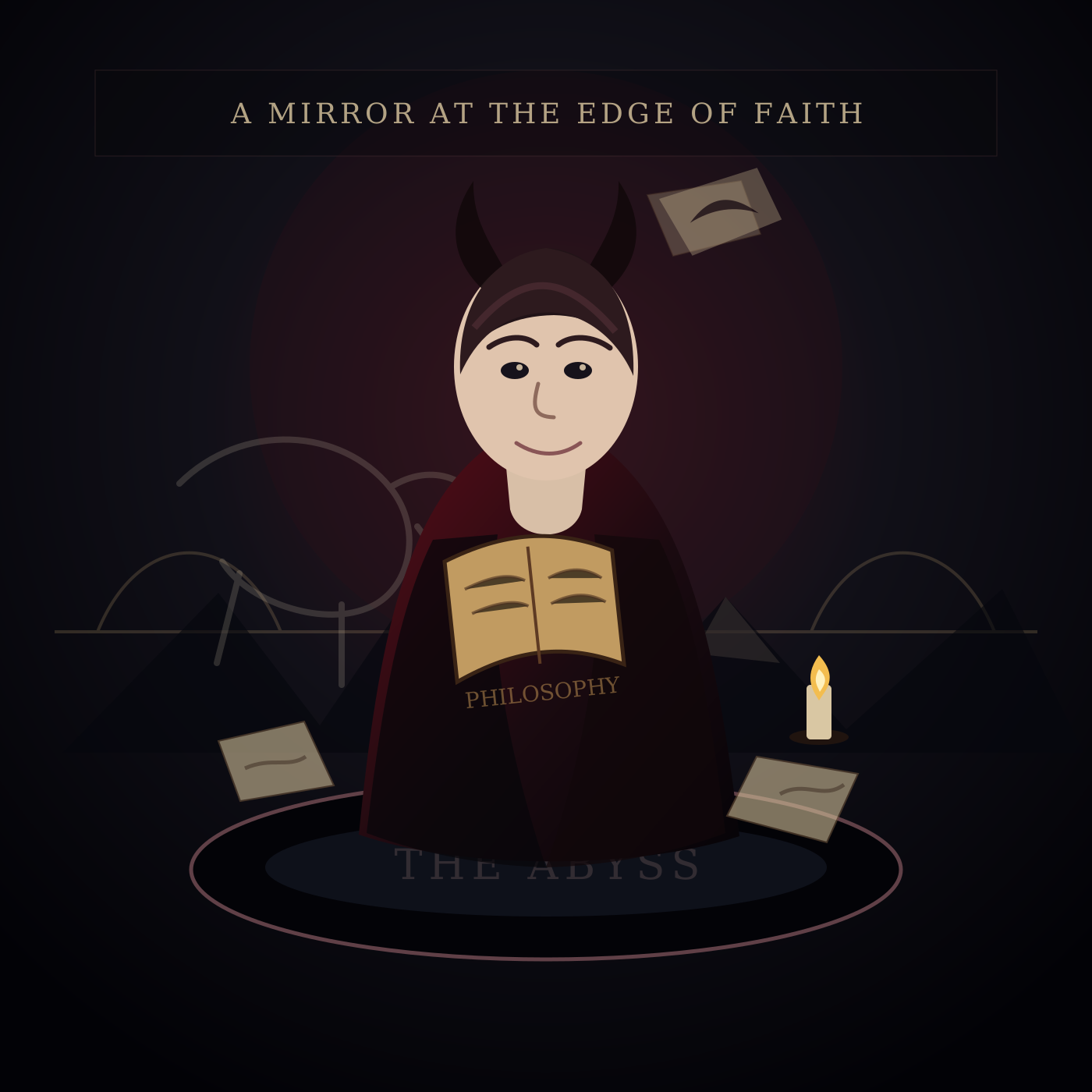
The Instagram reel shared for this note presents a short moral reflection on Nietzsche: the Turin horse story, the monster-and-abyss aphorism, and the warning that fighting darkness can deform the person doing the fighting. That is the right doorway into Nietzsche — but it is not enough to know the doorway. The useful work is to understand the life and the warning behind it.
- Social lead: Instagram reel about Nietzsche and the abyss
- Local source note: Captured source trail and editorial caveat
A life built for brilliance, loneliness and rupture
Friedrich Wilhelm Nietzsche was born on October 15, 1844, in Röcken, near Leipzig, in what was then Prussia. His father was a Lutheran minister. When Nietzsche was still a child, his father died, and the family moved to Naumburg. He grew up in a household dominated by his mother, grandmother, aunts and younger sister Elisabeth. That early mixture — religious inheritance, grief, discipline, education and loneliness — mattered.
Nietzsche was not an internet-style rebel. He was first a scholar. He studied classical philology: ancient languages, texts and cultures. His talent was so striking that in 1869, at age 24, he was appointed to a chair in classical philology at the University of Basel. The Stanford Encyclopedia of Philosophy notes that he was the youngest ever appointed to such a post there. Before he became the symbol of cultural rebellion, he was an academic prodigy.
His first major book, The Birth of Tragedy (1872), already showed the tension that would define him. It was not a cautious academic monograph. It was a bold, controversial interpretation of Greek tragedy, music, culture and decline. It also revealed the influence of Richard Wagner, whose artistic force initially captivated Nietzsche. Later, Nietzsche would break with Wagner, partly over nationalism, decadence, anti-Semitism and what Nietzsche saw as theatrical surrender to the very cultural sickness he wanted to overcome.
The body as battlefield
Nietzsche’s life was not only intellectual. It was medical, physical and painful. He suffered recurring headaches, nausea, eyesight problems and severe periods of illness. By 1879, his health forced him to resign from Basel. That resignation ended his formal academic career, but it opened the decade of writing that made him Nietzsche.
From then on he lived restlessly, often moving between Switzerland, Italy and France, searching for climates that might reduce his suffering. He wrote in aphorisms because the form suited both his method and his condition: sharp fragments, compressed diagnoses, lightning strikes rather than a single cathedral system.
His mature works include Daybreak, The Gay Science, Thus Spoke Zarathustra, Beyond Good and Evil, On the Genealogy of Morality, Twilight of the Idols, The Antichrist and Ecce Homo. These are not easy books. They are experiments in suspicion: suspicion toward morality, religion, metaphysics, pity, resentment, truth-claims, herd thinking, and even the hidden motives inside noble language.
“God is dead” was not a bumper sticker
Nietzsche’s most famous phrase, “God is dead,” appears in The Gay Science and echoes through Thus Spoke Zarathustra. It is often flattened into an atheist slogan. That misses the force of it.
Nietzsche was not simply saying, “I do not believe in God.” He was diagnosing a civilizational event: the belief in the Christian God had become unbelievable for much of modern European culture, yet the moral and psychological structure built on that belief still remained. In other words, people wanted Christian moral inheritance without Christian metaphysical authority.
That creates a dangerous gap. If the old foundation no longer commands belief, what supports value? What makes truth worth telling? What makes compassion more than preference? What prevents power from becoming the final argument? What gives suffering meaning?
For Managing Expectations, “God is dead” is not a triumph cry. It is a collapse warning.
Nihilism: the expectation after the floor disappears
Nihilism is what happens when the inherited answers die but no stronger answer has been built. Nietzsche saw this as one of Europe’s great coming problems. A person can live through a private version of the same crisis: the divorce, the diagnosis, the betrayal, the institutional failure, the loss of faith, the moment when an identity no longer works.
The immature response is to replace the lost god with a smaller god: ideology, tribe, resentment, money, attention, revenge, purity, victimhood, romantic obsession or total cynicism. Nietzsche’s question is harder: can a human being become strong enough to create values instead of merely inheriting or reacting?
This is why Nietzsche is dangerous. He can be misread as permission for cruelty. He can also be read, more carefully, as a demand for responsibility at a terrifying level: if you no longer receive meaning from above, then you must become honest enough, disciplined enough and creative enough to participate in meaning-making without lying to yourself.
The monster and the abyss
In Beyond Good and Evil, aphorism 146, Nietzsche writes:
He who fights with monsters should be careful lest he thereby become a monster. And if thou gaze long into an abyss, the abyss will also gaze into thee.
This is one of Nietzsche’s most practical warnings. It applies to politics, family conflict, activism, business warfare, legal battles, online outrage and spiritual combat. The danger is not only that evil exists. The danger is that hatred of evil can become one’s identity.
A person who stares constantly at corruption may become corrupt in method. A person who fights cruelty may become cruel in tone. A person who opposes manipulation may learn to manipulate. A person who studies darkness may begin to organize their whole personality around darkness.
The abyss is not just outside us. The abyss is also the mirror inside the fight.
The Turin collapse and the horse
In January 1889, Nietzsche collapsed in Turin. Afterward he wrote a series of increasingly disturbed letters. His friend Franz Overbeck came to Turin and found him gravely unwell. Nietzsche then passed through treatment in Basel and Jena before being cared for by his mother and later his sister. He never returned to philosophical productivity. He died in 1900 after years of incapacitating illness.
The famous story says Nietzsche saw a horse being whipped, threw his arms around its neck, and collapsed. The episode is powerful because it feels like a final parable: the philosopher of strength and cruelty broken by pity for a suffering animal. But responsible writing should say “reportedly.” The collapse is historical. The exact scene has legendary features.
That distinction matters. Managing Expectations does not need the myth to be exact in order to learn from it. The image endures because it compresses the contradiction of Nietzsche himself: fierce critique on the surface, extreme sensitivity underneath.
The sister, the archive and the danger of posthumous branding
After Nietzsche’s collapse, his sister Elisabeth Förster-Nietzsche gained control over much of his literary legacy. This matters because Elisabeth and her husband were connected to nationalist and anti-Semitic politics that Nietzsche himself often criticized. Later readers, including political movements, misused Nietzsche by cutting his language away from context and turning difficult ideas into slogans of domination.
That is one of the most important expectations to manage around Nietzsche: he is easy to quote badly. “Will to power,” “beyond good and evil,” “master morality,” “Übermensch” and “God is dead” all become dangerous when converted into permission slips for ego, cruelty or political mythology.
Nietzsche should be read as a surgeon of motives, not as a mascot for impulse.
What Nietzsche was fighting
| Target | Nietzsche’s concern | Managing Expectations translation |
|---|---|---|
| Herd morality | People outsource conscience to the group. | Do not confuse belonging with truth. |
| Resentment | Weakness can disguise itself as moral superiority. | Pain needs honesty before it becomes a worldview. |
| Comfortable belief | Inherited answers can become anaesthetic. | A belief should make you more awake, not less. |
| Nihilism | When old meaning collapses, people may stop valuing anything. | If the floor disappears, build stairs — not excuses. |
| Self-deception | People hide motives beneath noble words. | Ask what a belief does for the ego that holds it. |
What to keep, what to reject
Nietzsche should not be swallowed whole. No serious voice should be. His writing can be harsh, elitist, psychologically violent and easy to weaponize. His suspicion of pity can become inhuman if detached from love. His attack on herd morality can become vanity if the reader merely wants to feel superior.
But Nietzsche’s useful contribution is immense. He teaches that values have histories. He teaches that moral language can hide power. He teaches that people often call a thing “good” because it protects them from fear, envy or weakness. He teaches that a life without examined values becomes a life managed by inherited expectations.
Why he belongs in Voices
Managing Expectations is not about collecting agreeable voices. It is about collecting voices that force better questions. Nietzsche forces these:
- What expectation am I living under that I did not consciously choose?
- What value did I inherit that I have never examined?
- Where has my fight against a monster made me more monstrous?
- What abyss have I stared into long enough that it now shapes my face?
- If an old certainty has died, what will I build in its place?
That is why Nietzsche remains alive. Not because every answer he gave was correct, but because his questions still cut through comfort.
The Managing Expectations lesson
The mature reading of Nietzsche is not “nothing matters.” It is the opposite. If meaning is no longer passively inherited, then meaning becomes an act of responsibility. If the old god is dead culturally, then the human being must decide whether to become smaller, crueler and more tribal — or more awake, more disciplined and more capable of carrying freedom.
When the inherited script collapses, expectation becomes destiny. The question is whether you will replace the script with resentment, or write one strong enough to live by.
Source links
- Stanford Encyclopedia of Philosophy: Friedrich Nietzsche
- Internet Encyclopedia of Philosophy: Friedrich Nietzsche
- Project Gutenberg: The Gay Science / The Joyful Wisdom
- Project Gutenberg: Beyond Good and Evil
- Local source note
Voices shelf
Read more Managing Expectations voice notes: not heroes to worship, but pressure points for thinking clearly under uncertainty.
Back to Voices