Energy / SMR / supply chain / passive safety / data-center firm power
NuScale’s Boron-Oxide Pellet Milestone: Safety Component, Not Reactor Deployment Yet
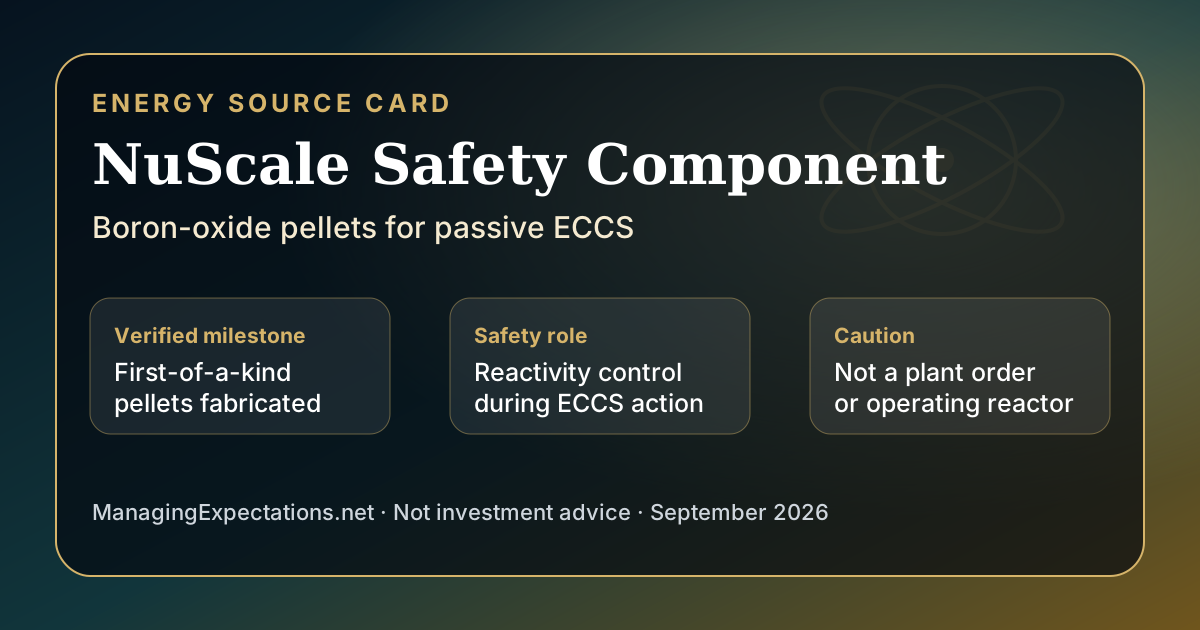
The useful headline is not “NuScale has deployed an SMR.” It is narrower: NuScale and MillenniTEK say they have fabricated first-of-a-kind boron-oxide pellets for NuScale’s passive emergency core cooling system, a concrete component-readiness step inside the broader SMR commercialization stack.
That matters because the advanced-nuclear race is not only about reactor announcements, data-center demand and government targets. It is also about whether specialized parts, materials, quality systems and manufacturing processes can be made repeatably enough for licensed plants.
Verified milestone
NuScale’s September 1 release says NuScale and MillenniTEK fabricated first-of-a-kind boron-oxide pellets for the passive ECCS.
Safety function claimed
The pellets are designed to dissolve into reactor coolant during ECCS actuation to help control and maintain core reactivity without operator intervention.
Expectation check
The source trail does not show a new plant order, site approval, construction start, operating licence or delivered electricity.
What changed
NuScale’s official release, also carried through BusinessWire/FT market wires, says the company and MillenniTEK fabricated first-of-a-kind boron-oxide pellets for NuScale’s passive emergency core cooling system. The release frames the work as a manufacturing and supply-chain readiness step for NuScale’s SMR technology.
The technical point is simple but important: the company says the pellets are intended to dissolve into reactor coolant when the ECCS actuates, helping control core reactivity at safe levels without operator intervention. That places the item in the “reactor safety hardware” file, not the “new power contract” file.
NuScale’s release describes its module as a 77 MWe / 250 MWt gross pressurized-water SMR that can be scaled in multi-module configurations. DOE’s 2023 certification article remains the useful official context: NRC certification lets utilities reference the design in applications, but it is not itself approval to build and operate at a specific site.
Why it matters for the Energy watch
- Manufacturing readiness is a gating issue. An approved design still needs qualified suppliers, component production, quality assurance, project finance, fuel, sites, customers and licences.
- Passive safety is central to SMR sales pitches. A component tied to passive emergency cooling is therefore more meaningful than a generic marketing update.
- For data centers, mine electrification and industrial heat, the relevance is firm-power optionality later. This milestone does not create near-term megawatt-hours for any AI campus or mine.
- For uranium or public-company readers, this is strategic infrastructure context only. It is not a buy/sell/hold signal.
Cautions
Do not treat this as proof that NuScale has solved SMR commercialization. The public evidence supports a component-fabrication milestone and company-stated commercialization-readiness work. It does not prove cost competitiveness, a binding customer order, a completed module factory, final project financing, site licensing or electricity delivery.
Also keep “NRC approval” precise. NuScale has a certified/approved SMR design history, but a future plant still needs site-specific licensing and project execution. Design certification reduces one regulatory uncertainty; it does not erase construction, supply-chain, market or ratepayer-risk questions.
Not investment advice: NuScale, SMR tickers, uranium, fuel-cycle suppliers and data-center firm-power narratives are volatile. This article is source-literacy and infrastructure evidence research, not a recommendation to buy, sell or hold any security.
Primary and reporting sources
- NuScale Power — NuScale Power and MillenniTEK Advance Manufacturing Technology for First-of-a-Kind Reactor Safety Component (official company release, September 1, 2026).
- BusinessWire — NuScale / MillenniTEK release copy (wire release, September 1, 2026).
- FT Markets — NuScale company announcement page (market-wire mirror, September 1, 2026).
- U.S. DOE Office of Nuclear Energy — NRC Certifies First U.S. Small Modular Reactor Design (official design-certification context, January 20, 2023).
- U.S. NRC — Advanced Reactors (official regulator context, page last reviewed/updated August 27, 2026).
- Utility Dive — Utilities eye SMRs for reliability as hyperscalers drive demand (trade/current market context, September 4, 2026).
- Managing Expectations source note and checked leads.