Chris sent a Facebook post from Engineering & Science about Dr. Patrick Soon-Shiong, ImmunityBio and Anktiva, also known as N-803 or nogapendekin alfa inbakicept-pmln. The useful read is this: Anktiva is a real FDA-approved immunotherapy product, but it is approved for a defined bladder-cancer setting in combination with BCG — not as a broad substitute for oncology care.
Medical caution
This article is health-media literacy, not medical advice. Anktiva is a prescription oncology biologic for a specific indication. Do not use a social-media post to choose, delay, replace or refuse cancer treatment. Patients should discuss options with a urologic oncologist/medical oncologist, especially because delaying cystectomy in persistent high-risk bladder cancer can be dangerous.
What the Facebook post says
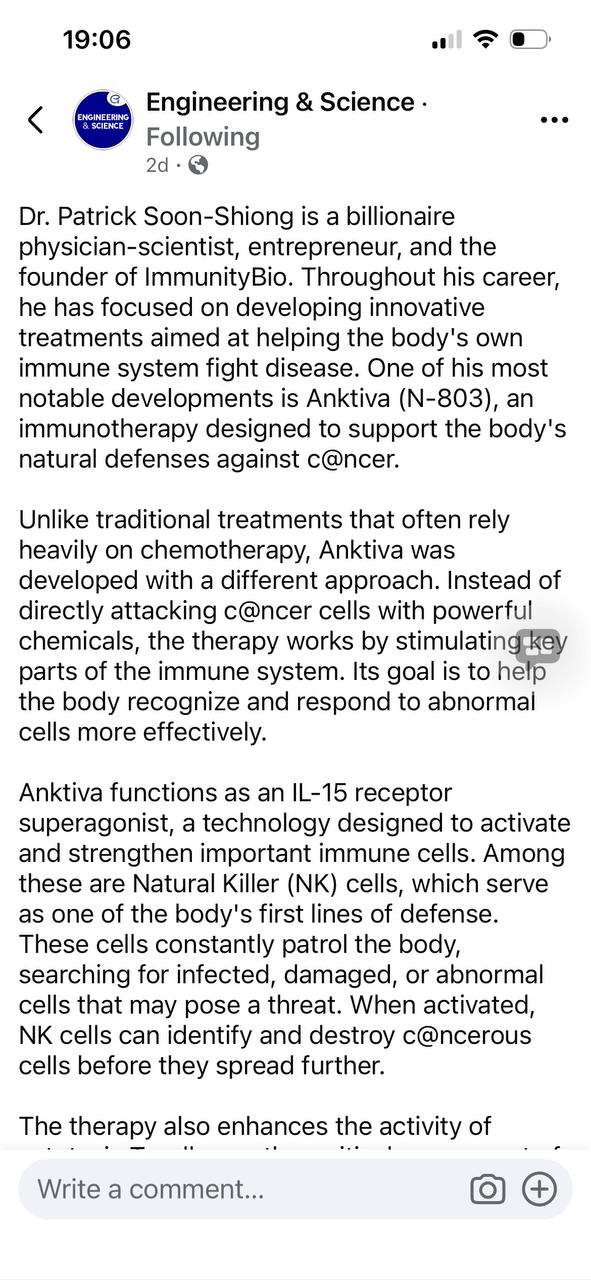
The Facebook post says Dr. Patrick Soon-Shiong is a billionaire physician-scientist, entrepreneur and founder of ImmunityBio; that Anktiva was developed to support immune defenses against cancer; and that it works by stimulating immune cells, including natural killer cells and cytotoxic T-cells. The later screenshots show the post framing Anktiva as part of a broader shift toward immunotherapy and saying it may reduce dependence on more aggressive therapies for certain forms of cancer.
The attached image claims: “This billionaire physician-scientist developed a cancer treatment designed to boost the body's natural killer cells without using chemotherapy. Sadly, not many people know his name.” The post had visible engagement of about 29.9K reactions and 4.8K shares in the screenshot. The word cancer is stylized as “c@ncer,” a common social-media tactic to avoid platform moderation or algorithmic suppression.
What official sources support
- FDA approval is real. On April 22, 2024, FDA approved nogapendekin alfa inbakicept-pmln, branded Anktiva, with Bacillus Calmette-Guérin (BCG).
- The approved indication is narrow. It is for adult patients with BCG-unresponsive non-muscle-invasive bladder cancer with carcinoma in situ, with or without papillary tumors.
- The mechanism is immune activation. The FDA label describes Anktiva as an IL-15 receptor agonist. IL-15 signaling is tied to activation/proliferation of NK cells, CD8+ T cells and memory T cells.
- The pivotal trial was single-arm. FDA cited QUILT-3.032, a multicenter trial in 77 patients with BCG-unresponsive high-risk NMIBC with CIS.
The result numbers — and the boundary
FDA reported a 62% complete response rate in QUILT-3.032, with 58% of responders maintaining response for at least 12 months and 40% maintaining response for at least 24 months. That is meaningful for a difficult bladder-sparing treatment setting.
But the boundary matters: this was not a trial of “Anktiva for all cancers.” It was intravesical Anktiva with BCG in a defined high-risk bladder-cancer population. It should be understood as an additional bladder-preserving option for selected patients, not a universal immune-system cancer solution.
Who Patrick Soon-Shiong is in this context
ImmunityBio’s SEC filing describes Dr. Patrick Soon-Shiong as the company’s Executive Chairman and Global Chief Scientific and Medical Officer, a physician-scientist and inventor with more than 30 years developing treatments for cancer and other diseases. The same filing credits him as inventor of Abraxane, an FDA-approved chemotherapy, and says his work has focused on restoring immune competence.
What the social post gets right, and what it softens
- Broadly right: Anktiva is an immune-modulating therapy connected to IL-15 biology, NK cells and T-cell activation.
- Broadly right: It reflects a real move in oncology: helping the immune system recognize and attack cancer rather than relying only on direct cytotoxic chemotherapy.
- Needs precision: Anktiva is used with BCG for a specific bladder-cancer indication, not as a standalone general anti-cancer treatment.
- Needs caution: “Natural defenses” language can sound gentle, but the FDA label lists common adverse reactions including urinary symptoms, urinary tract infection, increased creatinine/potassium, chills and fever.
- Most important caution: FDA labeling warns that delaying cystectomy can lead to metastatic bladder cancer, which can be lethal.
Patient-protection questions
- Is this cancer type and stage actually within Anktiva’s approved indication?
- Is the patient BCG-unresponsive, BCG-naive, or in another category?
- What are the alternatives: cystectomy, pembrolizumab, nadofaragene, clinical trial, intravesical chemotherapy, or observation?
- What is the plan if there is persistent CIS, recurrence or progression?
- Who is monitoring cystoscopy, cytology, biopsy timing and adverse reactions?
Evidence labels
- Confirmed: FDA approval of Anktiva + BCG for BCG-unresponsive NMIBC with CIS, with or without papillary tumors.
- Confirmed: IL-15 receptor agonist mechanism and immune-cell activation described in FDA label.
- Supported but bounded: complete-response data in the QUILT-3.032 bladder-cancer trial.
- Not established by the post: Anktiva as a general cancer cure, chemotherapy replacement, or treatment for all cancer types.
Primary links
- FDA approval notice: Anktiva for BCG-unresponsive NMIBC
- FDA prescribing information / label PDF
- PubMed: N-803 plus BCG plain-language review
- PubMed: QUILT-3.032 quality-of-life analysis
- ImmunityBio 2025 Form 10-K / leadership context
- Local source note
Bottom line
The post points to a real and important immunotherapy story. The correct Managing Expectations frame is: Anktiva is legitimate, FDA-approved and scientifically interesting — but only within a specific bladder-cancer indication, with specialist monitoring and real risks. It is not a social-media cure-all.
Health Papers, Studies & Films
Continue the source library for cancer-treatment claims, immunotherapy stories and evidence boundaries.
Back to Health Section