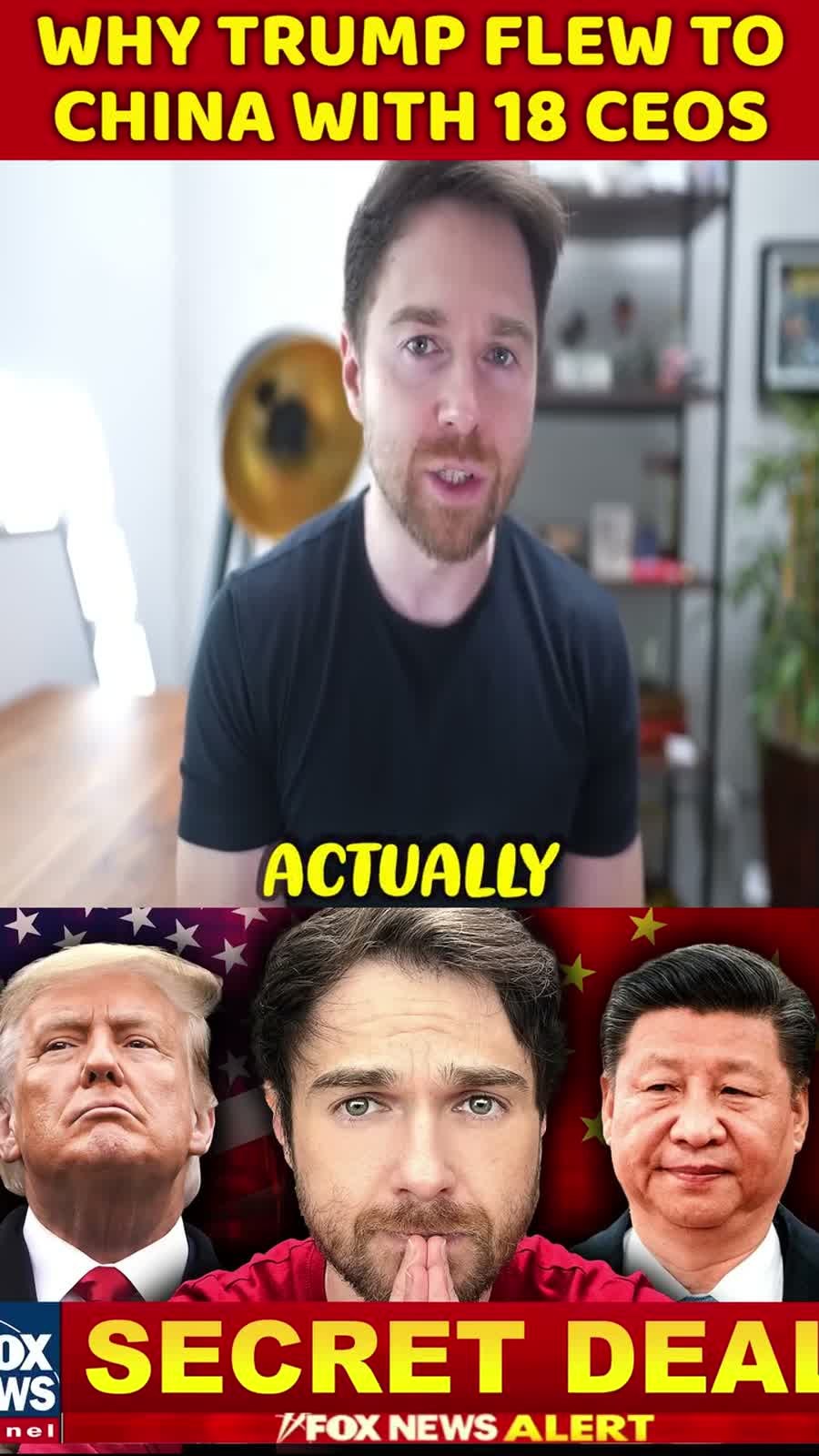
A viral Facebook video argues that a Trump trip to China with a boardroom of major CEOs was not really about tariffs. In the video’s theory, the meeting was a rehearsal for something bigger: a new monetary bargain, a kind of Plaza Accord 2.0, where China avoids a Japan-style currency trap and the adjustment gets routed through gold, energy, industrial investment and inflation instead.
Reader note
This is a theory map, not investment advice and not a claim that a secret deal has been proven. The point is to separate the useful structure of the argument from the parts that still need hard evidence.
The short version of the theory
The old Plaza Accord forced adjustment through currencies. The new version, if it exists, would avoid forcing China to revalue the yuan. Instead, the pressure would move into another balance-sheet asset: gold. The dollar weakens against gold, U.S. gold reserves look more valuable, China’s accumulated gold becomes more powerful, and both sides claim victory without saying the quiet part aloud.
In this story, Chinese capital flows into U.S. factories, the U.S. gets industrial headlines, China gets market access and monetary legitimacy, and gold becomes the pressure valve for a debt-heavy system that cannot tolerate a simple interest-rate solution.
Why the Plaza Accord matters
The original Plaza Accord was announced on September 22, 1985 by the finance ministers and central-bank governors of France, West Germany, Japan, the United Kingdom and the United States. The public aim was coordinated exchange-rate adjustment after a period in which the dollar had become painfully strong.
The video’s comparison is simple: in the 1980s, Japan accepted a currency adjustment that made its exports more expensive and helped trigger a financial boom-bust sequence at home. Whether that history is simplified or not, China would have studied it carefully. Beijing’s lesson would be obvious: do not become Japan in someone else’s monetary rescue plan.
The China version would not look like Japan
A direct yuan revaluation would hit China where it is most sensitive: exports, employment and social stability. So the theory says China would refuse that route. It would rather trade access, factories, rare-earth leverage, chip leverage and gold leverage than allow the yuan to be “Plaza Accorded.”
That is why the video focuses on a possible trillion-dollar investment bargain. Factories in America could be sold publicly as reshoring. But the deeper bargain would be stranger: Chinese money helps rebuild pieces of the U.S. industrial base while China buys a larger seat in whatever monetary architecture comes next.
Why gold becomes the escape valve
Gold is the elegant instrument in the theory because it sits outside the normal politics of currency pride. The U.S. Treasury’s own fiscal-data page says Treasury-owned gold is carried at a book value based on a statutory price of $42.222 per troy ounce, set in 1973, not at modern market price. That gap lets theorists imagine a balance-sheet reset: mark the old gold closer to reality, and the sovereign balance sheet suddenly looks different.
The same logic cuts both ways. China has been accumulating gold and would benefit from a major repricing. A dollar that falls against gold can be described as a market event rather than a surrender to the yuan. That makes gold a politically useful absorber of adjustment.
Energy is the timer
The video then adds energy pressure. The Strait of Hormuz is not a side issue: the U.S. Energy Information Administration has called it the world’s most important oil transit chokepoint, with 2022 flows equal to about 21% of global petroleum liquids consumption. Any sustained disruption would put pressure on oil, inflation, shipping, bond markets and political patience.
In the theory, energy pressure creates the clock. If the West needs stability before markets fully price supply-chain stress, China’s leverage grows. That does not prove a secret deal; it explains why a monetary bargain would become easier to imagine during an energy scare.
The social contract problem
The darkest part of the theory is not gold. It is distribution. If governments inflate away debt, asset owners may survive or even prosper while cash savers and wage earners fall behind. That is the K-shaped economy: one line up for people with scarce assets, another line down for people paid in weakening currency.
Add AI displacement, and the political problem gets sharper. If jobs are automated while food, rent, fuel and debt-service costs rise, the system needs not only money management but population management. That is where the video jumps into digital identity, programmable money and a “control grid.” Managing Expectations should label that part carefully: the infrastructure exists in pieces, but the full control-grid interpretation remains a claim, not a proven master plan.
What would make the theory stronger
- Official U.S.–China language about coordinated monetary adjustment, gold, reserve assets or balance-sheet treatment.
- Clear policy movement on U.S. Treasury gold valuation or gold certificates.
- Large, verified Chinese industrial investment commitments tied to tariff or national-security concessions.
- Evidence that gold flows are policy-directed rather than market, jewelry, vaulting, trading or private-sector flows.
- Oil-market evidence showing a sustained chokepoint disruption rather than a temporary risk premium.
What would weaken it
- No gold-policy movement after the alleged diplomatic window.
- No trillion-dollar investment framework, only normal tariff bargaining.
- Hormuz and energy flows normalizing without a monetary announcement.
- Gold rising mainly because of ordinary central-bank diversification, private demand or real-rate expectations.
- China avoiding U.S. factory exposure rather than expanding it.
Evidence labels
- Verified: The original 1985 Plaza Accord was a coordinated G5 exchange-rate initiative.
- Verified: U.S. Treasury-owned gold is carried at a statutory book value far below market price.
- Verified: Hormuz is a critical oil chokepoint.
- Theory: A U.S.–China bargain could reroute currency adjustment through gold instead of the yuan.
- Unproven: That a secret Plaza Accord 2.0 has been negotiated or signed.
Primary links and transcript
- Facebook source video: Jared Briefing / “The Real Reason Trump Brought 18 CEOs to China”
- 1985 G5 Plaza Accord announcement text
- U.S. Treasury Fiscal Data: Treasury-owned gold and statutory book value
- U.S. EIA: Strait of Hormuz oil chokepoint
- Local source note
- Full automated transcript
Bottom line
The useful part of the theory is not that every claim must be true. The useful part is the map: currencies, gold, oil chokepoints, industrial policy, tariffs, AI and social control are not separate stories anymore. If a Plaza Accord 2.0 ever arrives, it may not be announced as a currency deal. It may look like factory investment, energy diplomacy, gold repricing and a promise that everyone avoided a bigger crisis.