Energy / SMR forecasts / nuclear finance / AI power caution
SMR Forecast: Finance Before Power
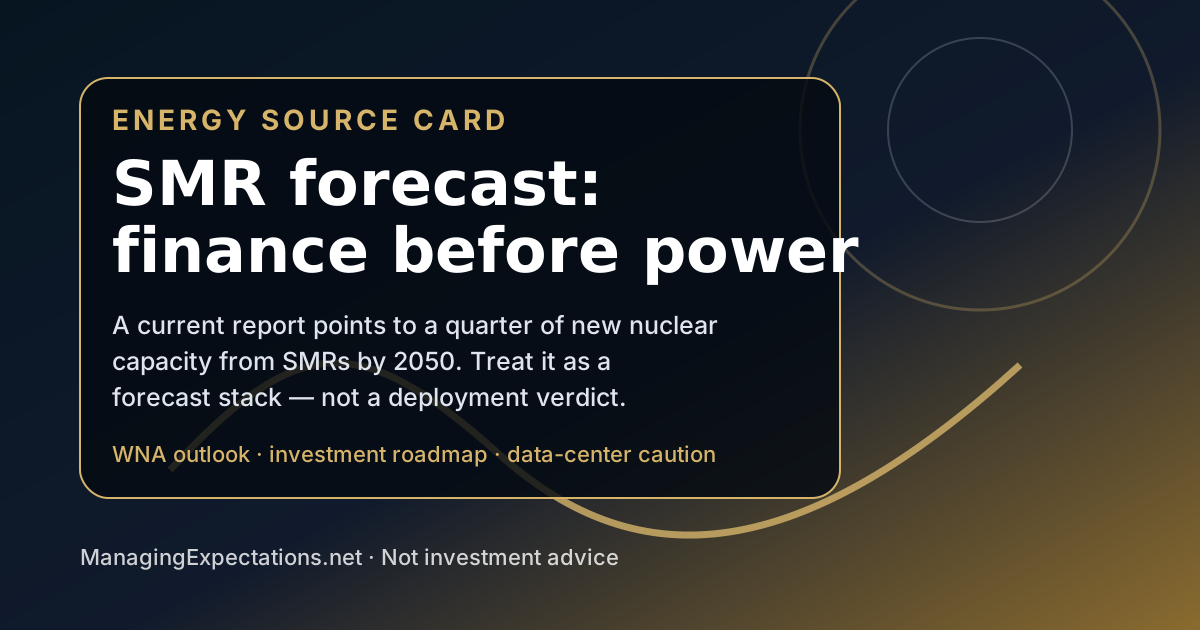
The useful headline is not that small modular reactors are now inevitable. The source-backed headline is narrower: a current Anadolu Agency Energy report says SMRs could account for about one-quarter of new global nuclear capacity by 2050 and attract roughly US$1.5 trillion in investment, while World Nuclear Association materials frame the larger nuclear buildout as a multi-trillion-dollar finance and supply-chain challenge.
That belongs in the Energy watch because AI/data-center power demand, industrial electrification and energy-security policy are all pushing nuclear back into the capital conversation. But it should be read as a forecast stack, not a deployment verdict. Forecast capacity is not a licence. Investment need is not financing close. A roadmap is not fuel delivery, construction completion, grid connection or an operating record.
Current lead
Anadolu’s August 9 energy item reports the SMR share and US$1.5 trillion investment figures, compiled from World Nuclear Association data.
Official anchor
WNA’s Outlook page says global nuclear capacity could reach 1,446 GWe by 2050 if existing-reactor operation and new-build targets are met.
Reality check
The WNA investment roadmap is about conditions for capital to flow — policy, risk pricing, market frameworks and supply chains — not proof that any specific SMR is ready.
What changed
Anadolu’s August 9 article packages the current market thesis in one place: rising electricity demand from AI, expanding data centres and electrification are helping revive nuclear investment narratives; SMRs are presented as a flexible option for data centres, energy-intensive industries and remote locations; and the article cites a roughly US$6 trillion nuclear value-chain investment requirement through 2050, including about US$1.5 trillion for SMRs.
The official source layer is more cautious. World Nuclear Association’s World Nuclear Outlook page says the 1,446 GWe by 2050 case depends on continued operation of existing reactors and deployment of new build meeting government targets. Its Roadmap to Mainstream Finance emphasizes that mainstream investors still need project foundations, standardization, priceable risks, remuneration frameworks, supply-chain capacity and transition mechanisms.
World Nuclear News’ investment-guide coverage adds the same practical caution: the investment need covers the full nuclear sector, from mining and the fuel cycle through reactor construction, decommissioning and storage. In plain English, a nuclear renaissance is not one bottleneck. It is an entire stack.
Why it belongs in the Energy watch
- AI/data-center power: the demand story is real enough to shape capital allocation, but this article does not prove that SMRs will power specific hyperscale campuses on a near-term schedule.
- Fuel-chain exposure: if SMR deployment scales, uranium mining, conversion, enrichment, fabrication, safeguards and waste systems matter as much as the reactor brand.
- Mine and industrial power: SMRs may fit remote or industrial loads in theory, but actual mine electrification still depends on licensing, local acceptance, offtake economics, operations, emergency planning and transmission alternatives.
- Forecast discipline: projections are useful for watching the direction of policy and finance, not for declaring built capacity before it exists.
Cautions
Do not overclaim this as proof of a commercial SMR fleet, a solved HALEU/enrichment bottleneck, a data-center power contract, or a guarantee that global nuclear capacity will triple. The WNA scenario itself is conditional on national targets being met. Anadolu’s SMR-share and investment figures should be treated as current reported projections, not official regulatory findings.
Not investment advice: this source card is an infrastructure and evidence note. It is not a recommendation to buy, sell or hold uranium miners, nuclear fuel-cycle companies, SMR developers, utilities, data-center power suppliers, ETFs or related securities.
Primary and reporting sources
- Anadolu Agency Energy — SMRs expected to provide one-quarter of new global nuclear capacity by 2050 (current mainstream/trade-style energy report).
- World Nuclear Association — World Nuclear Outlook Report (official WNA forecast/targets page).
- World Nuclear Association — Roadmap to Mainstream Finance: The Path to Scale Nuclear Energy (official finance-roadmap page).
- World Nuclear News — Investment guide targets nuclear’s USD6 trillion challenge (trade reporting on WNA investment guide).
- Managing Expectations source note and checked leads.