What this clip is
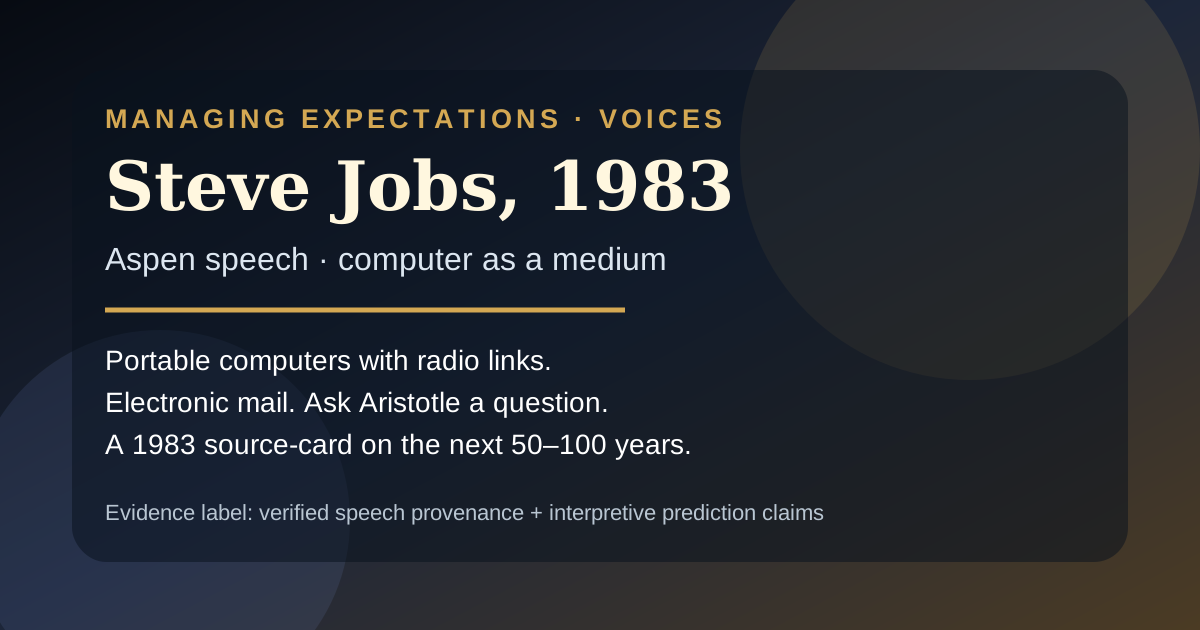
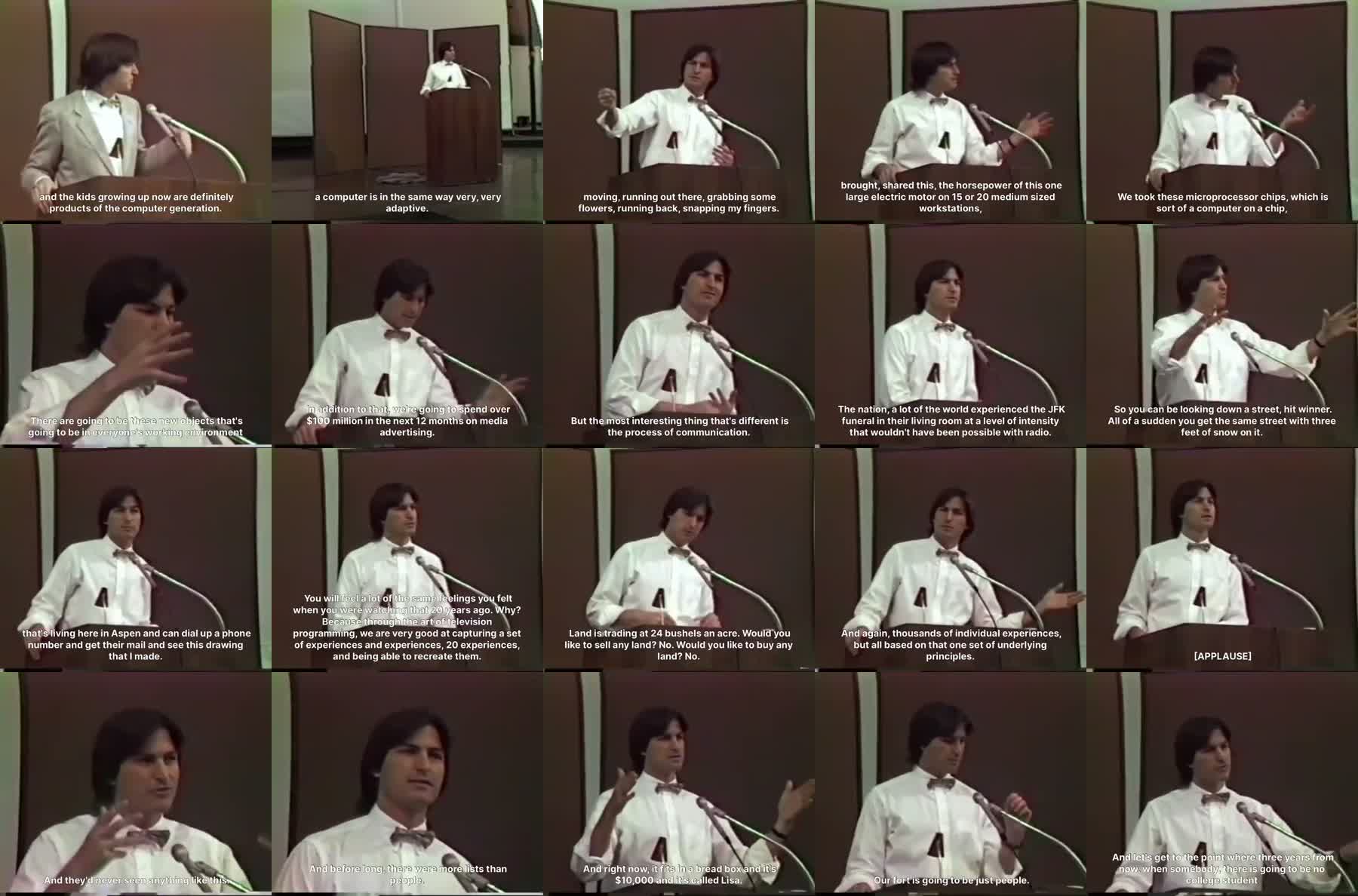
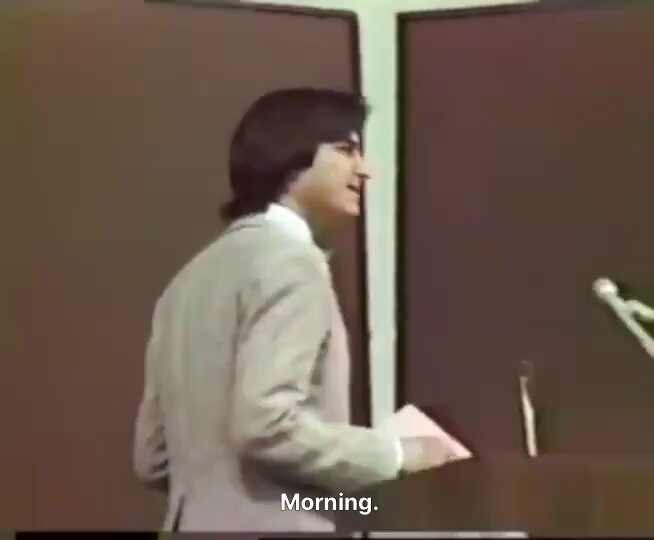
The X video resolves to a repost by Rohit / @HeyRohhit. I downloaded the public media, extracted frames, generated a contact sheet, and produced a machine transcript. The content matches Steve Jobs at the 1983 International Design Conference in Aspen, commonly circulated as The Future Isn’t What It Used to Be or simply Jobs’s 1983 Aspen speech.
Internal clues line up: Jobs says “This year in 1983,” discusses Lisa as a current product, talks about Apple spending more than $100 million on advertising, describes Aspen’s electronic map experiment, and repeatedly frames the personal computer as a new medium of communication.
Why the speech still matters
Computer as medium: Jobs says the computer would become “the predominant medium of communication” for children growing up in the computer generation.
Email and mobile networks: He describes electronic mail, linked computers, portable computers with radio links, and people walking around Aspen retrieving messages.
AI-style question answering: He imagines capturing a thinker’s principles so that after death someone could ask a machine, “What would Aristotle have said?” That is not a full modern generative-AI architecture, but it is a remarkable early statement of the desire behind chatbots and knowledge assistants.
App distribution: He describes software being transmitted electronically over phone lines and paid for by typing in a Visa number — a rough precursor to online software stores and app distribution.
Claim check
| Claim | Evidence label | Finding |
|---|---|---|
| The clip is Steve Jobs. | Supported | Frame review, transcript content and X metadata all support that the speaker is Steve Jobs. |
| The speech is from 1983. | Supported | The transcript itself says “This year in 1983,” and outside reporting identifies the recording as Jobs at the 1983 International Design Conference in Aspen. |
| The speech is “50 years ago.” | Incorrect literally | In 2026, 1983 is about 43 years ago. The correct phrasing is that Jobs was looking ahead 50–100 years. |
| Jobs predicted the Internet. | Broadly supported | He describes electronic mail, linked computers, databases, communication networks and software transmitted over phone lines. He did not use today’s consumer-Internet vocabulary. |
| Jobs predicted iPhone/iPad-style computing. | Partly supported | He describes a book-sized portable computer with radio links, easy to learn in 20 minutes. That anticipates mobile/tablet computing, but not the exact iPhone product. |
| Jobs predicted AI/chatbots. | Interpretive but plausible | The Aristotle passage anticipates interactive knowledge systems. It is not a modern technical description of large language models. |
Life history: the voice behind the forecast
Steve Jobs was born in San Francisco in 1955 and adopted by Paul and Clara Jobs. He attended Reed College briefly, dropped out, and later said the decision let him follow curiosities such as calligraphy — a thread he connected to typography and design in the Macintosh era.
In 1976 he co-founded Apple with Steve Wozniak and Ronald Wayne. Apple II helped popularize personal computing. By 1983, Jobs was selling the design community on a bigger idea: computers were not just office machines, but a new cultural medium that needed industrial design, typography, graphics, communication and emotional usability.
The years after the Aspen speech were turbulent. Macintosh launched in 1984. Jobs left Apple in 1985, built NeXT, acquired what became Pixar, and returned to Apple when Apple acquired NeXT in the late 1990s. The second Apple era produced iMac, iPod, iTunes, iPhone, App Store and iPad — the devices that make the 1983 Aspen talk read today like an early map of the world people now live inside.
Jobs died on October 5, 2011. Apple’s board statement described his “brilliance, passion and energy” as the source of countless innovations. The Managing Expectations lesson is not that Jobs was a flawless prophet. It is that he saw technology as a medium for human behaviour before most of the market did.
Source package
- Source note
- Claim table
- Key transcript excerpts
- Machine transcript
- Life timeline
- Contact sheet
- Thumbnail
- X / yt-dlp metadata
Source-card inclusion means study, not blanket endorsement. Transcript is machine-assisted and should not be treated as an official transcript.