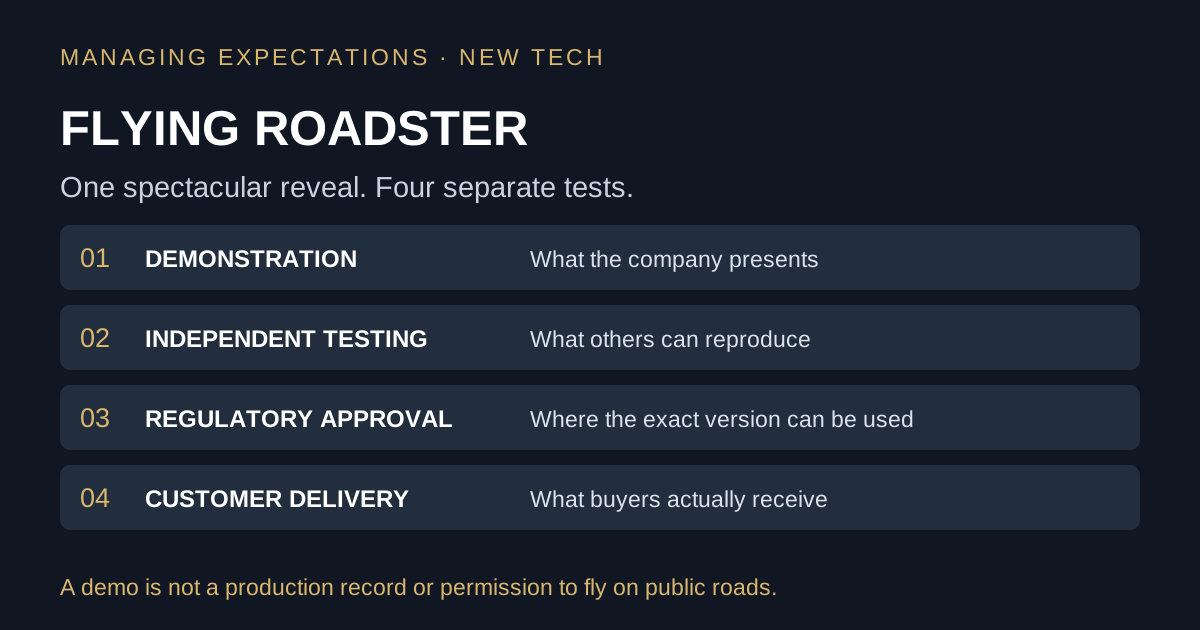
The distinction that matters
Tesla has presented a Roadster that can briefly get airborne using cold-gas thrusters. That does not mean every new Roadster will fly, that the stunt configuration is approved for public roads, or that customer cars are already in production. The reveal is worth watching without treating it as a delivery certificate.
Watch the source video
Watch on YouTube · MAGNO NEWS upload, October 17, 2026. The uploader credits Tesla’s livestream. This is company demonstration footage carried by a news channel, not an independent instrumented test. Auto-caption wording was checked against Tesla’s product description and outside reporting; proper names and technical units are not taken on trust from captions.
What the reveal actually adds
At SpaceX’s McGregor, Texas, testing facility, Elon Musk and Tesla’s team describe a collaboration that combines an electric sports car with aerodynamic and compressed-air systems. Cars.com, Mashable and Space.com describe the upside-down ramp demonstration and thruster-assisted airborne manoeuvres.
The engineering distinction is straightforward. The fan-and-seal system pulls air from beneath the car to generate downforce. The cold-gas thrusters expel compressed air to produce thrust and control orientation. Tesla’s official Roadster page describes both systems. Neither requires a suspension of physics: this is an attempt to use pressure differences and reaction forces in an unusual vehicle.
In the supplied video, Musk says the demonstration is autonomous to avoid risking a person; the team identifies the suited occupant as a mannequin. A remotely demonstrated stunt and a manoeuvre with a paying customer aboard are different safety propositions.
Three versions—not three flying cars
- Performance: Tesla describes a two-seat configuration with active aerodynamics and a multi-mode suction system, offered by reservation.
- Thrust: a limited-release, two-seat configuration with rear cold-gas thrusters for acceleration. Tesla markets it as “race ready.”
- Rocket: the invite-only, single-seat configuration with perimeter thrusters for upward acceleration and rotational movement. This is the version associated with the flight claim.
Those are manufacturer descriptions, not our certification findings. Cars.com specifically reports that the flying feature is not approved for public road use. “Road ready,” “race ready” and “air ready” are not interchangeable legal permissions—and none establishes Canadian approval.
How to read the 0.81-second claim
The presentation announces a 0–60 mph result of 0.81 seconds, also reported by Cars.com and Mashable. It should be described as a company demonstration result, not an independently certified production-car record. The video includes a briefly erroneous timing readout before the announced figure; raw timing records and a complete testing protocol were not part of this review.
Useful follow-up evidence would specify timing equipment, rollout conventions, surface, tyres, vehicle configuration, tank state and repeat runs. A dramatic best run cannot by itself establish durability, consistent customer performance or fair comparisons with other cars. Likewise, remarks about higher future speeds are ambitions, not achieved and independently measured specifications.
Compressed air still has a cost
The team says the tanks can be recharged without special propellant. That is a practical distinction from carrying conventional rocket fuel, not a claim of free energy. Compressing air requires energy, and a usable system must manage heat, pressure, tank integrity and the time between manoeuvres. The sources reviewed do not establish a customer flight duration, repeat-stunt duty cycle or complete operating-cost figure.
The delivery promise needs its own evidence
Musk says in the video that production will begin in 2028. That is a target, not a guaranteed delivery date. The Roadster’s earlier announcement and delays make production tooling, validation vehicles and actual customer handovers more informative than another calendar promise.
Outside reporting also distinguishes reservation payments from the undisclosed final vehicle price. A deposit is not the purchase price, proof of readiness or a guarantee that a particular configuration can legally be used where the buyer lives. We have not verified Canadian pricing, homologation, insurance availability or permission for airborne use.
What would change the assessment?
- Independent testing: repeatable acceleration and manoeuvre results with a published method.
- Safety evidence: occupant loads, failure behaviour, pressure-system inspection and safe operating limits.
- Specific approvals: documents for the exact configuration and jurisdiction, rather than marketing language.
- Customer delivery: a defined specification, final price, warranty, service plan and cars handed over.
The right response is neither automatic dismissal nor automatic belief. Celebrate the ambition, then keep demonstration, validation, approval and delivery separate. That is how an exciting reveal becomes a useful technology story rather than another promise we mistake for a product.
Sources and review limits
- Supplied MAGNO NEWS video: source of the presentation claims; transcript captured for editorial review.
- Tesla Roadster: primary manufacturer description. An initial extraction returned the legacy four-seat specification; a refreshed retrieval returned Performance, Thrust and Rocket. Old and new specifications are not combined here.
- Lawrence Hodge, Cars.com: variant distinctions, timing claim and public-road caveat.
- Stan Schroeder, Mashable: reveal reporting, unanswered specifications and reservation-versus-price distinction.
- Mike Wall, Space.com: thruster and mannequin context. Date wording differs across the upload and coverage; this article does not resolve the event’s exact calendar date.
These reports corroborate what was presented; they are not substitutes for independent testing. No regulator certificate, final sales contract or raw performance-test data was examined. Read the source note · More New Tech & Discoveries