The remarkable part of the Ukok Ice Maiden’s story does not need invention. A woman buried in the Altai Mountains survived in an ice-filled tomb with elaborate tattoos, clothing and the remains of six horses. When Natalia Polosmak’s team uncovered her in 1993, they recovered an unusually intimate record of an Iron Age life.
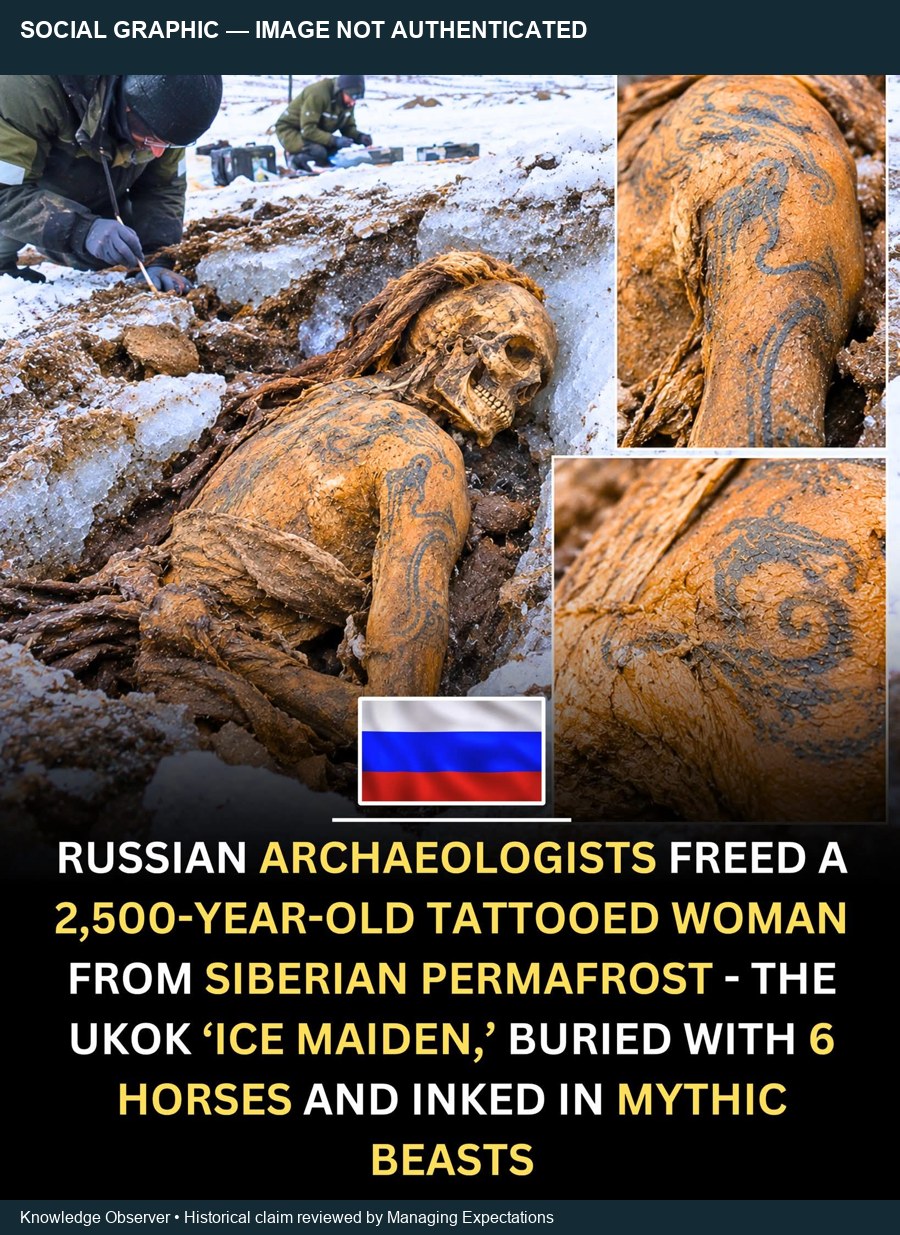
A Facebook graphic from Knowledge Observer brings that discovery back into circulation. Its central historical outline is supported. Its dramatic excavation image, however, has not been authenticated as a photograph of the find. Those are separate questions: a real discovery does not automatically make every picture attached to it genuine. [1] [2]
The 1993 discovery, preserved tattoos and six-horse burial are documented. “About 2,500 years old” is a rounded description, not a precise date. The social graphic’s image provenance remains unresolved, and the major 2025 tattoo-imaging study concerns a different Pazyryk woman.
The discovery behind the headline
The woman commonly called the Siberian Ice Maiden or Princess of Ukok was found on the Ukok Plateau in what is now Russia’s Altai Republic, in southern Siberia near the meeting region of Russia, China, Mongolia and Kazakhstan. Her burial belongs to the Pazyryk cultural world of Iron Age pastoralists and horse riders. The familiar “princess” label should not be mistaken for a securely established royal title. [2] [4] [5]
PBS NOVA’s 1998 documentary transcript identifies Polosmak’s 1993 expedition and describes the discovery of an intact wooden chamber flooded with water that had frozen. Six horses were positioned outside the chamber. The team then encountered a woman whose surviving skin bore elaborate tattoos. This was careful excavation of a burial—not someone found alive, and not a newly announced discovery. [2]
The archaeological designation also matters. The Ukok woman comes from Ak-Alakha-3, tomb 1. Keeping that identifier alongside her popular nickname helps prevent photographs, ages and findings from other Pazyryk mummies being reassigned to her. The 2025 Antiquity paper lists her separately from individuals found in other tombs. [4]
How a burial chamber became a time capsule
At some Altai burial sites, water entered the tomb chambers and froze. Conditions beneath the stone mounds kept the contents frozen through subsequent summers, preserving materials that usually decay: skin, wood, felt, leather, clothing and horse equipment. The British Museum describes this process in its account of the region’s ice mummies and burial mounds. [3]
“Preserved in ice” is not the whole funerary story. The museum also explains deliberate preparation of bodies and placement in wooden coffins. Human choices about burial and the later physical conditions worked together to create the archaeological record. The frozen state is therefore not evidence that these people practised modern cryonics or expected bodily revival. [3]
Why the six horses matter
The six horses in this particular burial are not merely a striking social-media detail. NOVA describes their remains outside the chamber and evidence that they were sacrificed. The animals, harnesses and associated objects help researchers reconstruct a society in which horses were central to mobility, wealth and funerary practice. [2]
Regional context adds depth without settling every question about this woman. The British Museum describes saddle-horses being killed and buried beside owners, together with horse gear, in Pazyryk funerary settings. Such arrangements support interpretation of a planned and meaningful burial. They do not, on their own, reveal an individual’s exact rank, personal beliefs or occupational title. [3]
That distinction is important when the story turns to whether she was a princess, priestess or shaman. Archaeologists can reason from the burial, but objects are not a written biography. NOVA itself presents her role as a question, not a settled identity. [2]
The tattoos: real artistry, uncertain meanings
Her body decoration is genuine archaeological evidence. The wider Pazyryk tradition includes elaborate animals, animal-combat scenes and composite creatures. The preserved designs belong to the broader Scytho-Siberian animal style visible in other objects as well as tattoos. The Antiquity researchers place Pazyryk culture within the varied Early Iron Age pastoralist societies of the Eurasian steppe, not a single uniform population stretching across every region. [4]
What the designs meant to their wearers is harder to recover. They may have carried personal, social or spiritual meanings, but the paper cautions that interpretation in prehistoric contexts remains speculative. Recognizing a mythical-looking animal is not the same as knowing the exact story, status or ritual attached to it. [4]
A useful update—with a different woman at its centre
In July 2025, researchers published High-resolution near-infrared data reveal Pazyryk tattooing methods. They combined near-infrared photography, photogrammetry and experimental tattooing comparisons to examine details that conventional photographs and simplified drawings can obscure. The study investigated line work, pigment distribution and possible differences in artists or working methods. [4]
Its principal subject is the female individual from Pazyryk tomb 5, held at the State Hermitage Museum—not the Ukok Ice Maiden from Ak-Alakha-3. National Geographic’s reporting separately identifies Polosmak as the archaeologist who discovered the famous Ice Maiden in 1993 and notes she was not involved in the new study. [4] [6]
This distinction does not make the newer work irrelevant. It provides valuable context for the same broad cultural tradition. It does mean that a photograph, age estimate or tattoo arrangement belonging to the tomb 5 woman should not be presented as a new finding about the Ukok woman.
The Facebook graphic: a lead, not a proven excavation image
The supplied link resolves to a Knowledge Observer photo post, not a video. The graphic names the Ukok Ice Maiden and highlights her antiquity, tattoos and six horses. The accessible caption preview mentions 1993; the headline printed on the graphic omits the discovery year. We recovered that image and preview, but not the complete caption or comment thread. [1]
No traceable original photograph, photographer credit or archival reference was established for the graphic’s excavation scene. Its appearance alone cannot reliably determine whether it is edited, staged, digitally illustrated or AI-generated. We therefore label the visual unauthenticated, rather than asserting a production method we cannot prove.
View the social graphic — depicts human remains; image not authenticated
What is established, and what remains interpretation?
A tattooed woman was found on Ukok in 1993
Documented
PBS NOVA identifies Natalia Polosmak and the discovery year. [2]
About 2,500 years old
Reasonable rounded description
An Iron Age burial, not an exact age measurement and not a new discovery. [2][4]
Six horses accompanied the burial
Documented
NOVA describes six sacrificed horses outside the wooden chamber. [2]
Animal and composite-creature tattoos survived
Documented
Preserved body decoration is genuine archaeological evidence; specific meanings remain interpretive. [2][4]
The viral image shows the actual excavation
Not authenticated
No photographer, archive reference or documented original was established for this graphic. [1]
The 2025 imaging paper studies this same woman
Incorrect if conflated
Its main subject is the woman from Pazyryk tomb 5, not the Ukok/Ak-Alakha-3 Ice Maiden. [4][6]
Preservation also carries responsibilities
These are human remains and a sacred landscape, not simply spectacular objects. NOVA documents tensions between archaeological research and local concerns about disturbing burials. A responsible account can recognize the scientific value while taking those concerns seriously, without turning spiritual beliefs into claims of proven supernatural effects. [2]
There is a physical preservation problem too. UNESCO’s 2008 publication on the Altai frozen tombs describes the threat that thawing permafrost poses to organic materials preserved for centuries. That publication is historical conservation context, not a measurement of present conditions at a particular mound. The 2025 research likewise identifies warming and thaw as threats to these rare sites. [4] [5]
The lasting significance of the Ice Maiden is the detail she brings to a distant human world: skilled hands, clothing, horses, funeral choices and individual identity. Separating those discoveries from unverified imagery does not diminish the story. It preserves what makes it worth telling.
Sources and research notes
Checked October 4, 2026. This is a historical feature prompted by a circulating post, not a report of a new excavation. Regional burial practices and findings from other mummies are labelled separately from evidence about the Ukok woman.
- Knowledge Observer — submitted Facebook photo post — Source lead: image headline and public caption preview. Full caption/comment thread was not recovered.
- PBS NOVA — Ice Mummies: Siberian Ice Maiden, transcript — Aired November 24, 1998; includes Natalia Polosmak and other researchers on the 1993 excavation, six horses, objects and interpretation.
- British Museum — Scythians, ice mummies and burial mounds — Curator St John Simpson, August 23, 2017; regional burial, preservation and horse-sacrifice context, not all details specific to the Ukok woman.
- Antiquity — High-resolution near-infrared data reveal Pazyryk tattooing methods — Published online July 31, 2025; primary study of the woman from Pazyryk tomb 5, explicitly a different individual from Ak-Alakha-3.
- UNESCO — Preservation of the Frozen Tombs of the Altai Mountains — 2008 conservation publication: permafrost, organic preservation and heritage protection. Historical context, not a current site-condition survey.
- National Geographic — Scientists reconstruct the tattoos of a 2,000-year-old Siberian ice mummy — July 30, 2025 reporting distinguishes the new study from Polosmak’s 1993 Ice Maiden discovery.
Source and methods note · Claim ledger · Source list · Sanitized post metadata
History deserves its evidence
Explore researched features on the past, without losing the difference between a discovery and its retelling.
Explore History All articles