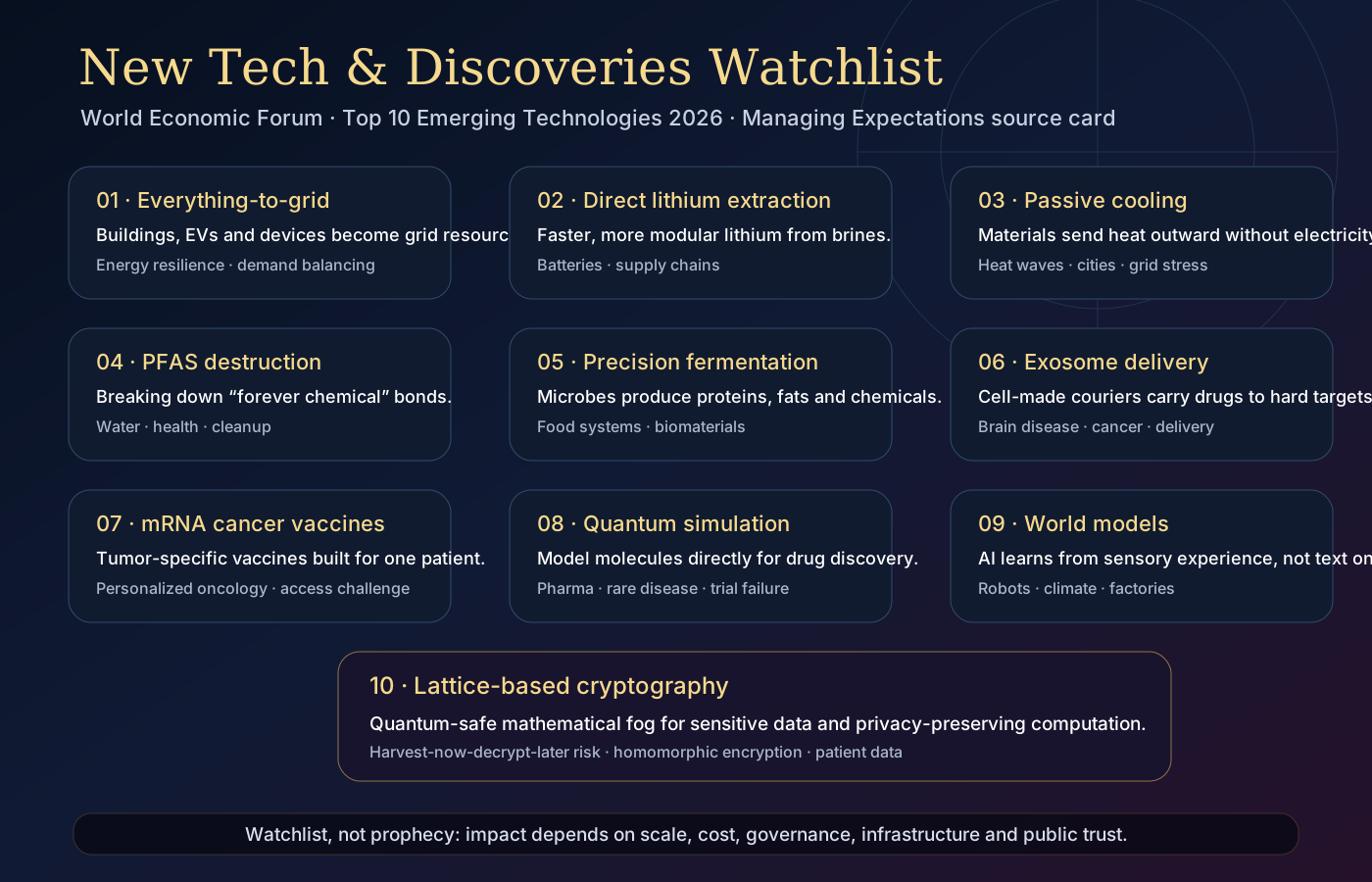
Every “next big thing” arrives carrying two risks: ignoring it too long, or believing it too early. The World Economic Forum’s Top 10 Emerging Technologies 2026 episode is useful because it gives us a compact watchlist across energy, climate, chemistry, food, medicine, quantum, AI and cybersecurity. The correct expectation is not “these will all change the world.” It is: these are ten places where scale, cost, governance and trust may decide what the next decade feels like.
Source-card caution
The WEF report page was linked in the YouTube description, but returned a 403 Access Denied to this environment during extraction. The article below is based on the captured YouTube metadata and full transcript of the official World Economic Forum / Radio Davos episode. Health technologies are not medical advice; they are watchlist items requiring clinician and regulatory context.
The source video
The YouTube episode is titled “The scientific advances ready to change the world: the Top 10 Emerging Technologies 2026”, published by the World Economic Forum on June 23, 2026. The guest is Kimmy Bettinger, described in the video notes as Lead, Expert and Knowledge Communities at the World Economic Forum. The episode says the list is selected through a process involving technology scanning, experts and an advisory council focused not only on what might scale, but what could be consequential if it reaches mainstream adoption.
- Video: World Economic Forum / Radio Davos episode
- Official report link from video description: Top 10 Emerging Technologies of 2026
- Local source note: Captured source note
- Local transcript: Full transcript
The ten technologies
| # | Technology | Plain-English meaning | Expectation to manage |
|---|---|---|---|
| 1 | Everything-to-grid energy | Buildings, electric vehicles, rooftop solar, batteries and devices become active grid resources, not just electricity consumers. | This is infrastructure coordination, not just a gadget. Utilities, standards, incentives and consumer trust matter. |
| 2 | Direct lithium extraction | A faster, more modular way to pull lithium from brines, potentially reducing reliance on slow evaporation ponds. | It could diversify battery supply, but extraction, refinement, permitting and environmental impacts still need scrutiny. |
| 3 | Passive radiative cooling materials | Coatings, films and materials that shed heat outward, potentially cooling buildings without using electricity. | Useful for heat adaptation, but not a substitute for shade, trees, building design and grid planning. |
| 4 | PFAS destruction | New approaches to break down “forever chemicals” instead of merely containing them. | Early-stage cleanup technology. Policy, liability, cost and site-by-site chemistry will shape adoption. |
| 5 | Precision fermentation | Programming microbes such as yeast to produce proteins, fats, cosmetic ingredients or chemicals. | Can reduce pressure on land/water systems, but consumer acceptance, price and regulation are decisive. |
| 6 | Exosome drug delivery | Using the body’s own cell-made message packets as couriers to deliver therapies, including across difficult barriers like the blood-brain barrier. | Promising delivery platform, not a cure-all. Safety, targeting, manufacturing and long-term evidence matter. |
| 7 | Personalized mRNA cancer vaccines | Tumor samples are analyzed so a vaccine can be tailored to mutations in a specific patient’s cancer. | Powerful oncology frontier, but cost, access, trial evidence and health-system logistics are central. |
| 8 | Quantum simulation for drug discovery | Using quantum computation to model molecules more directly, potentially improving early drug-candidate screening. | Could reduce waste in discovery, but practical quantum advantage is still a hard benchmark. |
| 9 | World models | AI systems that learn from sensory experience and physical interaction, not only text. | Important for robotics, factories and climate modeling — but “understands the world” should not be oversold. |
| 10 | Lattice-based cryptography | Quantum-resistant cryptography that hides data in high-dimensional mathematical “fog.” | Urgent for “harvest now, decrypt later” risk, but migration will be slow and operationally messy. |
What patterns show up?
The list has three obvious clusters.
- Energy and climate adaptation: everything-to-grid energy, direct lithium extraction and passive radiative cooling all respond to stressed grids, electrification and heat.
- Biology becoming programmable: precision fermentation, exosome delivery, personalized mRNA vaccines and quantum simulation all point to more targeted ways of making, moving or designing molecules.
- AI/security moving beyond language: world models and lattice-based cryptography show that the next AI wave is not only chatbots. It is machines learning from the physical world and security systems preparing for quantum-era attack.
The Managing Expectations rule
The strongest way to use this list is not to cheerlead it. It is to monitor it. Each technology needs a different proof path.
- For energy: watch pilots, grid interconnection rules, utility adoption and actual cost per kilowatt-hour shifted or saved.
- For materials and PFAS: watch field deployments, contaminant breakdown products, life-cycle impacts and regulatory decisions.
- For food and biotech: watch manufacturing scale, safety, pricing, consumer adoption and clinical endpoints.
- For AI and quantum: watch benchmark evidence, real-world deployment, security migration and governance standards.
A technology is not “world-changing” because it appears on a list. It becomes world-changing when it survives cost, scale, reliability, regulation and public trust.
Why this belongs on Managing Expectations
These lists are useful because they widen the radar. They are dangerous when they become certainty. The WEF framing is explicitly about technologies that could scale and become consequential, not guaranteed outcomes. That is exactly the right category for a New Tech & Discoveries shelf: serious enough to track, uncertain enough to label.
The correct posture is disciplined curiosity. Do not wait until every technology is mature before learning the vocabulary. Do not believe every frontier claim just because it sounds inevitable. Track the problem each technology is trying to solve, then watch whether the missing pieces arrive.
Source links
- YouTube: World Economic Forum / Radio Davos episode
- WEF report page linked by the video
- Local source note
- Local transcript
- Local metadata
AI and frontier technology shelf
Continue the Managing Expectations technology watchlist: capabilities, risks, infrastructure and evidence labels.
Back to AI / Tech