A white powder reserved for pharaohs. A farmer who allegedly rediscovered it. A nervous system made “10,000 times more conductive.” An Ex Historia reel ties these ideas to ancient Egypt, alchemy and the spice of Dune. The surrounding history is interesting—but its different strands do not all carry the same kind of evidence.
Egyptian gold symbolism, alchemical traditions and David Hudson’s patent are real subjects worth exploring. This review did not find reliable evidence that an ORMUS powder produces telepathy, bilocation or a 10,000-fold improvement in human brain conductivity. Real single-atom chemistry does not validate those claims. Unproven is not the same as impossible; it means the evidence required to establish the claim is still missing.
The source video
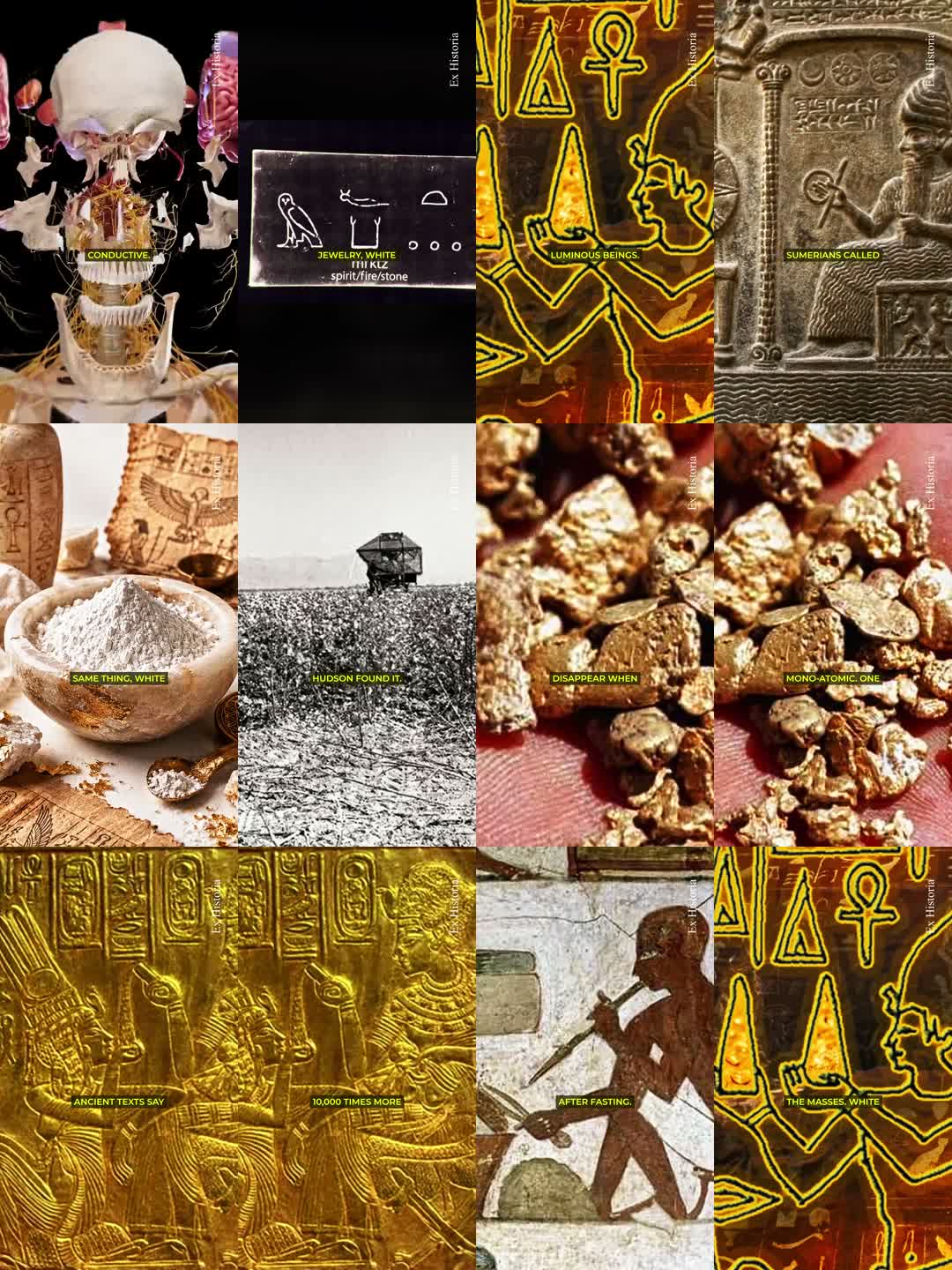
Context before playback: this approximately 96-second clip is presented as the claim being examined, not as a supplement recommendation. Its stylized Egyptian and laboratory scenes are not authenticated archaeological or experimental evidence. The review below separates what can be documented from what remains an assertion.
Source: Ex Historia, Facebook reel 1032958462700553. Submitted share link · Automatic transcript, with name/timing limitations. [1]
1. Gold really mattered in ancient Egypt
Gold’s place in Egyptian religious and funerary life is not an internet invention. The Australian Museum’s account of Ramses & the Gold of the Pharaohs describes a funerary mask made of gold—the “flesh of the gods”—and its role in preserving an idealized portrait of the deceased. That is a documented connection between gold, divinity and eternity. [3]
It does not follow that religious language about divine bodies was a technical description of an ingested material. The reel’s Karnak claim needs an identifiable inscription: which temple area, which wall or text, what date, and whose translation? Without those details, a viewer cannot check the proposed reading against the original. This review did not authenticate the alleged passage about luminous pharaohs, telepathy or being in two places at once.
2. The Egyptian word is a major checkpoint
The word often rendered mfkzt in white-powder-gold narratives deserves more than repetition. An academic chapter published by Brill discusses Egyptian mfkꜢt, its variant spellings and its relationship to Hebrew mineral terminology. Its semantic discussion identifies the material as turquoise, including evidence from Sinai mining and Egyptian jewellery. It also explains older confusion between turquoise and malachite. [2]
That is a substantial obstacle to treating the word itself as proof of a secret gold powder. It does not resolve every Egyptian ritual substance, but it does mean that an alternative translation needs a specific philological argument—not simply an evocative pronunciation or a temple image.
3. Manna and the philosopher’s stone: resemblance is not identity
The reel equates several traditions. In Exodus 16, manna is described as a fine, flaky substance, like white coriander seed, with a taste compared to wafers made with honey. This is a religious account of food in the wilderness, not an identification of monatomic gold. Calling two substances white does not establish that they are chemically the same. [4]
The philosopher’s stone belongs to another historical setting. Britannica describes the alchemical search for a substance believed to transform base metals and provide an elixir of life. Alchemical experimentation contributed to later chemical knowledge; its aspirations are not proof that the sought-after immortality substance existed or that it was modern ORMUS. [5]
The reel also invokes a Sumerian name and a “fire-stone” tradition. The automatic transcript is uncertain about that name, and this review did not locate an identified cuneiform text and scholarly translation establishing the proposed connection. We leave that attribution unverified rather than converting uncertain speech into an ancient quotation.
4. What David Hudson’s patent actually establishes
There is a traceable modern document behind the ORMUS story. The record for GB2219995A, associated with inventor David R. Hudson, concerns “orbitally rearranged monoatomic elements.” It lists a priority date of June 21, 1988, a UK filing on June 21, 1989, publication on December 28, 1989, and a subsequent grant publication in 1992. [6]
This establishes that a defined set of claims entered the patent record. It does not independently establish the reel’s 1975 discovery story, its unidentified laboratory’s findings or a reproducible room-temperature superconductor. Nor is a patent a clinical trial or proof that commercially sold powders match the material described.
For the alleged disappearing-and-reappearing material, the useful questions are concrete: what was its measured composition, what apparatus was used, what happened to the total mass, and could independent laboratories reproduce the observation under controlled conditions? A retold laboratory anecdote cannot answer those questions.
5. Real single-atom science is not a licence for every ORMUS claim
A fair review should not say that individual metal atoms are impossible. Single-atom catalysis is an established research field. A Royal Society of Chemistry review describes individually dispersed active atoms and methods for preparing and characterizing such catalysts. Those atoms can be anchored to supports; “single atom” does not automatically mean a free, unbonded atom floating in a supplement. [8]
Superconductivity also has a precise physical meaning. The US Department of Energy describes current flowing without electrical resistance and associated magnetic behaviour. Establishing those properties requires measurements on a specified material under specified conditions. It is a different proposition from saying that a powder enhances consciousness or disappears when heated. [7]
The brain claim makes another leap. Neuronal action potentials depend on ion gradients, membrane channels and synaptic communication. A claim of “10,000 times more conductive” needs a defined biological measurement, a comparator, dose information, safety data and independently replicated human results. The reel supplies none of that. Greater conductivity of a material would not, on its own, demonstrate improved intelligence or perception. [9]
6. What the biomedical search did—and did not—find
On October 4, 2026, a targeted PubMed search for ORMUS returned two records. One was a 2023 experiment involving an ORMUS-labelled preparation and basil plants under chromium stress. The other was an unrelated historical record mentioning the place Ormus. Neither was a human cognition trial. Additional searches for the orbitally-rearranged terminology and monatomic gold with brain, cognition or clinical terms returned no records under the queries used. [10]
The plant paper is worth acknowledging rather than saying “there is no research at all.” But a plant experiment does not validate the preparation’s proposed atomic identity, establish that it matches a retail product, or demonstrate benefits or safety in humans. These were targeted searches, not an exhaustive systematic review; PubMed’s automatic term mapping and phrase warnings are preserved in the search log.
7. Where Dune fits
The reel’s caption connects the story to Frank Herbert’s Dune. The publisher’s author biography dates the novel to 1965. Within the fiction, the extraordinary spice is a narrative device linking power, dependency and altered perception. That makes it a compelling comparison with older elixir stories. [11]
A thematic resemblance is not evidence that Herbert documented an Egyptian substance or Hudson’s material. No documentary trail establishing that specific origin was located in this review. The 1965 novel also predates the reel’s own claimed 1975 rediscovery, so the two cannot be treated as a simple discovery-then-novel sequence.
The claims at a glance
Egyptian gold had sacred associations
Documented historical context
Museum objects support gold’s religious and funerary significance, not an edible superconducting technology. [3]
Mfkzt means white powder gold
Conflicts with scholarly identification
The related Egyptian term mfkꜢt is discussed in academic mineral terminology as turquoise. [2]
Karnak records telepathy and bilocation after ingestion
Unverified attribution
No exact inscription, wall location, scholarly edition or independently verified translation is supplied. [1]
Manna, a Sumerian fire-stone and the philosopher’s stone are one substance
Unsupported identification
Religious descriptions and alchemical beliefs do not establish identical chemistry; the Sumerian name remains unidentified in this review. [4][5]
Hudson discovered it in 1975 and laboratories proved its powers
Patent exists; discovery story not independently established here
The retrieved patent has a 1988 priority date and 1989 publication. A patent is not independent replication. [6]
A room-temperature superconductor vanishes on heating
Not established by the retrieved evidence
Requires a characterized sample, controlled measurements and independent replication, not a disappearance anecdote. [6][7]
Brain conductivity increases 10,000-fold
Unsupported human-effect claim
No matching human trial found in this targeted review. Real neuron signalling does not reduce to metal conductivity. [9][10]
Dune’s spice is evidence of the same real material
Fictional parallel, not verification
The literary resemblance is interesting; no documentary trail establishing the proposed chemical or historical link was located. [11]
Curiosity without turning a legend into a prescription
There is room to investigate ancient materials, unusual chemistry and traditions of transformation without pretending the connections have already been proved. The strongest next evidence would be a published ancient text, independently characterized samples, replicated physical measurements and properly controlled human research—not more copies of the same story.
Health Canada warns that natural health products can carry risks from contamination, incorrect ingredients, interactions and unproven claims that delay proper care. This review did not test a product or establish a safe dose. Do not ingest an unidentified powder or replace prescribed care on the strength of this reel. If considering a product, discuss its exact ingredients and any Canadian authorization with a pharmacist or clinician. [12]
Sources and research package
Sources checked October 4, 2026. Source categories matter: an inventor’s patent, a religious text and a scientific study answer different questions.
- Source video — Ex Historia — Primary evidence of what the reel claims; not independent scientific corroboration.
- Brill — Chapter 6, Nōp̄eḵ—Turquoise — Academic linguistic discussion of Egyptian mfkꜢt, Sinai mining and turquoise.
- Australian Museum — Ramses & the Gold of the Pharaohs — Museum account of Egyptian funerary objects and gold as the flesh of the gods.
- Exodus 16:14–15, 31 — NRSVUE — Primary religious text in translation; describes manna, not a modern chemical assay.
- Encyclopaedia Britannica — Philosopher’s stone — Historical overview of alchemy, transmutation and elixir-of-life beliefs.
- David R. Hudson — GB2219995A patent record — Primary record of the inventor’s claims, dates and patent family; not independent replication.
- US Department of Energy — DOE Explains…Superconductivity — Scientific context for zero resistance and magnetic-field behaviour.
- Guo et al. — A minireview on the synthesis of single atom catalysts — RSC Advances (2022), DOI 10.1039/D2RA00657J; genuine single-atom materials science.
- Jozsa and Lui — Neuroanatomy, Neuron Action Potential — StatPearls/NCBI Bookshelf; neuronal ion gradients, channels and synaptic signalling.
- PubMed — ORMUS and basil under chromium stress — 2023 plant experiment; not a human brain, safety or cognition trial.
- Penguin Random House — Frank Herbert’s Dune Saga Collection — Publisher description and author biography date Dune’s publication to 1965.
- Health Canada — About Natural Health Products — Risks include contamination, incorrect ingredients, interactions, unproven claims and delayed treatment.
Source and methods note · Claim ledger · Source list · Video metadata · Source frame sheet
Keep the evidence and the possibility separate
Explore more source-led history, belief and unusual claims.
Occult & source reviews History · All articles