Health · AI medicine · longevity claims
AI, Longevity Escape Velocity and the “Try Not to Die” Claim
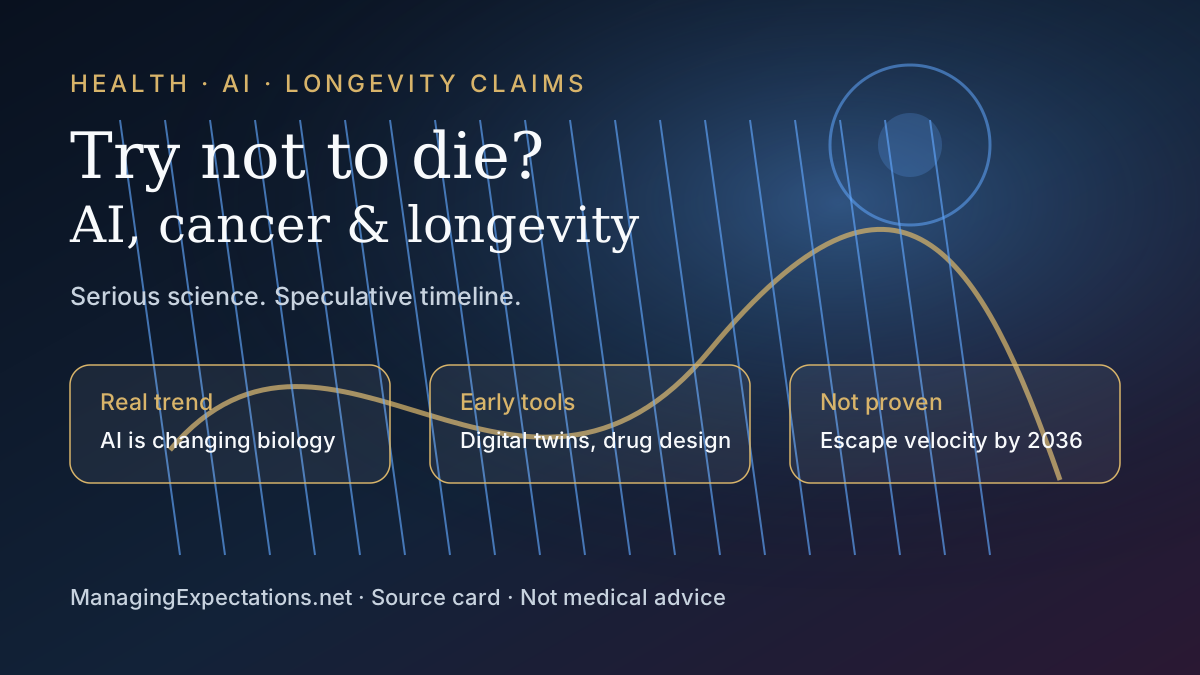
A FoundMyFitness clip with Dr. Derya Unutmaz argues that the next decade may be unusually important for staying alive because AI could accelerate cancer treatment, digital twins, drug discovery and eventually age reversal. The kernel is real: AI is changing biomedical research. The timeline is the fragile part.
What the clip claims
The clip says the next 10–15 years may be “the most critical time in human history” to stay alive because AI may compress medical progress. It claims a person who avoids dying now could live long enough to benefit from new cancer treatments, digital-twin medicine, muscle-regeneration tools and eventually “longevity escape velocity.”
“Try not to die for the next 10 years.”
The strongest claim is not just better medicine. It is that within roughly 15–20 years, aging itself may be reversible enough that an 80- or 90-year-old could return biologically toward age 30 or 40 and repeat the process almost indefinitely.
Short verdict
Real
AI is already useful in biomedical research, protein-structure prediction, imaging, cancer research, medical-device software and drug-discovery pipelines.
Promising but early
Digital twins, AI-designed drugs, personalized oncology and aging biomarkers are active research areas but still face validation, safety, bias, privacy and regulatory barriers.
Speculative
“Most cancers 100% beatable within a decade,” “longevity escape velocity in 8–10 years,” and complete whole-body age reversal within 15–20 years are forecasts, not clinical facts.
Evidence table
| Claim | Status | Meaning |
|---|---|---|
| AI is accelerating medicine. | Well supported | NCI, NIH, FDA and major journals document real AI applications in cancer research, devices, data infrastructure and molecular biology. |
| AlphaFold changed biology and drug-discovery tooling. | Established | AlphaFold 2 and AlphaFold 3 are major technical milestones, especially in structural biology and biomolecular interaction prediction. |
| Digital twins can replace or greatly shorten clinical trials soon. | Promising but early | Health digital twins are a serious research area, but human trials, real-world validation and regulation remain hard barriers. |
| Most cancers may become beatable within a decade. | Optimistic forecast | AI can improve screening, stratification, drug design and personalization, but “100% curable” is not supported for all cancers. |
| GLP-1 drugs add 5–10 years to lifespan. | Overstated as written | GLP-1 drugs can reduce weight and improve cardiometabolic risk for some patients; translating that into exact added lifespan is not settled. |
| Complete aging reversal within 15–20 years. | Speculative | Partial reprogramming and aging biomarkers are real, but safe whole-body rejuvenation is not proven medicine. |
| Longevity escape velocity is on the horizon. | Futurist hypothesis | The term comes from life-extension circles. It is not an achieved clinical threshold. |
Who is Dr. Derya Unutmaz?
Dr. Derya Unutmaz is a professor at The Jackson Laboratory. JAX describes his work as research into human T-cell differentiation, activation and regulation in normal immune response, disease and aging. That makes him a relevant voice on immunology, chronic disease and aging biology; it does not make a 10-year longevity forecast settled medical consensus.
What is worth watching
- AI oncology: earlier detection, better image interpretation, better trial matching, mechanistic modelling and personalized treatment design.
- Digital twins: patient-specific models built from labs, imaging, genomics, wearables and medical history; promising, but dependent on data quality and validation.
- AI-designed drugs: faster candidate discovery does not eliminate toxicity, dose-finding, manufacturing, trials, cost or access barriers.
- Aging biomarkers: epigenetic clocks and multimodal biological-age tools can be useful research measures, but a better clock score is not the same as a proven longer life.
- Partial reprogramming: connected to the existing Managing Expectations Yamanaka source-card. It is one of the most interesting age-reversal research lanes, but not a proven whole-body therapy.
Companies and labs to track
- Google DeepMind / Isomorphic Labs: AlphaFold and AI-driven drug-discovery infrastructure.
- Insilico Medicine: AI-first drug discovery and clinical pipelines.
- Recursion: industrial-scale biology, imaging, machine learning and drug discovery.
- Tempus AI: oncology data, diagnostics and AI-enabled precision medicine.
- Freenome / Grail-style early detection lanes: blood-based screening and machine learning; useful but highly regulated and disease-specific.
- Altos Labs, NewLimit, Life Biosciences, Retro Biosciences: aging/longevity companies, some adjacent or direct to reprogramming; see the Yamanaka source-card for caveats.
Bottom line
The useful takeaway is not “AI has already made humans live indefinitely.” It is this: the medical toolchain is changing quickly enough that healthspan, prevention, screening, biomarkers, earlier diagnosis and better treatment matching may matter more than ever.
The unsafe takeaway would be to treat a podcast forecast as a reason to abandon current cancer care, buy unproven anti-aging products, or assume whole-body age reversal is available. Possible direction, not proven destination.
Source links
- Facebook Reel source
- FoundMyFitness full YouTube episode
- Derya Unutmaz — Jackson Laboratory profile
- The Unutmaz Lab — Jackson Laboratory
- AlphaFold 2 — Nature 2021
- AlphaFold 3 — Nature 2024
- NCI — AI and Cancer
- FDA — Artificial intelligence-enabled medical devices
- NIH Common Fund Bridge2AI
- WHO — Ethics and governance of AI for health
- Digital twins for health — npj Digital Medicine 2024
- Existing Managing Expectations Yamanaka / partial reprogramming source-card
Source note · Facebook clip transcript · YouTube episode metadata · Related Yamanaka source-card