Health · Longevity biotech · ER-100
ER-100, Partial Reprogramming and the “Anti-Aging Shot” Claim
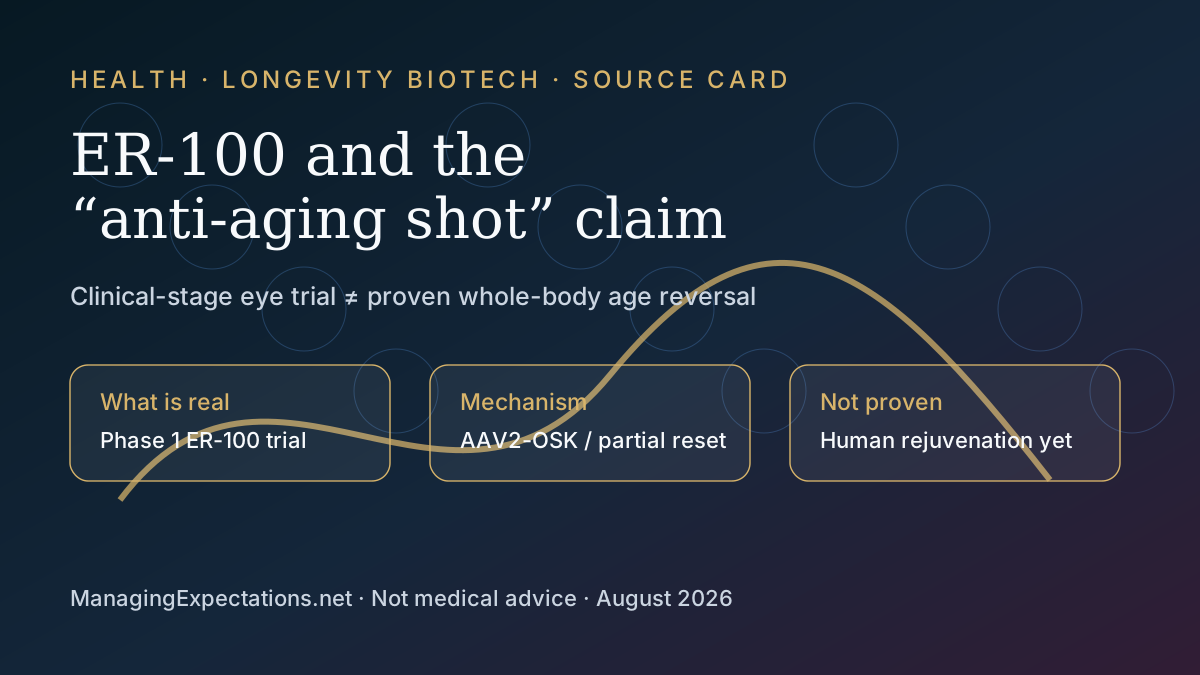
A Dr. Gabrielle Lyon Reel frames ER-100 as a gene-therapy shot that could reverse biological aging. The source trail shows a real milestone: Life Biosciences has a Phase 1 ER-100 trial for optic neuropathies. But Phase 1 eye-disease safety testing is not proof of systemic human age reversal.
What the Reel says
The captured transcript says ER-100 is a “new drug, gene therapy” that “potentially can reverse biological aging,” flips a biological switch, tells cells to “go back,” and is in a first clinical trial with 12 people.
[0.00 -> 3.72] This ER 100, which is a new drug, gene therapy, [3.72 -> 6.64] potentially can reverse biological aging. [6.64 -> 9.32] And typically we think about the treatments of disease [9.32 -> 10.68] and managing symptoms, [10.68 -> 13.68] but this essentially flips the biological switch. [13.68 -> 15.24] It tells the cells actually go back [15.24 -> 16.36] and do something different. [16.36 -> 18.56] Right now we're in the first clinical trial [18.56 -> 19.96] and there's 12 people. [19.96 -> 22.28] So I believe that it's gonna take some time. [22.28 -> 24.12] However, if this works, [24.12 -> 27.44] it is gonna transform human history and lives.
Short verdict
Real milestone
Life Biosciences reports FDA IND clearance and first participant dosed for ER-100 in optic neuropathies.
Early clinical stage
ClinicalTrials.gov describes NCT07290244 as evaluating safety and tolerability of a single ER-100 dose in adults with OAG or NAION.
Not proven
This is not yet an approved therapy, not proven vision restoration, and not proven whole-body age reversal or longevity extension.
Evidence table
| Claim | Status | Meaning |
|---|---|---|
| ER-100 exists and is in human testing. | Supported | Life Biosciences and ClinicalTrials.gov document a Phase 1 trial. |
| ER-100 uses partial epigenetic reprogramming. | Supported as company mechanism | Life Bio describes AAV2-OSK: controlled expression of OCT4, SOX2 and KLF4. |
| The trial has 12 participants. | Supported by Reel/clinical-trial context if enrollment matches current registry | Small Phase 1 trials are primarily about safety/tolerability, not broad efficacy. |
| ER-100 could reverse biological aging. | Hypothesis / translational ambition | The mechanism is connected to aging biology, but human rejuvenation has not been demonstrated. |
| ER-100 is an anti-aging shot for the public. | Not proven / misleading shorthand | The current trial is for optic nerve diseases, not elective whole-body longevity treatment. |
| This will transform human history if it works. | Speculative forecast | Reasonable to watch closely; not a clinical conclusion. |
Why the eye matters
Optic neuropathies are a logical first testbed for partial reprogramming because the eye allows local delivery and measurable visual endpoints. That is very different from safely resetting multiple tissues throughout the body.
How this fits the existing Yamanaka source-card
ER-100 is one of the most concrete clinical translation examples in the broader Yamanaka / partial-reprogramming field already tracked by Managing Expectations. It strengthens the “serious science” side of the story, while also strengthening the caveat: the first human trial is local, small and early.
Bottom line
Clinical-stage but unproven. ER-100 is a real and important longevity-biotech milestone. It should be read as a first safety-stage test of partial epigenetic reprogramming in optic neuropathy patients — not as proof that an anti-aging shot can reverse human aging.
Source links
- Facebook Reel source
- Fox News clip — Dr. Gabrielle Lyon anti-aging shot
- Life Biosciences — first patient dosed in Phase 1 ER-100 trial
- Life Biosciences — FDA IND clearance for ER-100
- Life Biosciences — Optic Neuropathies and ER-100
- ClinicalTrials.gov — NCT07290244 ER-100 safety/tolerability trial
- Nature Biotechnology — FDA go-ahead to test cellular rejuvenation therapy in humans
- Managing Expectations — broader Yamanaka / partial-reprogramming source-card
- Managing Expectations — AI/longevity escape velocity source-card