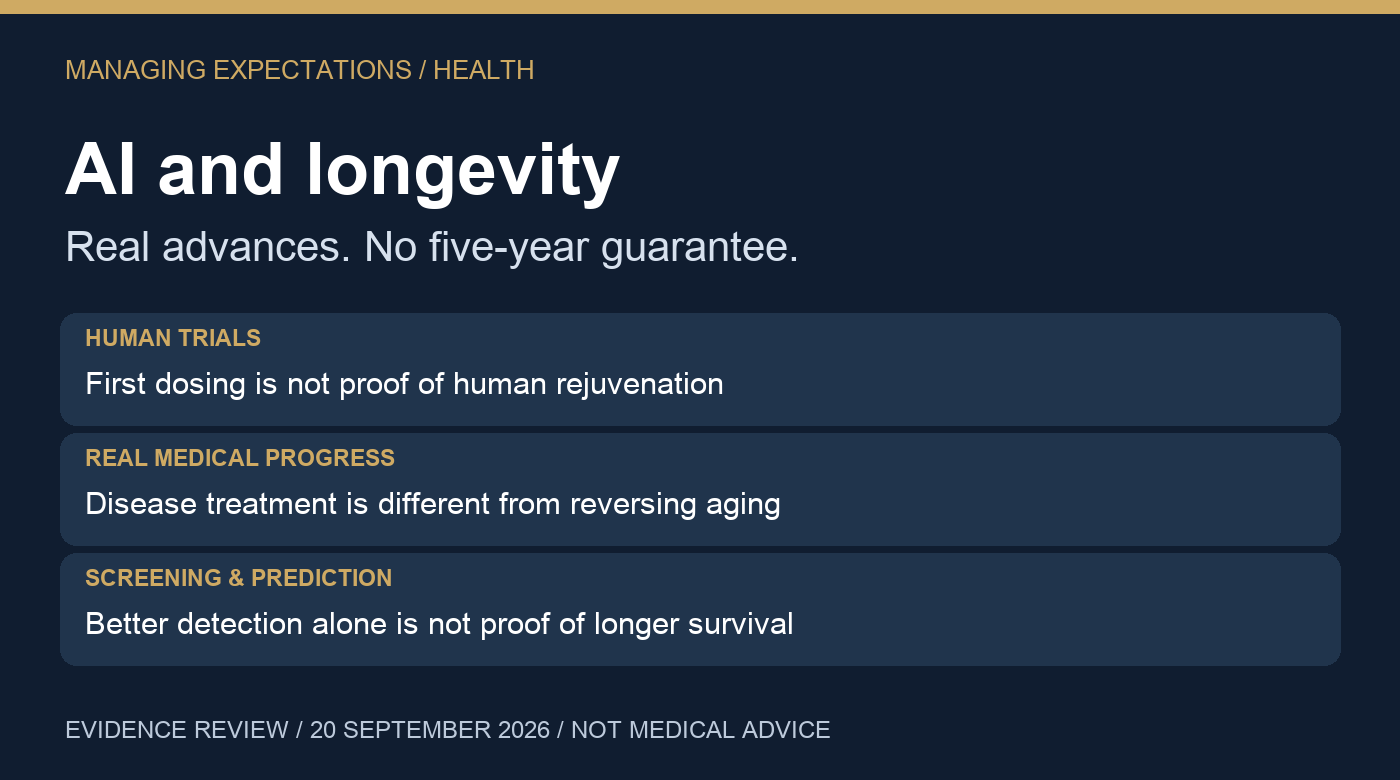
Serious science. Speculative timeline.
There is no evidence-backed promise that surviving five more years will give someone access to age reversal, immortality or a dramatically extended lifespan. The video highlights important research, but combines mouse experiments, laboratory measurements, approved disease-specific treatment, early human trials and forecasts. Those categories cannot be treated as equivalent proof.
Not medical advice. Do not delay diagnosis, screening or prescribed care while waiting for a breakthrough. Experimental reprogramming, gene therapy and senolytics belong in properly regulated clinical research—not do-it-yourself treatment.
The source video
“Please Stay Alive For 5 More Years”, published August 24, 2026 by There’s An AI For That, is a roughly 20-minute overview of AI and biotechnology. We reviewed the retrieved transcript and its linked studies, then checked selected claims against clinical publications, regulator records and newer institutional updates. The video includes genuine caveats about failure and the gap between mice and humans; its headline is nevertheless a forecast, not a medical finding.
The central correction: “tested in a person” does not mean “shown to work.” The video's four human examples do not share the same evidence level. Nor is a protein-design tool automatically the technology that produced every gene therapy or transplant discussed.
Reprogramming: from mouse vision to an early human eye trial
The 2020 Nature paper by Lu and colleagues used expression of OCT4, SOX2 and KLF4—often shortened to OSK—in mouse retinal ganglion cells. It reported regeneration after optic-nerve injury and improved visual function in mouse models of glaucoma and aging. That is not evidence that every blind eye can be repaired, or that the whole animal was made young.
The video's “cells forget their instructions” explanation is a useful metaphor for one hypothesis, not a complete account of aging. DNA can acquire damage and mutations; the 2023 Hallmarks of Aging review describes interconnected processes including genomic instability, epigenetic change, mitochondrial dysfunction, senescence and inflammation. It is inaccurate to imply that the original genetic instructions never change or that damage is irrelevant.
Life Biosciences announced on June 9, 2026 that its first ER-100 participant had been dosed. The announcement does not identify the exact administration day. This is a real clinical milestone, but a sponsor announcement of first dosing is not evidence that human vision has improved.
The posted ER-100 registry record, NCT07290244, describes a Phase 1, open-label, non-randomized study in adults with open-angle glaucoma or non-arteritic anterior ischemic optic neuropathy. Estimated enrollment is 18, not a completed cohort of 18. The primary focus is safety and tolerability, with additional visual-function measures; it is not a trial of lifespan extension or whole-body rejuvenation. The record was last updated in May 2026 and lists recruiting, with no results posted when checked for this article. That is the posted registry status, not a live promise of availability at any particular site.
Delivery, control of gene expression, preservation of cell identity and potential tumour risks remain central questions for reprogramming. Permission to conduct a trial is not marketing approval, and a proposed mechanism is not a demonstrated patient outcome.
AI is changing research—but a laboratory multiplier is not a lifespan multiplier
AlphaFold is a major protein-structure prediction advance. RFdiffusion and related protein-design work extend what researchers can design and test. Neither a predicted structure nor a designed protein establishes safety, delivery, effectiveness or survival benefit in a patient. Experimental validation remains essential.
OpenAI and Retro Biosciences’ August 2025 report describes greater than 50-fold higher expression of stem-cell reprogramming markers with engineered proteins in laboratory experiments, relative to wild-type controls. That is not 50-times-better vision, 50-fold human rejuvenation or 50-times-longer life. The report includes work producing induced pluripotent stem cells; that is not interchangeable with safely rejuvenating existing cells inside a person while preserving their identity.
OpenAI described internal replication across donors, cell types and delivery methods. We label this as a company research report, not independent proof of a human anti-aging therapy. Its disclosure also identifies Sam Altman as an investor in Retro. Funding and prominent backers can support research; they do not substitute for clinical results.
The Evo paper also supports a narrower version of the video's gene-editor claim: researchers co-designed a novel Cas9/guide-RNA system and demonstrated DNA-cleavage activity in the laboratory. One of 11 selected candidates showed robust activity after a much larger computational filtering process. This was not an approved human gene-editing treatment, an autonomous clinical discovery, or a demonstrated longevity intervention.
What has actually crossed into human medicine?
AI-discovered lung drug: an early clinical signal, not a longevity result
The 2025 rentosertib trial is real: 71 patients with idiopathic pulmonary fibrosis were randomized across three treatment groups and placebo for 12 weeks. The primary endpoint was treatment-emergent adverse events; lung function was a secondary endpoint. At the highest once-daily dose, mean forced vital capacity increased by 98.4 mL, versus a 20.3 mL decline with placebo.
That is an encouraging signal in a serious lung disease—not evidence of age reversal, longer survival or a treatment ready for everyone. Only 55 participants completed the 12-week treatment period. Treatment-related adverse events were more common with rentosertib, and liver injury/dysfunction contributed to withdrawals. Larger, longer trials are needed. The discovery process used AI alongside human laboratory, clinical and regulatory work; it was not a drug autonomously invented, validated and approved by a machine. Read the original study PDF.
Casgevy: an approved disease-specific therapy—not an anti-aging treatment
The FDA’s December 2023 approval confirms the video's central CRISPR milestone. Casgevy edits a patient’s own blood stem cells outside the body, which are then returned to increase fetal haemoglobin and reduce sickling. In the approval evidence, 29 of 31 evaluable patients met the endpoint of freedom from severe vaso-occlusive crises for at least 12 consecutive months.
This is a major medical advance, but not proof that gene editing generally cures disease or extends healthy people’s lifespan. It requires specialized stem-cell treatment, high-dose conditioning chemotherapy and long-term follow-up. U.S. authorization for a specific disease is not a claim of universal access, suitability or an approved longevity use in Canada.
Pig kidneys: temporary organ support is different from reversing aging
NYU Langone’s updated account confirms that Towana Looney received a kidney from a pig with 10 gene edits on November 25, 2024. It was removed on April 4, 2025, after 130 days, following rejection in the setting of reduced immunosuppression to treat an unrelated infection. She returned to dialysis. The genes reduced compatibility barriers; they did not make rejection impossible.
There is also newer evidence worth adding to the video: Mass General Brigham reports that Tim Andrews spent 271 days without dialysis after a different pig-kidney transplant, and later received a human kidney in January 2026. The pig graft developed injury and ultimately failed; the report describes a potential bridge to human transplantation, not a permanent cure. The Lancet paper concerns one recipient, not a comparative survival trial.
NYU also documents the start of the EXPAND clinical trial. Trial authorization and a first operation are steps toward testing safety and durability—not routine-market approval. Organ support can be clinically valuable without demonstrating slower biological aging. The video's blanket wording that all pig organs failed also obscures differences between graft failure, patient death from another cause and a later transition to human transplantation.
Failures matter—and citations must match the claim
The video correctly points to a failed senolytic trial. In 2020, UNITY reported that UBX0101 did not beat placebo on its 12-week knee-pain primary endpoint in a randomized study of 183 people with knee osteoarthritis. That result limits claims for that intervention in that setting; it does not prove that every senolytic approach must fail.
However, the video description’s “UNITY failure” link points to a different 2019 study: a nine-person, open-label trial of dasatinib plus quercetin in diabetic kidney disease. It is not the UBX0101 knee trial. The distinction is important when a video says every claim is backed by a linked paper.
The same restraint applies to supplements. A 2025 review of NAD-precursor supplementation describes limited human efficacy and sparse tissue-level evidence. Biological activity or a change in NAD levels is not proof of longer human life. Neither enthusiasm for supplements nor sweeping claims that they are “proven not to work” should replace a specific question about the population, outcome and quality of evidence.
A company-and-timeline claim that does not check out
Near 17:42, the video says the company associated with Demis Hassabis had its first AI-drawn cancer drug cleared for human testing in January 2026. That specific milestone was not corroborated in the sources reviewed. Reuters reported on January 20 that Isomorphic Labs was targeting its first clinical trials by the end of 2026, after an earlier delay.
A separate, readily confused January announcement is Insilico Medicine’s ISM8969 IND clearance. That company report concerns an NLRP3 inhibitor intended for Parkinson’s disease—not an Isomorphic cancer drug. The video does not name its alleged drug, so we cannot establish that this was its intended source. We do not treat the January Isomorphic claim as verified or infer clinical success from permission to start testing.
AI screening: better detection is promising, but survival is a separate endpoint
Breast screening: the newer MASAI results need careful wording
The video cites the 2023 MASAI safety analysis, but its account combines results from later publications. The 2025 report followed a trial population of 105,934 randomized women. AI-supported screening detected 6.4 cancers per 1,000 participants versus 5.0 per 1,000 with standard double reading, and reduced screen-reading workload. The AI supported radiologists; it was not a standalone replacement for all clinical care.
The 2026 interval-cancer analysis is especially important. Interval cancers—those found between screening rounds—occurred at 1.55 versus 1.76 per 1,000 participants. The rate ratio was 0.88, but its 95% confidence interval was 0.65–1.18. The study established non-inferiority for this endpoint; it did not establish a statistically significant reduction in the overall interval-cancer rate. Some adverse cancer characteristics were descriptively less frequent, and sensitivity improved.
These are meaningful screening-performance findings. They are not yet a demonstrated reduction in breast-cancer mortality, proof that every additional detected tumour would have become fatal, or proof that “terminal” diagnoses have routinely been converted into curable ones. False positives, overdiagnosis and longer-term outcomes still matter.
The Mayo ECG paper: a signal of atrial fibrillation, not a lifespan trial
The 2019 Mayo study retrospectively analyzed standard ECGs to identify people with atrial fibrillation from recordings taken during sinus rhythm. Its methods included a window around the first recorded AF ECG, including the preceding 31 days. That paper does not, by itself, establish the video's broader claim of predicting new rhythm problems years before they occur.
“Sinus rhythm” also does not mean an ECG was entirely normal or that the person had no disease. The study evaluated classification performance—not whether introducing the algorithm reduced strokes, deaths or added years of life. Prediction, a changed clinical decision and a better patient outcome must each be tested.
Is there a ceiling to human lifespan?
The 2016 Nature lifespan paper argued that observed longevity patterns supported a natural limit. Its interpretation was disputed, including in subsequent demographic analysis. The video's acknowledgement that this remains debated is appropriate. Neither a disputed demographic ceiling nor a forecast that it can be broken supplies a clinical five-year timetable.
Average life expectancy, remaining life expectancy at a given age, the oldest recorded individual and an intervention's effect on survival are different measures. Historical improvements in sanitation, vaccination and medical care cannot simply be extrapolated into a prediction that today’s newborns will experience their 90s like their 40s.
What the five-year headline leaves unanswered
Before an experimental longevity intervention becomes a dependable option, researchers must establish a meaningful benefit, identify who benefits, measure harms and durability, and make the intervention deliverable and accessible. Faster discovery may help, but it does not remove those requirements or impose a reliable deadline.
Biological-age clocks can predict aspects of health risk. Improving a score is not automatically a validated substitute for reducing disability, disease or death. Equally, the absence of a proven whole-body rejuvenation treatment does not mean ordinary medicine has never extended life. Treating disease, reducing risk and improving population health are real achievements; they are different from proving that aging itself has been reversed.
A constructive takeaway
Follow the trials, not the countdown. It is reasonable to be hopeful about AI-assisted discovery, better screening and new therapies while rejecting a guaranteed rescue date. Continue appropriate preventive care and specialist treatment. Do not use a video to justify unapproved gene interventions, high-dose supplements, prescription senolytics or postponing needed care.
Evidence and source trail
Links throughout the article lead to the original studies, official records and clearly identified company or hospital reports. We reviewed the major clinical and longevity claims, not every financial figure, biographical anecdote or forecast in the video. “Company reports” and “first patient dosed” are deliberately distinguished from peer-reviewed human outcomes and marketing authorization.