Reviewed 2026-09-23 · Cell and animal research, company claims and human-study limits.
A TikTok about a grape-seed compound called procyanidin C1, or PCC1, links a Chinese longevity company’s ambitions to a mouse study—and asks whether living to 150 would even be enjoyable. There is real senolytic research behind the story. There is not evidence that a pill lets people live to 150.
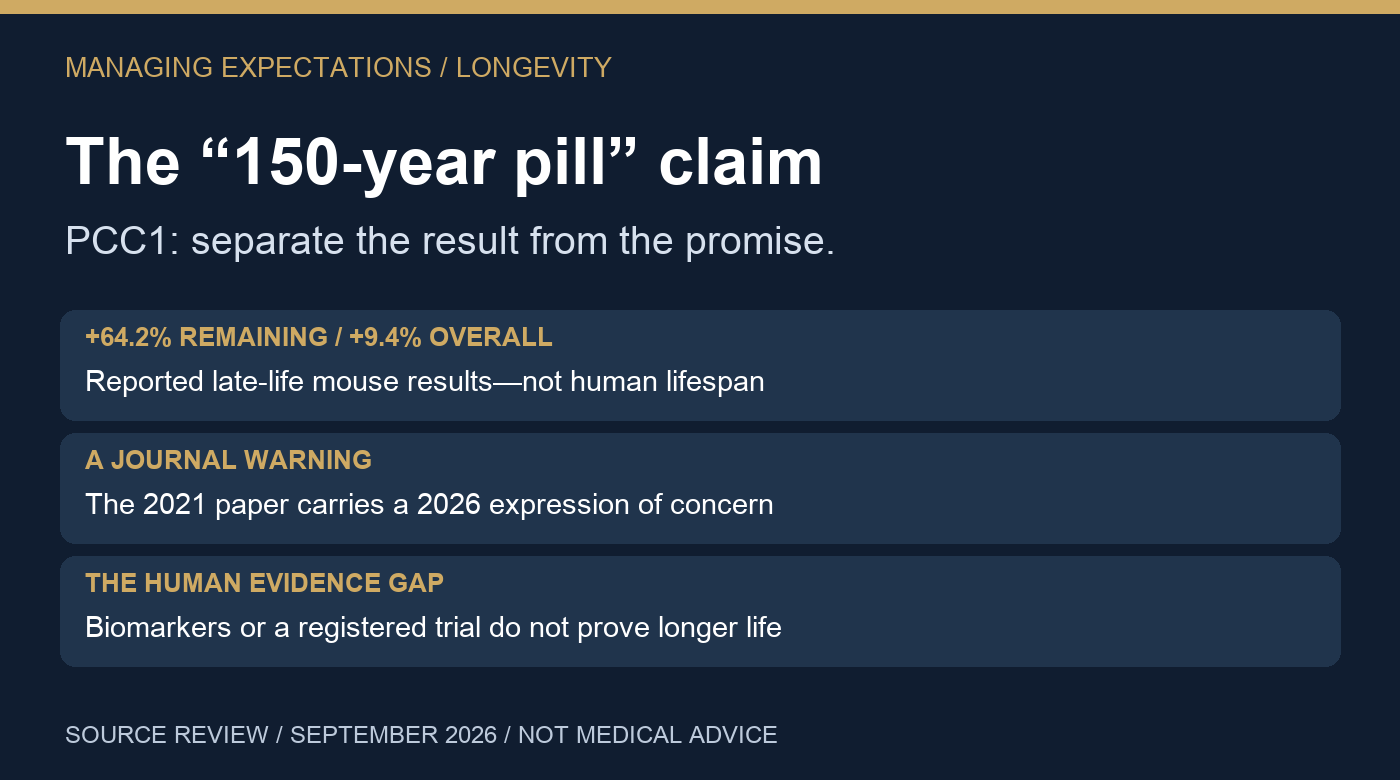
The creator deserves credit for saying the human lifespan claim is unsubstantiated. Two additional distinctions matter: the famous 64.2% figure concerns the mice’s remaining lifespan after late-life treatment, and the original paper now carries a journal warning.
Important: the original paper has an editorial expression of concern
On February 23, 2026, Nature Metabolism published an Editorial Expression of Concern about the 2021 PCC1 paper. The editor identified a control-mouse image in Figure 6b that appeared highly similar to an image in another publication. The authors requested a correction but could not retrieve the underlying raw data; the notice advises readers to interpret those data with caution.
This is not a retraction, and the notice does not state that the lifespan curves in Figure 8 were fabricated. It does mean the paper should not be presented as an unqualified foundation for a commercial longevity promise. The notice and original paper should be read together.
What the 2021 research actually reported
The primary paper is “The flavonoid procyanidin C1 has senotherapeutic activity and increases lifespan in mice,” published December 6, 2021 in Nature Metabolism. Its authors include Qixia Xu, Qiang Fu and corresponding author Yu Sun, with research affiliations including Shanghai institutions and international collaborators. It is an academic cell-and-animal study, not a completed human trial of a Lonvi-branded pill.
PCC1 is a compound found in grape seed extract. The study reported effects on senescent cells and their inflammatory secretions, followed by several mouse experiments. In its late-life survival experiment, mice entered treatment at 24–27 months. The reported groups contained 91 PCC1-treated mice and 80 vehicle-treated controls, including males and females.
The two percentages describe different intervals
- 64.2%: reported increase in median post-treatment—or remaining—lifespan.
- 9.4%: reported increase in overall lifespan.
- 150 years: not an observed human result from this study.
Beginning treatment near the end of life makes the remaining-lifespan denominator much smaller than the whole-life denominator. The TikTok does initially say “median remaining lifespan”; it should not be paraphrased as demonstrating 64% longer total lifespan. Neither mouse percentage can simply be multiplied into a human life expectancy.
The paper also disclosed commercial funding and patent or company interests, including By-Health funding for senolytic research in Yu Sun’s laboratory. Those disclosures are relevant context, not proof that the results are false. They also caution against treating later company marketing as independent replication of the academic work.
“Zombie cells” is a nickname, not the whole biology
Senescent cells generally stop dividing but remain metabolically active. Some release a mixture of inflammatory and tissue-signalling molecules known as the senescence-associated secretory phenotype, or SASP. A senolytic aims to eliminate selected senescent cells; reducing their secretions is a related but different effect.
The 2021 authors reported concentration-dependent effects in laboratory systems: suppression of SASP at lower concentrations and senescent-cell killing at higher concentrations. These findings do not establish that an ordinary grape-seed supplement selectively clears unwanted cells throughout a person’s body, or that more of a compound is safer or better.
Where the company claim came from
The company’s name is Lonvi Biosciences, not the automatic transcript’s “Lanvi.” In Andrew Higgins’s November 2025 New York Times reporting, Lonvi’s chief technology officer, Lyu Qinghua, predicted that living to 150 was realistic. The report separately described the company’s belief that its pills, combined with healthy living and medical care, could help people live beyond 100 and up to 120. These are forecasts and commercial claims, not measured patient outcomes.
The same reporting says Lonvi opened its laboratory in 2022 and was not connected to the Shanghai scientists behind the earlier discovery. The academic mouse experiment, Lonvi’s later product, the product distributor and other sponsors’ human studies should not be treated as one interchangeable evidence package.
Human work exists—but it does not demonstrate longer life
The TikTok is right that the 150-year claim has not been substantiated. Its broader statement that the research has not reached humans needs updating.
1. Lonvi’s preliminary biomarker report
A company-affiliated preliminary report describes 30 volunteers aged 50–86 and a final analysis of 17 people after a short supplementation course. Blood was sampled before the intervention and again on day five. The study had no control group and was described as retrospective; the company’s branded shop labels its pilot small, uncontrolled and not peer reviewed.
Most importantly, the report says inclusion in the analysed responder subset required a significant downward trend in at least three of four SASP indicators. Selecting participants partly because their biomarkers improved biases the analysis toward apparent success. It cannot establish how a typical unselected person would respond.
Changes in blood markers such as p21, SA-β-gal or inflammatory signals do not by themselves prove body-wide removal of senescent cells, reversal of aging, disease prevention or longer life. The report’s absence of observed adverse events over a short period does not establish long-term safety. This is a lead for better trials, not a longevity guarantee.
2. A registered skin-rejuvenation study
NCT06641869, “Study of PCC1 for Skin Rejuvenation,” is sponsored by Express Rx, Inc, not identified as Lonvi-sponsored in the record. The registry lists it as completed, with 74 participants, a randomized open-label design and 12-week skin outcomes such as barrier function, wrinkles, texture and radiance.
As retrieved September 23, 2026, ClinicalTrials.gov reported no posted results. Registration was first posted after the study’s stated completion. These are limitations on what the record establishes—not proof that no results exist anywhere else or that the study did not occur. Its endpoints are not lifespan or disease-free survival.
Our ClinicalTrials.gov searches found this record but no matching Lonvi human-lifespan study. That was a bounded search, not an exhaustive search of every international registry. It does not justify saying that no human PCC1 work exists worldwide.
Follow-up animal research is not the same as replication
A 2024 PNAS paper investigated PCC1 and age-related retinal changes. A 2025 npj Aging study examined mouse immune-system changes and grip strength; its authors explicitly said they did not assess lifespan. These studies show continuing scientific interest. They do not independently reproduce the headline remaining-lifespan result or establish a human 150-year effect.
A research compound is not every grape-seed product
Purified PCC1, ordinary grape-seed extract and a branded combination with an enhanced-absorption carrier are different preparations. The company’s marketed combinations and human report are not automatically equivalent to the material used in the mouse experiments.
NIH’s NCCIH says grape-seed extract is generally well tolerated, but advises people taking medicines to consult their healthcare provider about interactions; pregnancy and breastfeeding safety are poorly known. Its human evidence summaries concern outcomes such as blood pressure and lipids, not proven lifespan extension.
Memorial Sloan Kettering cautions about possible bleeding risk with blood thinners and describes several potential interactions based on laboratory findings, whose clinical relevance remains uncertain. These cautions should not be exaggerated into inevitable harm—or dismissed because a product is labelled natural.
For Canadian readers, Health Canada’s grape-seed ingredient safety assessment concerns specified standardized extracts in supplemented foods. It explicitly excludes modified forms or special carriers that change bioavailability and related handling in the body. That assessment is not approval of Lonvi’s formulation or its longevity claims. We did not determine a product-specific Canadian licence status.
Not a supplement protocol
This report is educational, not medical advice. It supplies no dosing schedule and does not recommend buying PCC1, copying an animal experiment, changing medication or replacing medical care. Discuss any contemplated supplement with a clinician or pharmacist who can review the actual product and your medicines.
The useful longevity question
The creator’s closing retirement-age remark is a joke, not a policy prediction. The underlying question is worth asking: would extra years also be healthy, independent and worthwhile? A lifespan claim and a healthspan benefit are different goals, and short-term biomarker changes establish neither by themselves.
What would improve the evidence? Independent replication of the relevant animal findings; well-designed, prospectively registered human trials; transparent safety reporting; and outcomes that show meaningful function or reduced disease burden rather than only laboratory markers. No current evidence reviewed here establishes that PCC1 makes people live to 150.
Bottom line: real compound, real experimental research, an important journal caution and preliminary human work—but no demonstrated 150-year pill. That is a reason to follow the science carefully, not to turn the claim into a treatment promise.
Related Managing Expectations longevity coverage
- AI and Longevity: Real Advances, No Five-Year Guarantee
- David Sinclair’s protocol: research signals versus a proven stack
- ER-100 and partial reprogramming: early human testing is not demonstrated age reversal
The supplied TikTok
@shannanegens · uploaded September 22, 2026 · approximately 105 seconds. The creator explicitly says the 150-year claim is not substantiated in humans. The full clip was preserved for editorial review, not rehosted here.
 Watch the original TikTok ↗
Original short link: vt.tiktok.com/ZSbepP3Uo. Platform access may require login.